
Pioneer Power Solutions Battles Persistent Losses Amid Critical Power Shift
Post-divestiture, Pioneer Power Solutions confronts continued operational losses and concentrated revenue risks within its critical power segment.
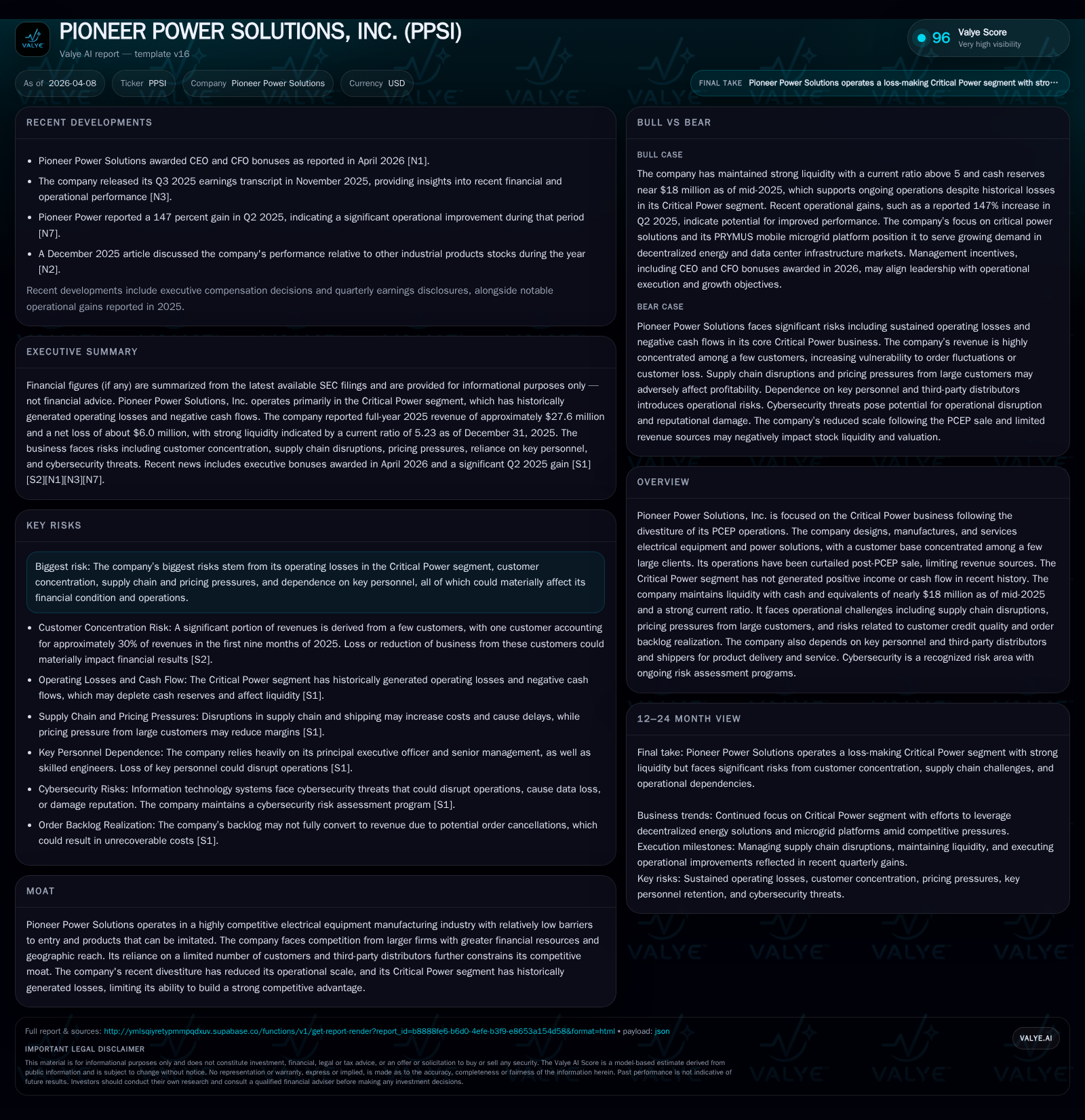
Following the sale of its PCEP operations, Pioneer Power Solutions has narrowed its focus exclusively to the Critical Power business, which continues to struggle with sustained operating losses and negative cash flow. The company contends with significant challenges stemming from customer revenue concentration, pricing pressures from large buyers, supply chain disruptions, and reliance on key personnel and third-party distributors. Despite maintaining a solid liquidity cushion with approximately $18 million in cash mid-2025 and a robust current ratio exceeding 5, the ongoing inability of the Critical Power segment to generate positive income limits growth prospects and weighs on overall financial performance.
Transition from Diversified Operations to a Sole Focus on Critical Power
In early 2025, Pioneer Power Solutions completed the divestiture of its PCEP operations, effectively halving the company's operational footprint and confining it to a standalone Critical Power segment. This strategic move narrowed revenue streams considerably as PCEP formerly contributed a substantial portion of sales. Post-sale disclosures emphasize that the remaining business "has limited sources of revenue," underscoring the revenue contractions experienced thereafter [S1]. The divestiture fundamentally reshaped Pioneer’s concentration risk profile; all subsequent operational dynamics center on Critical Power activities.
This transition also curtailed scale economies previously shared across multiple product lines and introduced heightened exposure to market and operational fluctuations in one narrowly defined sector.
Historic Revenue Trends and Loss Drivers in the Critical Power Segment
Looking at financial trends from fiscal years 2022 through 2025 reveals persistent earnings struggles despite volatile topline movements. Revenue climbed markedly from $27 million in FY2022 to a peak of $41.5 million in FY2023 before retrenching to approximately $27.6 million by FY2025 [F1]. This roller-coaster reflects post-divestiture adjustments combined with underlying demand variability.
Operating income remained negative throughout this period and worsened from -$4.0 million in FY2022 to -$6.6 million in FY2025, illustrating increasing cost burdens or margin erosion within Critical Power. Net income mirrored this trend: clipping positive net income registered only temporarily in FY2024 before tipping further negative again last year (-$6.0 million) [F1]. Operating cash flow (CFO) also stayed persistently negative, ranging between roughly -$3.9 million (FY2023) down to -$6.2 million (FY2024) and recovering slightly to -$5.8 million last year. Capital expenditures increased moderately but remain minor relative to revenue scale.
Historical performance (annual)
| FY | Rev ($mm) | Net ($mm) | CFO ($mm) | OpInc ($mm) | Rev YoY | Net YoY |
|---|---|---|---|---|---|---|
| 2025 | 28 | -6 | -6 | -7 | +20.8% | -118.8% |
| 2024 | 23 | 32 | -6 | -5 | -44.9% | +1778.3% |
| 2023 | 41 | -2 | -4 | -3 | +53.7% | +47.8% |
| 2022 | 27 | -4 | -6 | -4 |
Source: SEC companyfacts cache [F1].
Capital returns and efficiency (annual)
| FY | Div ($mm) | FCF ($mm) | ROE% |
|---|---|---|---|
| 2025 | 17 | -8 | -20.5 |
| 2024 | -10 | 89.9 | |
| 2023 | -6 | -13.3 | |
| 2022 | 1 | -7 | -21.5 |
Source: SEC companyfacts cache [F1].
Table: Fiscal years 2022–2025 show declining or volatile critical power revenues alongside widening operating losses [F1]
These outcomes demonstrate persistent margin pressures despite temporarily improved net results in FY2024 likely linked to non-operating factors not detailed here.
Customer Concentration Risks and Pricing Pressures Facing Pioneer Power
Pioneer’s narrowed customer base heightens vulnerability: two customers accounted for roughly one-third of quarterly revenues recently—19% and 17%, respectively—as per Q3'25 results [S2][S6]. Additionally for nine months ended Sept’25 one single customer made up ~30% of overall revenues [S6]. The outsized dependency on few clients elevates top-line volatility risk sharply.
Pricing power rests heavily with these large buyers because their volumes command supplier competition on price terms; Pioneer routinely faces “significant pricing pressures” originating directly from these dominant customers who leverage their buying clout “ negotiate lower prices.” If Pioneer cannot offset these reductions through internal efficiencies or expense cuts it faces declining margins [S4][S5][S11].
Credit quality deteriorations among major accounts also weigh heavily — extended payment delays or defaults could materially harm cash flows given significant portions of working capital are receivable exposures tied to these few parties [S4][S5][S9][S16].
The concentrated revenue composition constrains pricing leeway and amplifies operational leverage effects on earnings.
Supply Chain Constraints and Dependence on Key Personnel and Third Parties
Persistent "supply chain volatility" affects both component availability and delivery timelines critical for timely contract fulfillment. Pioneer depends on multiple layers of third-party relationships—including shippers managing outbound logistics plus distributors handling sales installations and service functions—that lie outside direct control [S10][S13]. These external dependencies introduce risks such as shipping container shortages at ports or labor disruptions that delay product deliveries.
Such delays can damage reputation among end customers risking lost future contracts at high switch costs given competitive alternatives abound across electrical equipment suppliers with more expansive geographic reach [S13][S14].
Key personnel concentration emerges notably around CEO Nathan Mazurek alongside senior electrical/mechanical engineers essential for product design continuity; replacing such talent would be difficult due to niche skills required and impacts operational execution plans if attrition occurs unexpectedly [S1][S12][S16]. Recruitment challenges amid skilled labor shortages accentuate vulnerabilities.
Liquidity Position and Capital Allocation amid Operating Losses
At June-end 2025 Pioneer held almost $18 million in cash/equivalents delivering a strong liquidity cushion supported by an impressive current ratio calculated near 5.23 — meaning short-term assets substantially exceed liabilities easing immediate cash flow strains despite ongoing operating losses [F1][S22]. However persistent negative free cash flow (operating cash flows minus capital spending) of about -$8.5 million last fiscal year underscores ongoing cash usage pressures due primarily to continued segment-level losses and investment needs [F1].
Capital expenditures fluctuated—rising quickly into FY24 ($3.76 million) before declining again last year ($2.68 million)—suggest selective reinvestment possibly aimed at sustaining core operations rather than growth scaling [F1]. Dividends paid jumped significantly in FY25 ($16.7 million), which appears counterintuitive amid loss-making operations; this raises questions regarding trade-offs between rewarding shareholders versus preserving reinvestment or liquidity buffers under profitability stress [F1][S27].
ROE approximated negative twenty percent based on last annual net loss relative to equity base — echoing poor returns typical for turnaround or shedding-stage businesses anchored predominantly in subscale loss-making segments.
Outlook: Backlog Realization Risks and Potential Growth Constraints
As of December ’25 order backlog stood at nearly $12.6 million comprising firm purchase orders believed reliable but carrying pronounced "backlog realization risk" since customer cancellations—even if partial—can lead to unrecovered costs plus asset underutilization penalties harmful to margin recovery efforts [S11][S16].
The pipeline’s composition therefore requires close monitoring for firm-to-soft order conversion integrity with Executive disclosures cautioning that some contracts may fail completion expectations further constraining potential topline growth.
Pricing compression stemming from large client bargaining power combined with supply chain pressures may limit ability to pass on inflationary cost increases affecting margin restoration timelines profoundly.
Thus forward growth could be capped absent new customer acquisition diversification or enhanced operational efficiencies lowering break-even thresholds.
Strategic Considerations: What to Watch Next for Pioneer Power
Recent news spotlighted awarded CEO/CFO bonuses signaling potential management confidence or ambition within constrained circumstances though such incentives may reflect baseline retention more than aggressive growth prospects given structural headwinds faced by Critical Power segment [N1].
Investors should track several near-term indicators: stabilization or improvement in backlog firming metrics; progress against supply chain disruption resolution; diversification away from concentrated customers; improvements in cost structures enabling margin expansion despite pricing pressures; plus tangible mitigation efforts addressing key personnel risk exposures.
Operational leverage pinch points will come into sharper relief over ensuing quarters evaluating whether incremental revenue gains translate first into reduced losses then positive profitability supporting long-term viability beyond current liquidity cushions.
In sum pioneer remains caught between oligopolistic customer influences compressing returns amidst narrow revenue streams dominated by one struggling business unit — punctuated by acute execution dependencies that will dictate if it can reverse persistent losses or ultimately face further contraction pressures.
Disclaimer: This report is intended solely for informational purposes grounded strictly in publicly available data sources cited herein without offering any investment advice or recommendations.
Disclaimer: This is research-only, informational analysis and not investment advice. It may include AI-generated interpretation and general industry context. Always verify important details using primary sources.

Comments