
Quartzsea Acquisition Corp's Strategic Setback and Next Steps After Merger Termination
Quartzsea Acquisition Corp’s journey from a promising IPO to a failed merger highlights regulatory challenges and strategic pivots in the SPAC landscape.
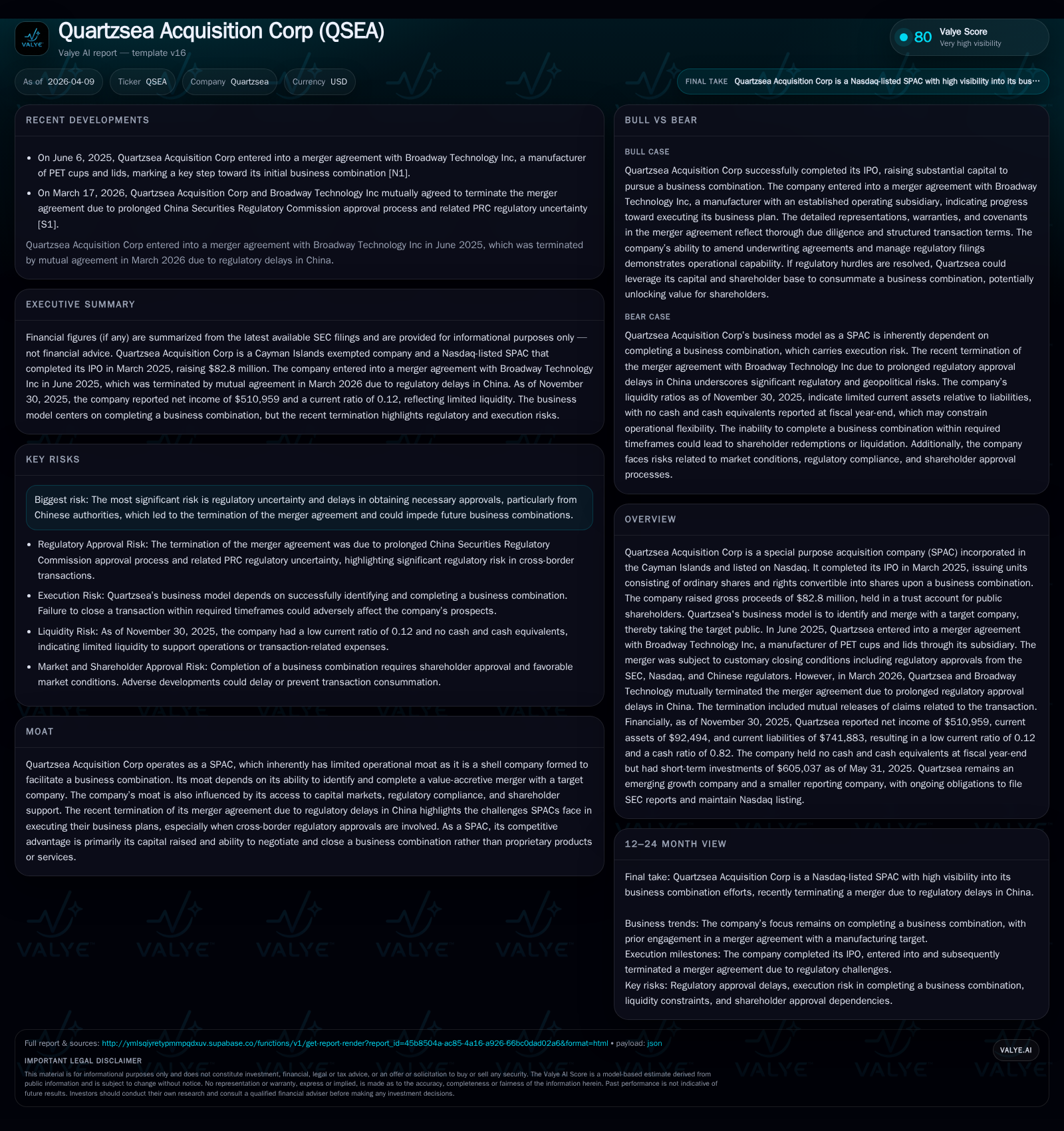
Quartzsea Acquisition Corp launched successfully with an $82.8 million IPO in March 2025, aiming to bring private businesses public via mergers. However, its pivotal merger agreement with Broadway Technology Inc., a PET cup manufacturer, was mutually terminated in March 2026 due to protracted Chinese regulatory approval delays. Financially, the SPAC maintains a trust fund dedicated to shareholders but exhibits typical operating losses inherent to its shell structure and has no dividends or buybacks. Moving forward, its growth depends on navigating regulatory hurdles and securing new business combinations amid uncertain market conditions.
From IPO to Merger: Quartzsea Acquisition Corp’s Early Trajectory
Quartzsea Acquisition Corp initiated its corporate journey with a Nasdaq-listed initial public offering (IPO) completed on March 19, 2025, generating gross proceeds of $82.8 million pursuant to issuance of 8,280,000 units at $10 per unit [S7]. These units combined one ordinary share and rights convertible into fractional shares upon consummation of an initial business combination. The sponsor simultaneously contributed approximately $2.3 million through purchase of private placement units [S7],[S12], establishing a foundational capital base. Proceeds were placed into a structured trust account—an essential mechanism preserving investor capital pending successful mergers—signaling investor prudence customary within SPAC formations.
Strategically, Quartzsea sought acquisition targets fitting its remit, culminating in June 2025 with an announced merger agreement with Broadway Technology Inc., a PET cup and lid manufacturer [S17],[S18]. This transaction implied a post-merger equity valuation near $520 million based on the planned issuance of new shares priced at $10 each [S17],[S18]. The integration would allow Broadway Tech access to public markets funding through this reverse merger route while affording Quartzsea shareholders exposure to a specialized packaging industry player.
Regulatory Roadblocks and the Collapse of the Broadway Technology Deal
Despite contractual optimism, the Broadway transaction confronted significant regulatory barriers tied primarily to China’s Securities Regulatory Commission (CSRC). Per the termination agreement dated March 17, 2026, both parties mutually ended the merger due to prolonged delays acquiring necessary PRC approvals critical for cross-border compliance and listing prerequisites [S3],[S28]. Beyond Chinese regulatory scrutiny, typical approvals from SEC and Nasdaq listing standards further complicated the closing.
Cross-border SPAC deals often endure heightened examination rooted in jurisdictional complexities—ranging from disclosure norms, ownership structures, anti-monopoly clearances, and geopolitical considerations—factors increasingly amplified amid U.S.-China tensions. This scenario impeded cash deployment from trust accounts and eroded merger confidence. The termination underscored an intrinsic risk for SPACs focusing on international targets where regulatory timelines are volatile and approval pathways uncertain.
Financial Snapshot: Annual Performance Review
As a special purpose acquisition company without ongoing operations or revenue-generating assets beyond its trust account, Quartzsea's financials reflect typical SPAC characteristics [F1]. Operating income for fiscal year ending November 30, 2025 registered a loss of approximately $1.9 million—a figure driven largely by administrative expenses such as legal fees, accounting services, underwriting costs, and minimal general overhead rather than core business activities.
Interestingly, net income was positive at around $511 thousand [F1], which could be attributed to non-operating sources such as interest income on the trust account prior to capital deployment or accounting adjustments. Liquidity was effectively zero at period end given utilization of IPO proceeds for merger-related expenses; current assets totaled just over $92 thousand against current liabilities approaching $742 thousand—indicating a low current ratio near 0.12 that aligns with paying off accrued liabilities more than maintaining liquid buffers [F1].
Historical performance (annual)
| FY |
|---|
| 2025 |
Source: SEC companyfacts cache [F1].
This figure underscores that without a consummated business combination, QSEA operates essentially as an administrative shell entity supporting empty corporate overhead.
Capital Structure and Allocation: Cash Management and Returns
Quartzsea’s capital management centers heavily on safeguarding public shareholders' interests via the trust account established post-IPO [S7],[S12]. The capital remains largely static until deployment upon satisfactory deal closure but is subject to deductions including deferred underwriting commissions per amendments dated March 3, 2026 [S10]. These commissions represent roughly 4% of gross proceeds payable only if business combinations occur—a common incentive balancing underwriter compensation against deal success.
No dividends or share repurchases have been declared or executed during this SPAC lifecycle phase [S7],[S11],[S14], consistent with industry norms where returns principally materialize through accretive mergers rather than yield distributions prior to deal completion.
Reported approximate return on equity (ROE) stands negative near -13% reflecting net profitability contextually irrelevant for currently non-operational entities but highlighting costs incurred versus equity capital outstanding [F1]. Positive net income noted above may represent one-off gains rather than sustainable profits.
Evaluating Growth Prospects: Strategy Beyond the Failed Merger
Following the aborted Broadway Technology merger driven by regulatory quagmires [S28], Quartzsea’s strategic pathway involves redeploying its remaining resources toward identifying alternative acquisition candidates aligned with shareholder value preservation goals [S8]. Management cites ongoing intentions to evaluate suitable targets that can satisfy compliance dynamics across multiple jurisdictions while delivering enterprise value enhancements post-merger.
However, regulatory uncertainty—especially around cross-border deal approval timelines—remains a principal growth constraint challenging execution pacing. The company must calibrate diligence pipelines carefully while balancing pressure on finite capital holding periods before trust fund liquidation deadlines typical in SPAC frameworks.
Watchpoints Ahead: Market Sentiment and Deal Pipeline Considerations
Key indicators for market observers include announcements signaling renewed merger agreements or extensions regarding shareholder redemption terms [S10]. Additionally crucial are disclosures about liquidity adequacy considering deferred payment obligations tied to underwriting commissions that become payable only upon closing another business combination event.
Shareholder engagement outcomes such as proxy voting results related to potential new combinations will offer insight into investor appetite amid stalled deal momentum. Regulatory developments impacting China-US cross-border transactions should continue shaping Quartzsea’s feasibility window for execution.
Special Purpose Acquisition Company (SPAC) Model Dynamics and QSEA’s Competitive Position
By design, Quartzsea functions primarily as a capital-raising vehicle engaging in "business combinations" rather than developing proprietary products or operational know-how—a structural moat dependent predominantly on sponsor capabilities mitigating deal sourcing risks alongside maintaining robust investor confidence through transparent governance practices.
Its competitive standing within an evolved SPAC environment is circumscribed by external macro factors such as prevailing investor sentiment toward blank check vehicles and tightening regulatory oversight impacting deal complexity especially for international targets.
Success thus hinges not only on internal execution agility but also navigating layered legal frameworks—balancing SEC mandates on disclosure and Nasdaq listing rules with evolving foreign investment regulations under China's CSRC purview.
This analysis synthesizes available data from Quartzsea’s public filings up to April 2026. It provides an overview grounded in disclosed financials and corporate events without projecting speculative outcomes beyond provided evidence.
Disclaimer: This is research-only, informational analysis and not investment advice. It may include AI-generated interpretation and general industry context. Always verify important details using primary sources.

Comments