
Applied Digital Corp's Financial Reinvention and Growth Outlook in AI-Era Data Hosting
Applied Digital balances rapid capital deployment and operational growth amid evolving demands in AI, HPC, and blockchain workloads.
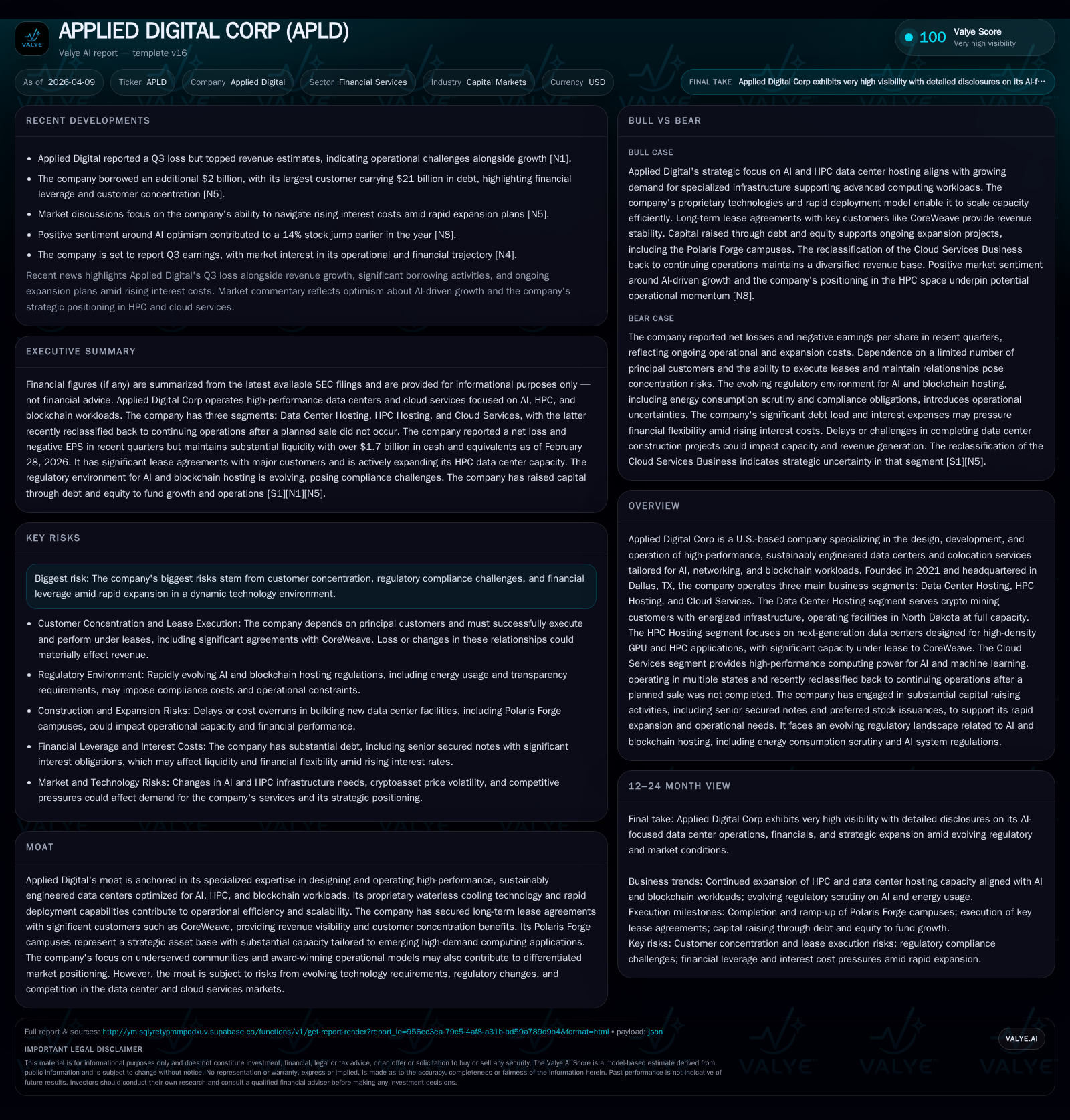
Founded in 2021, Applied Digital Corp has rapidly expanded its specialized data center infrastructure focused on high-performance computing (HPC), blockchain, and AI workloads. Its recent financial trajectory shows marked operating income improvement yet widening net losses and negative operating cash flow, reflecting heavy capital investments and scaling pressures. Long-term lease deals with CoreWeave and proprietary cooling technology underpin growth prospects, while concentration risks and regulatory uncertainties temper the outlook. The company’s recent multi-billion dollar debt issuances and preferred equity sales provide liquidity for Polaris Forge expansions but increase leverage amid negative ROE and FCF profiles.
A Look Back: Operating Trends and Financial Performance Through FY2025
Applied Digital Corp's historical operating income trend reveals a meaningful recovery despite persistent profitability challenges. Operating losses narrowed from approximately -$99 million in FY2024 to -$16.8 million in FY2025, an 83% improvement indicating operational efficiencies or scaling leverage [F1]. However, net income degraded sharply over the same period, with losses expanding from -$149 million to undetermined levels ongoing but still negative [F1]. This divergence suggests elevated non-operating expenses possibly linked to financing costs or asset impairments.
Operating cash flow demonstrates volatility consistent with rapid expansion: positive CFO years in FY2023 ($58.7 million) and FY2024 ($13.8 million) gave way to a negative cash burn exceeding -$115 million in FY2025 [F1]. The swing corresponds with significant capital expenditures on data center buildouts, typical of infrastructure-heavy companies pursuing growth.
Concurrently, equity capital grew substantially—from $124.8 million at FY2024 end to nearly half a billion dollars by FY2025—reflecting equity raises supporting development projects [F1]. The balance sheet remains well-capitalized with a strong current ratio of approximately 2.38 as of Q3 FY2026 [F1], suggesting healthy short-term liquidity amid heavy investment cycles.
Historical performance (annual)
| FY | Net ($mm) | CFO ($mm) | OpInc ($mm) | Net YoY |
|---|---|---|---|---|
| 2025 | -115 | -17 | ||
| 2024 | -149 | 14 | -99 | -234.4% |
| 2023 | -45 | 59 | -44 | -89.8% |
| 2022 | -24 | -1 | -21 |
Source: SEC companyfacts cache [F1].
Capital returns and efficiency (annual)
| FY | ROE% |
|---|---|
| 2025 | |
| 2024 | -119.6 |
| 2023 | -75.0 |
| 2022 | -32.5 |
Source: SEC companyfacts cache [F1].
Operating income improved substantially in FY2025 despite persistent net losses; cash flows turned sharply negative reflecting capex intensity.
Drivers Behind Revenue Growth and Profitability Shifts
Applied Digital’s revenue derives primarily from three segments: Data Center Hosting focused on energized crypto mining infrastructure; HPC Hosting targeted at AI/ML and GPU-dense workloads; and Cloud Services specializing in high-performance computing power.
The Data Center Hosting segment continues to operate at full capacity at the Jamestown (106 MW) and Ellendale (180 MW), North Dakota facilities that service crypto mining customers [S15]. This full utilization provides steady revenue streams but is subject to the cyclical nature of crypto markets.
Notably impactful is the HPC Hosting business anchored by multi-year leases with CoreWeave—the leading HPC customer—which signed agreements on May 28, 2025 for an aggregate of 250 MW at the Polaris Forge campuses [S15][N1]. Polaris Forge facilities are purpose-built for next-gen high-density HPC workloads including natural language processing and machine learning applications.
Cloud Services was recently reclassified as continuing operations post proposed transaction plans [S2], indicating refocus or divestiture of prior assets. This segment serves multiple states showing geographic diversification but faces competitive cloud giants disrupting traditional HPC provisioning [N5].
Revenue is bolstered by long-term contracts with anchored customers like CoreWeave providing visibility; however, earnings volatility remains given sector shifts especially in crypto mining demand.
Emerging Opportunities in AI, HPC, and Blockchain Workloads
Applied Digital’s strategic positioning aligns closely with burgeoning AI cloud demand—a market expected to achieve multi-billion-dollar ARR driven by GPU fleet expansions like those seen at IREN Limited [N5].
The company’s Polaris Forge campuses integrate proprietary waterless cooling technology enabling efficient thermal management critical for dense GPU arrays deployed in AI training clusters [S2][N14]. This patent-backed solution enhances operational cost efficiencies versus traditional chilled-water methods.
With the new generation of GPUs requiring specialized power & cooling support for sustained performance, Applied Digital’s high-performance colocation offering gains differentiation against legacy providers less optimized for these hyper-scale workloads.
Blockchain workload support remains embedded in Data Center Hosting via energy-intensive crypto mining but is increasingly volatile due to regulatory uncertainty [S2]. Still Applied Digital’s focus on underserved communities like North Dakota reflects a socially conscious approach besides infrastructural advantages.
Risks from Customer Concentration and Technology Evolution
Customer concentration risk is material—CoreWeave commands significant licensing across the Polaris Forge campuses forming a major portion of HPC segment revenue coupled with leasing contractual obligations [S15][N13]. Any deterioration in CoreWeave’s financial standing (notably carrying debt over $21 billion per recent reporting) may impact Applied Digital’s receivables or contract renewals [N13].
Regulatory landscapes remain fluid especially concerning crypto-asset mining operations entailing potential compliance or operational discontinuities [S2]. Furthermore technological obsolescence risk intensifies as AI hardware architectures evolve rapidly necessitating continuous capex investment not always immediately accretive.
Labor shortages or supply chain bottlenecks may disrupt project timelines given niche engineering requirements inherent to HPC hosting campus builds.
Capital Allocation: Debt Issuances, Equity Infusions, and Cash Reserves
APLD has aggressively tapped debt markets: In November 2025 it issued $2.35 billion of senior secured notes due 2030 bearing a high coupon of 9.25%, illustrating elevated cost of capital linked presumably to growth-stage credit risk [S4][S7]. These proceeds funded repayment of prior loans including SMBC facility along with capex on Polaris Forge expansions.
Equity financing activity includes issuance of Series G convertible preferred stock totaling approximately $740 million through February 28, 2026 with no outstanding shares remaining after conversions into common stock [S7][S16]. Additionally approximately $196 million was raised under an at-the-market (ATM) common stock sales agreement initiated June 2025 [S6][S7][S16].
Available liquidity is robust; unrestricted cash plus equivalents stood near $1.7 billion as of Q3 FY2026 complemented by a revolving credit facility of $65 million—with no draws—supporting working capital needs [F1][S13].
Debt amortization schedules show semiannual principal repayments beginning December 15, 2027 through maturity December 2030 for the senior notes [S25][S26]. Recently March 10 saw a $2.15 billion offering at lower coupon (6.75%) due March 2031 aimed at further funding new projects pending escrow release conditions [S22].
This layered approach reflects deliberate capital structure optimization balancing secured notes with preferred equity conversions while maintaining covenant discipline around restricted payments such as dividends or buybacks which remain absent [S14][S24].
Returns Analysis: ROE and Cash Flow Realities Amid Expansion
The combination of sustained operating losses offsets growing equity base producing an approximate negative return on equity near -30% as computed with latest annual net loss relative to year-end equity [F1]. This underlines continued shareholder dilution effects notwithstanding investor confidence reflected in large follow-on financings.
Free cash flow remains deeply negative principally due to significant capital expenditure outlays for constructing next-gen HPC campus facilities (net CFO approximated at -$115M offsetting capex driving deeper FCF deficit) [F1][S21].
Interest expense patterns feature mixed trends including reductions attributable to renegotiated leases even as loan interest expense increased reflecting overall leverage rise [S29]. This dynamic tempers financial flexibility over medium term absent operating margin improvements.
No dividend distributions or share repurchase programs exist given developmental stage prioritizing reinvestment into infrastructure scaling rather than shareholder returns currently [S14][S24].
What to Watch: Upcoming Milestones, Lease Contracts, and Market Positioning
Key near-term catalysts include commissioning completions for Polaris Forge Phase II and Delta Forge I campuses representing multi-hundred MW capacity additions critical to sustaining HPC hosting growth momentum [N3][S2]. These facilities will also test operational efficiencies derived from proprietary cooling technologies impacting margins.
Lease negotiations or renewals with anchor tenant CoreWeave bear watching due to their outsized revenue implications together with prospective expansion deals that could enhance revenue visibility beyond contracted capacity.
Interest rate environment poses refinancing considerations especially on large scheduled amortizations beyond late-2027 horizon given escalating borrowing costs outlined by market commentary recently [N8]. Capital market access will remain essential for Applied Digital’s strategic roadmap execution.
Additionally ongoing decisions surrounding divestiture or retention of Cloud Services segment will affect business scope focus potentially redefining segmental exposure going forward [S2][N14].
This analysis synthesizes publicly available financial disclosures compiled as of early April 2026 without expressing investment opinions. Readers should consider inherent risks highlighted including customer concentration effects and technology demand shifts when evaluating Applied Digital Corporation's evolving market position.
Disclaimer: This is research-only, informational analysis and not investment advice. It may include AI-generated interpretation and general industry context. Always verify important details using primary sources.

Comments