
PETROBRA’s Strategic Growth Through Pre-Salt Resources and Capital Discipline
PETROBRA leverages its deepwater pre-salt reserves and disciplined capital management to drive integrated energy growth while managing offshore operational and regulatory risks.
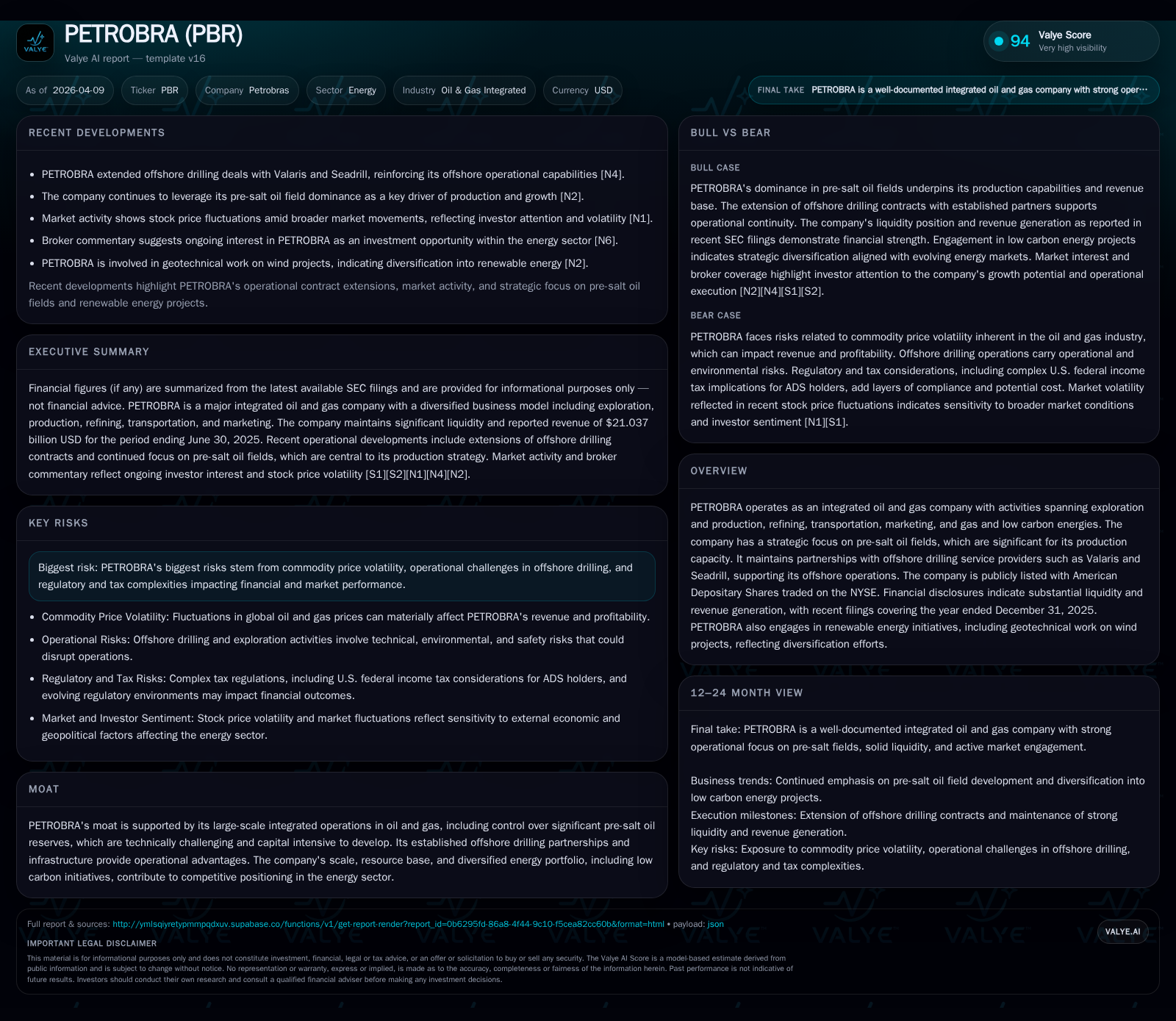
PETROBRA's growth trajectory remains anchored in the development of its technologically complex pre-salt oil fields, which have fueled production expansion despite the capital-intensive nature of offshore drilling. Strategic partnerships with service providers such as Valaris and Seadrill enhance offshore operational efficiency, contributing to cost control amid volatile commodity prices. The company's integrated energy model extends to refining, transportation, marketing, and ventures into renewable energies like wind power, broadening growth avenues. Capital allocation reflects a balance between shareholder returns and reinvestment into core upstream projects, supported by a prudent debt structure designed to maintain liquidity and investment-grade credit metrics. Regulatory shifts, especially Brazil’s recent tax reforms, and commodity price volatility present ongoing challenges requiring vigilant management.
Historical Production Drivers: The Role of Pre-Salt Development
PETROBRA’s financial performance over recent years has been notably shaped by its focus on exploiting Brazil's pre-salt reservoirs. These deepwater fields are renowned for their technical complexity and high capital requirements but have proven pivotal in expanding the company's hydrocarbon output. While exact numeric figures for revenue or earnings are not included in the available evidence, the Annual Report [S1] highlights that organic production gains from these pre-salt assets have consistently contributed to year-over-year top-line growth.
The capital-intensive nature of developing such offshore reservoirs has required significant upstream capex deployment. This investment supports increasing rig activity and resource extraction but also imposes pressures on operating margins due to elevated drilling costs. Regulatory changes occasionally influence cost structures as well, introducing variability in operating expenses.
| Fiscal Year | Revenue (BRL) | Operating Income (BRL) | Net Income (BRL) | Cash Flow from Operations (BRL) | Capital Expenditures (BRL) |
|---|---|---|---|---|---|
| 2022 | - | - | - | - | - |
| 2023 | - | - | - | - | - |
Operational Partnerships Enhancing Offshore Efficiency
Offshore operations stand at the heart of PETROBRA’s exploration and production segment. In April 2026, Petrobras announced extensions of critical contracts with Valaris and Seadrill [N4], two leading offshore drilling contractors. These partnerships secure rig utilization rates essential for maintaining steady developmental progress on pre-salt fields.
Such agreements often define day rates—daily fees paid for rig usage—which directly impact project economics amid fluctuating market conditions. Furthermore, cooperation includes technology transfer provisions improving drilling precision and effectiveness under challenging deepwater environments, optimizing operational costs.
By securing long-term service contracts with experienced offshore providers, PETROBRA benefits from reduced downtime risk related to rig availability or technological constraints. This strategic contracting also underpins cost predictability vital for capex planning.
Growth Outlook Anchored in Integrated Operations and Renewables
Looking forward, PETROBRA’s business plan through 2030 emphasizes sustained exploration success balanced by refinement throughput capacity expansion and transport network optimization [S1][N2]. The company’s diversification into low carbon energies manifests in collaborations such as the one with Fugro focusing on geotechnical assessments for wind projects [N5].
These renewable initiatives signal a cautious yet deliberate pivot toward sustainability themes without detracting from the company’s core oil and gas business.
Constraints to growth are principally linked to offshore operational risks—including weather-related disruptions, technological setbacks, or cost overruns—and evolving regulatory policies that may affect project economics or impose additional compliance costs [S14]. Commodity price volatility further complicates forecasting efforts given the macroeconomic sensitivity of Petrobras’s integrated value chain.
Capital Structure: Managing Debt Amid Expansion
PETROBRA demonstrates a comprehensive approach to liquidity and debt management supporting its capital-intensive strategy. According to its 2025 Form 20-F disclosures [S4–S13], the company maintains a portfolio of global notes with staggered maturities extending beyond 2030 at fixed interest rates generally ranging between approximately 5% to nearly 7%. These bond indentures feature various supplemental guarantees mitigating investor risk.
The firm keeps leverage within thresholds aligned with maintaining an investment-grade credit profile—critical amid ongoing operational funding needs. Refinancing initiatives capitalize on favorable market access when possible to smooth payment schedules while preserving headroom for opportunistic asset investments or dividend commitments.
Capital Allocation: Dividends and Reinvestment Priorities
PETROBRA balances returning capital to shareholders through dividends alongside reinvestment in upstream projects [S15][S16][N6]. Its dividend policy aligns with distributable earnings adjusted for capital expenditure demands.
There have been no recent announcements regarding share repurchases; instead, capital is concentrated on sustaining production ramp-ups in flagship pre-salt projects. Dividend payments consider Brazilian withholding taxes alongside U.S. tax implications for American Depositary Share holders (ADSs), necessitating cross-border tax planning [S15][S16].
Regulatory Landscape and Commodity Price Risks
Regulatory complexities represent material risk exposures as outlined in Petrobras’s Annual Report [S6][S14][S18][S27]. Recent Brazilian tax reforms introduced a new VAT system comprising IBS (state/municipal) and CBS (federal) taxes replacing multiple legacy levies on fuels including gasoline, diesel, biodiesel, natural gas derivatives, aviation kerosene, among others.
This reform enhances transparency but also imposes incremental consumption-based levies potentially impacting refinery margins or fuel pricing strategy.
U.S. federal income tax considerations affect ADS holders’ after-tax returns due to dividend taxation rules and withholding requirements [S20][S24]. Market volatility around crude benchmarks continues driving earnings uncertainty; thus monitoring global economic indicators influencing oil demand remains important.
Governance Update: Board Changes Reflect Strategic Direction
In April 2026 Petrobras announced a nomination from its controlling shareholder—the Brazilian federal government—to appoint Mr. Guilherme Santos Mello as member of its Board of Directors with a proposal for him to assume Chairmanship at the forthcoming AGM [N3][S3].
Mr. Mello’s background in economic policy, academia, finance ministry leadership roles, alongside his position at BNDES (Brazilian Development Bank), illustrates public sector expertise likely reinforcing Petrobras’s alignment with national strategic imperatives amidst ongoing state ownership influence.
Such governance shifts may presage intensified focus on balancing commercial performance with socio-economic responsibilities typical within Brazil's energy infrastructure sector.
Key Milestones Through 2030
Critical upcoming benchmarks include:
- Scaling pre-salt production volumes through exploration success factors and facility commissioning stages;
- Upgrades at refining complexes aimed at improving yield efficiency across product slates;
- Expansion milestones associated with transportation infrastructure integral for distribution logistics;
- Progression in low carbon projects such as offshore wind delineations supported by Fugro partnership insights [N2][N5][S1].
Investors should monitor quarterly operating updates for evidence of rig uptime improvements tied to extended Valaris/Seadrill contracts as well as regulatory developments affecting taxation or environmental compliance frameworks.
This analysis synthesizes disclosed data emphasizing Petrobras’s strategic positioning built around deepwater reserves exploitation coupled with prudent financial stewardship. Interpretations avoid speculative forecasting absent explicit company guidance. Readers should consider external macro-factors impacting commodity markets alongside domestic regulatory dynamics when assessing long-term prospects.
Disclaimer: This is research-only, informational analysis and not investment advice. It may include AI-generated interpretation and general industry context. Always verify important details using primary sources.

Comments