
Alchemy Investments Acquisition Corp 1 and Cartiga Merger: Financial Hurdles and Strategic Milestones Ahead
Analysis of Alchemy’s SPAC transition through the Cartiga merger underscores liquidity challenges, operational losses, and key regulatory timelines.
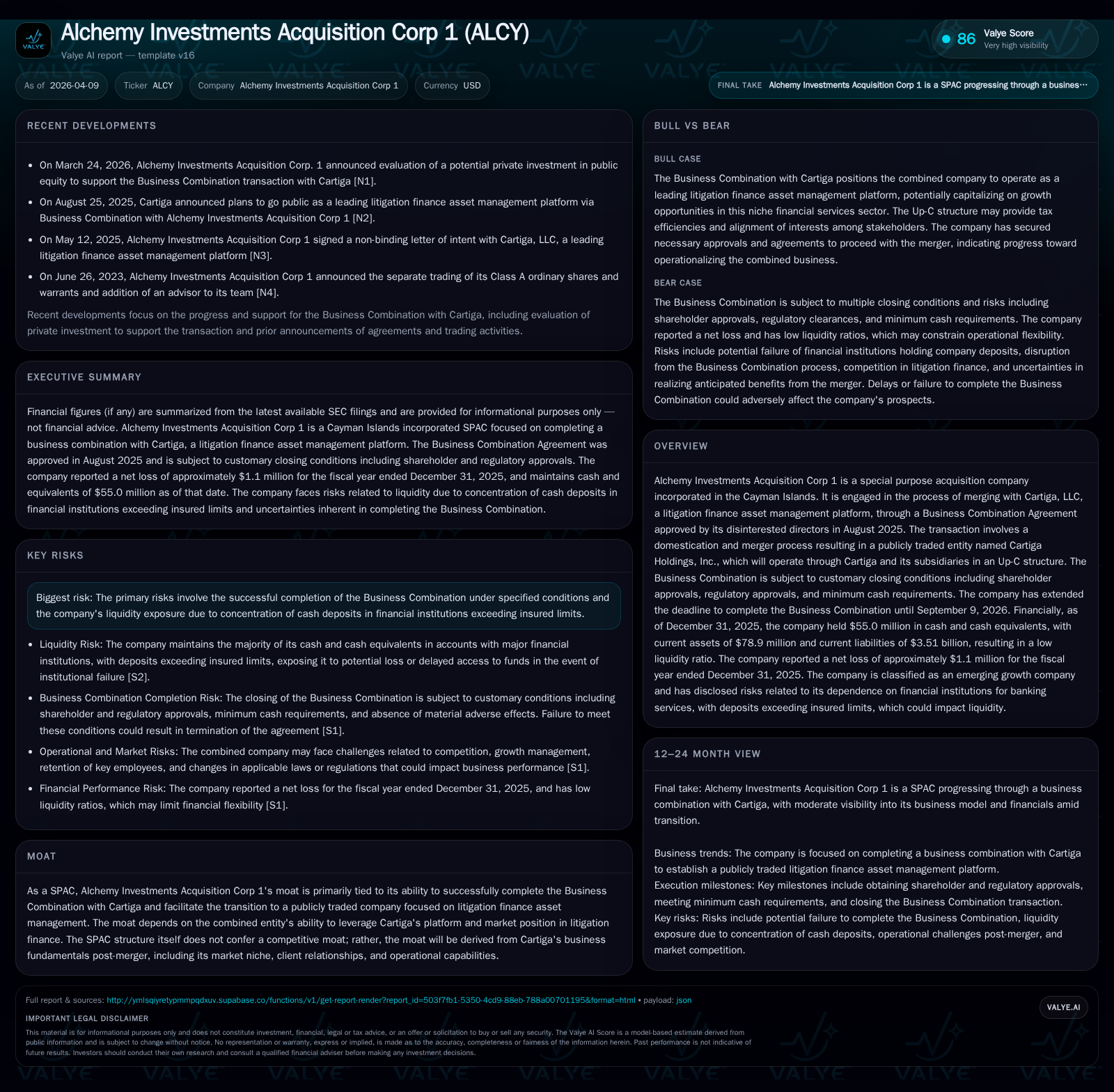
Alchemy Investments Acquisition Corp 1 (ALCY), a Cayman Islands-incorporated SPAC, aims to transform into a litigation finance asset management platform via its merger with Cartiga, LLC. The transaction, valued at $540 million and structured as an Up-C, remains subject to shareholder and regulatory approvals with an extended deadline of September 9, 2026. Historical financials reveal operating losses deepening by about 20% year-over-year with significant cash reserves offset by outsized current liabilities, underscoring liquidity pressures typical of pre-combination SPACs. Going forward, the combined entity’s growth hinges on leveraging Cartiga’s niche within litigation finance while carefully navigating customary closing risks and managing capital structure post-merger.
From Special Purpose to Operating Business: Alchemy’s Growth Trajectory So Far
Alchemy Investments Acquisition Corp 1 (ALCY) operates as a special purpose acquisition company incorporated in the Cayman Islands. As typical with SPACs prior to completing a business combination, ALCY has no operational revenues recorded in its financial history. Instead, its income statement reflects primarily costs associated with maintaining the listing and transaction-related activities.
Over the course of FY2023 through FY2025, ALCY's operating income registered negative figures trending deeper into losses: from -$659,983 in 2023 to -$1,429,215 in 2025 — a near 20% deterioration year-over-year between FY2024 (-$1,192,408) and FY2025 [F1]. Similarly, net income reversed from gainful years of over $3 million in early years to a loss of approximately -$1.1 million in FY2025 [F1]. This trajectory aligns with standard SPAC lifecycle patterns where early operating expenses and legal/regulatory costs accumulate against zero or minimal revenue until consummation of a target acquisition.
The company's equity base shows negative balances increasing from about -$5.36 million in FY2023 to -$8.51 million by FY2025 [F1], reflecting accumulated deficits. The return on equity compute using net income divided by equity yields a positive rough figure but must be interpreted cautiously given negative equity values indicating technical insolvency metrics not uncommon during the SPAC pre-deal phase.
Operating cash flow statistics echo the deteriorating trend with CFO plunging further negative to -$1.31 million at the latest fiscal year-end from previous figures around -$658k [F1], emphasizing continued cash burn ahead of deal closure.
Historical performance (annual)
| FY | Net ($mm) | CFO ($) | OpInc ($) | Net YoY |
|---|---|---|---|---|
| 2025 | -1 | -1306154 | -1429215 | -125.9% |
| 2024 | 4 | -658568 | -1192408 | +28.9% |
| 2023 | 3 | -863183 | -659983 |
Source: SEC companyfacts cache [F1].
Capital returns and efficiency (annual)
| FY | Buybacks ($mm) | ROE% |
|---|---|---|
| 2025 | 4 | 12.9 |
| 2024 | 114 | -64.7 |
| 2023 | -61.5 |
Source: SEC companyfacts cache [F1].
Note: Operating income and net income trends do not represent traditional earnings given SPAC status.
This illustrates that before merging with an operating business like Cartiga LLC, ALCY exists essentially as a shell incurring administrative expenses with no direct revenue generation.
The Road to Cartiga Holdings: Details and Drivers Behind the Business Combination
On August 19, 2025, ALCY's disinterested directors formally approved a Business Combination Agreement to merge with Cartiga LLC—a specialized litigation finance asset management platform—forming a publicly traded entity named Cartiga Holdings Inc. [S12]. This transaction is valued at approximately $540 million equity value [S9] and structured as a domestication from Cayman Islands incorporation to Delaware followed by an Up-C merger whereby Cartiga operates through an OpCo subsidiary.
The Up-C structure is specifically chosen to retain partnership tax advantages associated with limited liability company ownership interests held by legacy Cartiga members post-merger [S9]. Under this arrangement:
- ALCY domesticates into Pubco (Delaware corporation).
- Newco merges into Cartiga (OpCo), which survives as a wholly owned subsidiary.
- Equity interests convert into Pubco Class A/B common stock alongside OpCo units held by former Cartiga owners.
This creates a dual-class stock system balancing public shareholders’ economic participation with tax-efficient ownership for founding investors [S9].
The closing deadline for consummating this complex transaction was extended beyond original terms to September 9, 2026 following shareholder approval via Charter Amendment allowing incremental monthly extensions funded by small per-share deposits into trust accounts [S9][S17]. This extension indicates integration complexity and regulatory navigation challenges inherent in such cross-jurisdictional corporate reorganizations.
Financial Performance Review: Operating Losses, Cash Position, and Capital Structure Insights
At fiscal year-end December 31st, 2025—just months prior to expected closing—ALCY reported cash and cash equivalents totaling approximately $55.0 million [F1]. However, current liabilities stood substantially higher at around $3.5 million [F1], implying a starkly imbalanced current ratio near 0.02 [F1], signaling limited short-term liquidity cushion from working capital perspectives.
Given that ALCY is still pre-combination without operational revenues or recurring cash inflows apart from trust account funds raised during the IPO process,[S6][S7] its liquidity primarily depends on these reserve pools plus any bridge financing or PIPE investments secured during the transaction phase.
Risk disclosures emphasize concentration risk from deposits exceeding FDIC insured limits across multiple financial institutions [S6][S7], introducing potential exposure should any custodian bank face distress or failure—an acute concern amid volatility pressures experienced by parts of the U.S. banking system recently.
Equity burn reflected in growing accumulated deficit levels combined with negative operating cash flows deepening near $1.3 million annually signifies ongoing funding needs until deal closure mitigates these trends through productive operations resuming under Cartiga’s management platform [F1].
Unlocking Potential: Litigation Finance Platform as a Growth Engine Post-Merger
Cartiga Holdings’ core value proposition post-transaction revolves around leveraging Cartiga LLC’s litigation finance asset management platform—an area combining financial structuring expertise with legal claim monetization strategies targeting underserved niches within alternative investment markets [N1].
The combined entity will likely focus on expanding assets under management (AUM), scaling client relationships especially institutional allocators seeking differentiated non-correlated returns derived from lawsuit settlements or verdict financing.
Strategically, the competitive moat stems largely from domain expertise within litigation finance specialization, one that encompasses proprietary diligence methodologies, and favorable access pathways to diversified claim portfolios.
While ALCY itself accrued no moat pre-merger due to its SPAC nature, the new company inherits potential competitive advantages through Cartiga’s established operational capabilities post integration.
Future revenue generation depends heavily on successful transition execution, widening market adoption of litigation finance products, and effective cost control aligning operational scalability alongside risk underwriting precision.
Regulatory, Shareholder Approval Process and Market Conditions Impacting Closing Risks
Several conventional obstacles stand between announcement and closing: shareholder approval thresholds require both simple majorities for the Business Combination Agreement and two-thirds supermajorities for domestication plan ratifications under Cayman law [S9][S17]. Failure to meet these votes would annul or suspend progress.
Regulatory approvals—including anti-trust clearance under Hart-Scott-Rodino Act—and Nasdaq initial listing validations must also precede closing [S21]. Market conditions affect counterparties' stability providing custodial services for funds held in trust accounts—a notable vulnerability disclosed given cash concentration above insured limits exposing liquidity risk if financial institutions falter [S6][S7][N1].
Termination clauses within agreements allow either party recourse should material adverse effects arise or required approvals fail beyond specified deadlines (originally May 2026 but extended) [S10][S18][S21], reinforcing that despite unanimous director support for the deal completion risks remain non-trivial.
Capital Deployment Strategy: Buybacks Decline Amid Finalization Phase and Equity Structure Shifts Post-Merger
Capital allocation prior to deal finalization reflects typical SPAC restraint regarding return of capital via dividends given their non-operational status. After aggressive share repurchases totaling over $114 million in FY2024,[F1] buybacks moderated significantly down to approximately $3.79 million in FY2025 signaling less capital recycling activity closer to business combination closure where shareholder bases consolidate eligibility for post-merger equity positions [F1][S8][S16].
Upon merger consummation: the Up-C structure introduces dual classes of common stock (Class A public shares vs Class B non-economic voting stock) linked with OpCo unit holdings retained by former Cartiga owners ensuring continuity of incentives alongside public ownership dilution control measures[S9][S11]. Lock-up agreements will restrict transferability of large holders’ shares typically for six months post-closing barring price triggers ensuring orderly market float stabilization[S28].
Shareholder alignment is further maintained via support agreements obligating directors and officers not to redeem shares pre-closing facilitating smoother financing commitment executions along with registration rights provisioned to offer limited liquidity facilities post-listing[S13][S24].
Key Upcoming Milestones and What Investors Should Monitor Next
Crucial events anticipated ahead include:
- Finalization deadline extended through September 9th , 2026 enclosing all remaining regulatory approvals and shareholder votes confirming charter amendment enabling month-to-month continuation funding[S9,S17];
- Proxy statement filings occurring after commencement of definitive SEC Registration Statement on Form S-4 detailing comprehensive deal disclosures required for shareholder consideration[S15];
- Nasdaq initial listing application approval signifying readiness for publicly traded status under new ticker symbol set reflecting Cartiga Holdings Inc.[S21];
- Potential private investment rounds evaluated contemporaneously offering supplemental capital injection options enhancing Available Closing Buyer Cash condition adherence[N1];
- Monitoring quarterly disclosures upon becoming fully operational entity focused on litigation finance asset management tracking AUM growth trajectory, cost efficiency progress, and legal/regulatory compliance milestones crucial for validating strategic thesis execution post-combination closure.
In sum,AICY’s transformation hinges heavily upon successful navigation of corporate governance hurdles, lifting capital structure fragility via deal proceeds allocation, and operationalizing proprietary platform advantages nestled within alternative assets realm. Maintaining vigilance across these dimensions will be critical for contextualizing future developments.
This analysis is based solely on publicly available SEC filings and news reports without forward-looking projections beyond disclosed facts.
Disclaimer: This is research-only, informational analysis and not investment advice. It may include AI-generated interpretation and general industry context. Always verify important details using primary sources.

Comments