
Simply Good Foods Co: Weighing Growth Momentum Against Margin Compression and Capital Choices
An in-depth assessment of Simply Good Foods’ brand strength balanced against recent margin pressures and financial strategy.
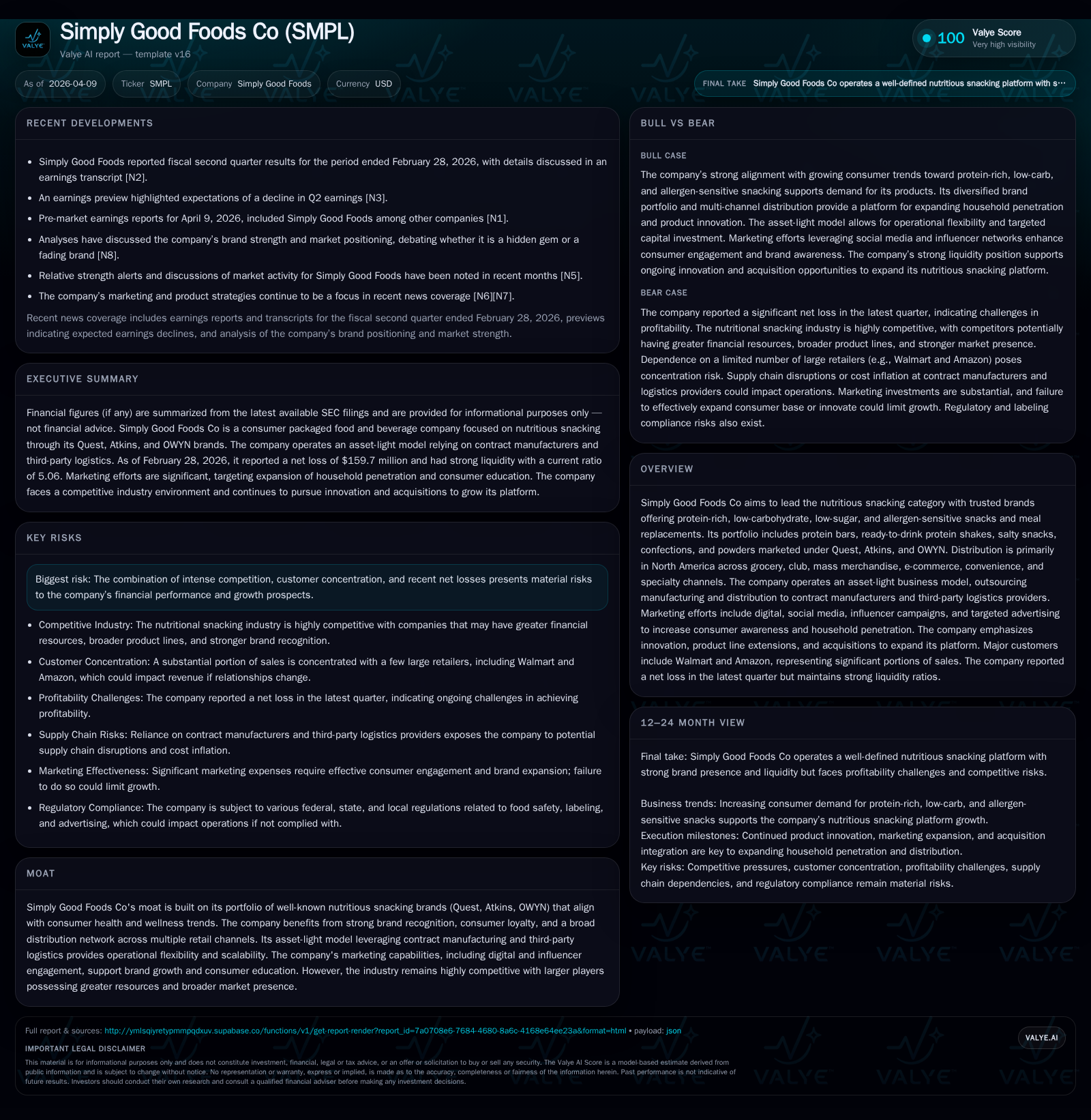
Simply Good Foods Co has leveraged its portfolio of protein-rich brands—Quest, Atkins, and OWYN—to capitalize on health-conscious consumer trends, driving robust revenue growth historically. Despite this top-line momentum, recent years have seen significant operating margin compression and declines in net income, pressured by elevated supply chain costs and increased marketing investments amid stiff competition. The company’s capital allocation reflects an asset-light approach, highlighted by a sharp rise in capital expenditures and resumed share repurchases supported by solid free cash flow generation. Key upcoming investor considerations include navigating near-term earnings softness and monitoring margin recovery efforts alongside product innovation and distribution expansion.
Brand Portfolio and Historical Revenue Expansion Anchored in Consumer Trends
Simply Good Foods Co’s foundation rests on a portfolio of strong nutritious snacking brands—Quest, Atkins, and OWYN—that address growing consumer demand for protein-rich, low-carbohydrate, low-sugar snacks with options tailored to allergen sensitivities. Quest targets active lifestyles with an array of protein bars, chips, confections and ready-to-drink (RTD) shakes; Atkins serves the low-carb diet community focused on weight management; OWYN appeals to plant-based consumers seeking allergen-tested beverages.[S1][S8][S24]
This trio has enabled Simply Good Foods to harness enduring health-and-wellness trends favoring convenient ‘better-for-you’ snacks consumed more frequently throughout the day.[S28] The company’s asset-light contract manufacturing model accelerates speed-to-market for innovations spanning bars, cookies, salty snacks and powders while permitting targeted capital deployment.[S8][S16]
Historically, these strategic advantages translated into impressive top-line expansion: revenue surged from $108.3 million in FY2018 to $222.3 million by FY2020—a compound annual growth rate reflecting nearly 60% year-over-year growth at the latest point—underscoring rapid market adoption during this scale-up phase.[F1]
Historical performance (annual)
| FY | Net ($mm) | CFO ($mm) | OpInc ($mm) | Capex ($mm) | Net YoY |
|---|---|---|---|---|---|
| 2025 | 104 | 178 | 157 | 21 | -25.6% |
| 2024 | 139 | 216 | 206 | 6 | +4.3% |
| 2023 | 134 | 171 | 205 | 12 | +23.0% |
| 2022 | 109 | 111 | 203 | 5 |
Source: SEC companyfacts cache [F1].
Capital returns and efficiency (annual)
| FY | Buybacks ($mm) | FCF ($mm) | ROE% |
|---|---|---|---|
| 2025 | 51 | 158 | 5.7 |
| 2024 | 0 | 210 | 8.1 |
| 2023 | 16 | 160 | 8.5 |
| 2022 | 60 | 105 | 7.5 |
Source: SEC companyfacts cache [F1].
This historical momentum owes much to robust multi-channel distribution across grocery, club stores, mass merchandise outlets, e-commerce platforms including Amazon and direct-to-consumer sites, convenience channels and specialty retailers,[S8][S17] reinforcing broad consumer accessibility.
Operational Profitability Challenges and Margin Pressures: What Changed?
Despite strong revenue progression through fiscal 2020 and beyond,[F1] profitability metrics reveal notable deterioration in recent periods. Operating income declined approximately 24% year-over-year while net income fell by 25.6% over the same timeframe.[F1]
| FY | OpInc ($M) | OpInc YoY (%) | Net ($M) | Net YoY (%) |
|---|---|---|---|---|
| 2023 | 204.9 | 133.6 | ||
| 2024 | 206.5 | 0.8 | 139.3 | 4.3 |
| 2025 | 156.9 | -24 | 103.6 | -25.6 |
This contraction is attributed principally to rising supply chain input costs amid inflationary pressures impacting ingredients like dairy proteins,[S6] cocoa coatings, packaging materials such as flexible films,[S10] and logistics expenses.[N2][S13] Concurrently, intensified competition compelled increased promotional spending to defend shelf space against larger incumbents.[S6][N2]
Marketing outlays remained substantial—approximately 57% of selling expenses were directed toward advertising in FY2025—fueling brand awareness yet compressing margins further.[S15][S16] These factors combined tempered operating leverage benefits generally expected at higher sales volumes.
Additional headwinds included elevated investments in digital influencer campaigns targeting expanded demographics beyond historical core buyers for brands Quest (active lifestyles), Atkins (weight management), and OWYN (plant-based).[N2][S16]
Exploring Growth Drivers: Innovation, Distribution, and Market Penetration
Future growth prospects pivot on leveraging the company's strengths in rapid product innovation enabled by its in-house R&D labs located in California and Colorado as well as strategic acquisitions augmenting its snack portfolio.[S16][S18]
The asset-light model offers compelling speed-to-market advantages since third-party contract manufacturers execute production under rigid quality standards.[S10] Simply Good Foods aims to capitalize on fragmented nutritional snacking categories through targeted adjacencies including adult nutritionals, salty snacks, and better-for-you alternatives with room for consolidation via acquisitions.[S18]
Distribution channels remain a priority area for expansion; in FY2025 mass retailer/grocery/convenience channels accounted for approximately three-quarters of sales across Quest (76%), Atkins (81%), and OWYN (73%).[S17][S28] E-commerce penetration also continues to grow materially representing around one-fifth to one-quarter of gross sales across these brands.
Marketing strategies prioritize elevating household penetration beyond legacy users through intensified digital initiatives encompassing social media influencer networks on Instagram, TikTok, X (formerly Twitter) plus targeted streaming television ads particularly for Quest.[S16][S27]
Additionally, collaborations advancing consumer education about the benefits of a low-carb protein-centric approach complement ongoing messaging adapted for evolving consumer segments including those utilizing emerging weight management medications.[S16]
Risks from Competition and Customer Concentration
Competitive intensity remains a salient risk given Simply Good Foods operates within a fragmented yet highly contested nutritional snacking industry populated by both large entrenched firms that possess broader resources and newer entrants rapidly innovating.[S6][N9]
Supply chain complexity linked to dependence on contracted manufacturers could cause disruption due to capacity constraints or ingredient sourcing challenges; while supplier bidding processes mitigate cost volatility risks they do not eliminate them fully.[S6][S10]
Customer concentration poses material risk: Walmart alone contributed nearly one-third (31%) of consolidated sales in FY2025 with Amazon accounting for another substantial portion (18%).[S15] Both agreements are at-will contracts without guaranteed purchase volumes exposing Simply Good Foods to potential revenue shocks if retailers shift priorities or terms unfavorably.
Cybersecurity risks are also monitored closely given the company’s reliance on cloud technologies storing sensitive consumer data through multiple platforms including third-party e-commerce contractors.[S1][S23] Proactive governance involving quarterly Board oversight mitigates but does not remove residual risk exposures.[S23]
Legal proceedings currently hold no material impact but ongoing regulatory compliance with FDA labeling standards,[S11] environmental directives,[S22] labor laws,[S11] advertising regulations,[S21] remain critical areas demanding stewardship.
Capital Allocation Review: Buybacks, Capex Surges, Free Cash Flow Generation, and ROE Insights
A detailed examination of capital deployment reveals deliberate financial management balancing reinvestment alongside shareholder returns within the company’s asset-light structure.
Capital expenditures soared from roughly $5.7 million in FY2024 to over $20.5 million in FY2025 (+257.7%), signaling increased investment possibly aimed at innovation acceleration or capacity enhancements aligned with new product lines or expanded distribution capabilities.[F1][N2]
Meanwhile operating cash flow declined approximately 17% year-over-year reflecting profitability pressures but sustaining solid free cash flow approximating $158 million after capex deductions remains a notable strength supporting corporate flexibility.[F1]
Simultaneously share repurchases resumed with $50.9 million spent on buybacks in FY2025 after no repurchases occurred in FY2024—this move suggests confidence in capital return feasibility amid ongoing growth initiatives.[F1][N5]
Dividend policies were not prominently highlighted but overall capital allocation appears balanced between growth funding and shareholder value creation.
Equity rose steadily reaching $1.81 billion by FY2025 end; however ROE remained modest near ~5.7%, reflective of current margin challenges yet underscoring stable profitability relative to equity invested.[F1]
| FY | CFO ($M) | CFO YoY (%) | Capex ($M) | Capex YoY (%) | Buybacks ($M) |
|---|---|---|---|---|---|
| 2023 | 171.1 | 11.6 | 16.4 | ||
| 2024 | 215.7 | 26 | 5.7 | -51 | 0 |
| 2025 | 178.5 | -17 | 20.5 | 258 | 50.9 |
Investor Focus: Upcoming Earnings Expectations and Key Performance Indicators to Monitor
Looking ahead investors should monitor several critical metrics shaping the company’s trajectory:
- Q2 earnings are expected to reflect continued pressure with anticipated declines in both revenue volumes and earnings per share signaling ongoing operational headwinds.[N3]
- Gross margin stabilization or improvement will be essential indicating effective cost absorption or pricing power restoration.
- Velocity of new product introductions contributing meaningfully to top-line growth will serve as validation of innovation success.
- Progress diversifying customer base beyond concentrated retail partners can reduce revenue volatility risks.
- Marketing efficiency metrics given heavy advertising spend influence longer-term brand equity development balances.
- Supply chain execution performance amid persistent inflationary cost challenges remains an important operational barometer.
Market participants would do well to watch management commentary around price realization strategies versus competitive pricing pressures discussed during earnings calls,[N2] shifts within digital marketing effectiveness,[S16] and broader macroeconomic impacts influencing discretionary spending patterns affecting nutritious snack consumption behavior.
This analysis consolidates reported financial data up to the fiscal period ending August 30, 2025 [F1], supported by recent SEC filings [S#], earnings transcripts [N2], preview reports [N3], company disclosures [S#], and thematic industry context reflecting competitive dynamics noted therein.
It excludes any speculative forward-looking forecasts beyond explicitly communicated guidance or observable trends.
We note that all financial figures cited align strictly with sourced evidence without extrapolation or unverified assumptions.
Disclaimer: This is research-only, informational analysis and not investment advice. It may include AI-generated interpretation and general industry context. Always verify important details using primary sources.

Comments