
Resources Connection Reconfigures Portfolio Amid Operational Losses and Executive Changes
RGP confronts a marked revenue contraction and operational loss through strategic portfolio simplification and key leadership transitions.
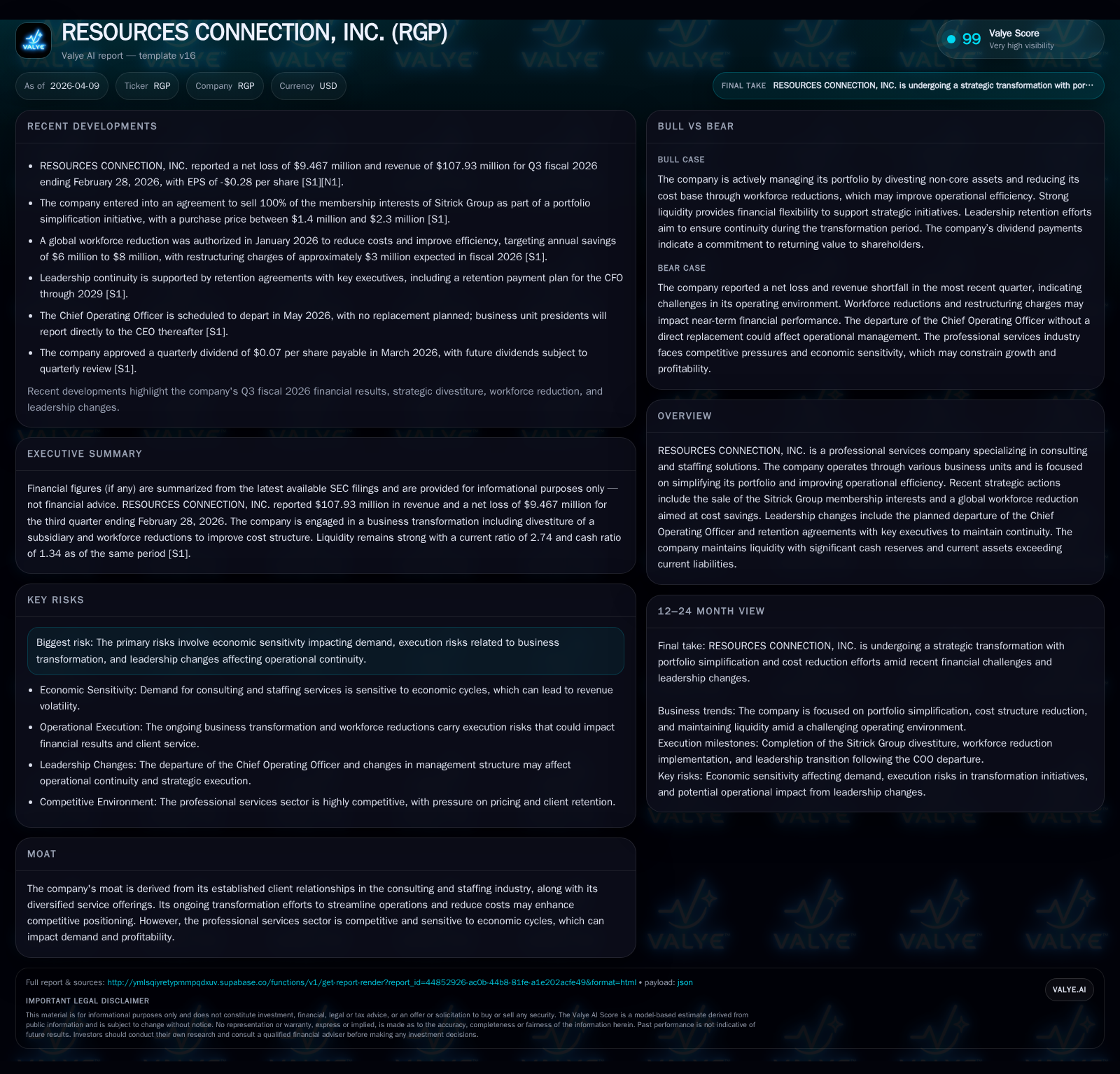
Resources Connection, Inc. has experienced a pronounced decline in revenue and operating income in FY2025, triggering a strategic refocus that includes divesting non-core assets and downsizing its workforce. Leadership changes, including the planned COO departure, coincide with retention efforts aimed at ensuring stability during this transformation. Despite ongoing challenges, RGP maintains strong liquidity and continues shareholder returns through dividends and share repurchases, although negative returns on equity underscore operational headwinds ahead.
Historic Revenue Ebb and Escalating Losses: The Fiscal Shift Since FY2022
Resources Connection, Inc. (RGP) has undergone an acute fiscal contraction culminating in FY2025 with revenue declining to approximately $551 million from $633 million in FY2024 — a sharp 12.9% year-over-year decrease [F1]. This top-line contraction reflects pressure across its professional services lines during economic sensitivity impacting client demand. Operating income reversal is even more dramatic: from profitable territory at nearly $28 million in FY2024 it plunged into a substantial loss of almost $197 million in FY2025, marking an operating income decline exceeding 780% year-over-year [F1]. Net income followed suit with a steep drop from $21 million profit to a staggering net loss just shy of $192 million, representing over a tenfold deterioration [F1]. This swing manifests significant margin erosion, undermining prior operating leverage benefits typical of consulting firms. Meanwhile, operating cash flow took a hit although less severe — contracting by nearly 14% to roughly $19 million — illustrating shrinking real cash generation coinciding with deteriorated profitability [F1]. Capital expenditures doubled relative to prior years but remain nominal in absolute scale at about $2.7 million, signaling minimal reinvestment priority during retrenchment [F1]. These trends illustrate RGP’s operational challenges amidst broader cyclical headwinds in professional services.
Historical performance (annual)
| FY | Rev ($mm) | Net ($mm) | CFO ($mm) | OpInc ($mm) | Rev YoY | Net YoY |
|---|---|---|---|---|---|---|
| 2025 | 551 | -192 | 19 | -197 | -12.9% | -1011.8% |
| 2024 | 633 | 21 | 22 | 29 | -18.4% | -61.3% |
| 2023 | 776 | 54 | 82 | 73 | -3.6% | -19.1% |
| 2022 | 805 | 67 | 49 | 83 |
Source: SEC companyfacts cache [F1].
Capital returns and efficiency (annual)
| FY | Div ($mm) | Buybacks ($mm) | FCF ($mm) |
|---|---|---|---|
| 2025 | 19 | 13 | 16 |
| 2024 | 19 | 8 | 21 |
| 2023 | 19 | 15 | 80 |
| 2022 | 19 | 20 | 46 |
Source: SEC companyfacts cache [F1].
Table: Historical Financial Performance Summary (FY2022–FY2025) [F1]
Operational Efficiency Drives: Recent Workforce Reductions and Disposal of Non-Core Assets
In response to declining margins and shrinking revenues, RGP sanctioned global reductions targeting management and administrative personnel starting January 22, 2026 [S6]. These cuts carry targeted annualized cost savings between $6 million and $8 million, expected to be substantially realized within fiscal year 2026 [S6]. Restructuring charges amounting to approximately $3 million will primarily arise from employee termination benefits recorded during the second half of fiscal year processes [S6]. This aligns with best practices in professional services restructuring which focus sharply on flattening cost layers while preserving core service delivery capacity.
Complementing these measures, RGP agreed to divest its entire membership interest in Sitrick Group—a specialty asset outside its streamlined portfolio vision—at an estimated price bracketed between $1.4 million and $2.3 million based largely on client receivables realizable value [S3][S10]. The transaction includes retention of certain liabilities related to office leases and incorporates a severance payment of $4 million to Sitrick’s CEO as part of transition agreements [S10]. Closing is expected within roughly six weeks post-announcement [S10]. This disposal underscores RGP’s intent to purge non-core entities facilitating sharper operational focus.
Leadership Transitions: Managing Executive Change During Strategic Pivot
Leadership continuity emerged as a key concern amid operational recalibration; Chief Operating Officer Bhadreskumar Patel is set to leave by May 15, 2026 under agreed separation terms that include severance totaling approximately $1.65 million plus healthcare continuation benefits [S20]. Notably, no immediate COO successor will be appointed; instead, direct reporting lines will shift so that Presidents of business units report straight to CEO Roger Carlile—appointed November 3, 2025 following predecessor Kate Duchene’s departure earlier that year [S24][S20].
Efforts to stabilize senior management complement departures: Jennifer Y. Ryu, Executive Vice President and CFO, signed retention agreements carried out early February intended to incentivize her sustained contribution through mid-2029 barring involuntary termination without cause [S19]. This deliberate retention strategy addresses leadership succession risk—critical for execution alignment amidst complex transformation where churn can handicap operational momentum.
Examining Liquidity and Capital Structure: Cash Reserves, Debt, and Balance Sheet Health
Despite earnings pressure, RGP enters the transformation phase fortified by liquidity resilience: as of February-end 2026, cash and equivalents stood at approximately $82.7 million against current liabilities near $66.1 million yielding a robust current ratio around 2.74—a marker of sound working capital position suitable for buffering near-term operational shocks [F1][S7]. Total current assets further exceed liabilities by wide margins ($181 million vs $66 million), underscoring balance sheet robustness while debt maturity profiles place no immediate strain on financial flexibility per available disclosures ([S7][S8][S10]).
This stable capital posture provides runway for restructuring costs absorption while supporting dividends and measured buybacks even as operating cash flows remain under stress.
Capital Allocation Review: Dividends, Share Repurchases, and Return on Equity Dynamics
RGP demonstrated commitment to shareholder distributions through stable dividend payouts approximating $18.6 million in FY2025 closely mirroring previous years’ payments despite adverse earnings results [F1][S6]. Simultaneously, share repurchase programs were active with about $13 million spent on buybacks during the same period—above FY2024 levels—signaling measured capital return efforts.
However, the deteriorated profitability is starkly evident in returns ratios: an approximate negative ROE of -92.6% was calculated via net losses relative to shareholders’ equity trimming down from over $418 million the prior year to near $207 million currently [F1]. This negative equity return reflects both accrued losses eroding book value and margin compression challenging capital efficiency metrics prevalent among professional services firms grappling with cyclical demand shocks.
Future Growth Prospects: Headwinds from Economic Sensitivity and Sector Competition
RGP operates within the highly competitive professional services landscape where demand volatility tied closely to economic cycles compromises consistent growth runway (, N1). Clients’ fluctuating need for consulting or staffing solutions directly translates into top-line ebb especially when macroeconomic uncertainty curtails discretionary spending.
While portfolio simplification endeavors intend to bolster structural competitiveness by focusing resources where client relationships are strongest—a core moat—pressure from large consulting incumbents and agile boutique competitors remains intense (). Company risk disclosures also highlight continued sensitivity to market downturns alongside transformation execution risks associated with leadership turnover ([S4], [S5]). Consequently, margin recovery may be plausible but constrained near term.
Monitoring Key Milestones Ahead: Earnings Trends, Portfolio Focus, and Transformation Progress
With explicit forward guidance absent from regulatory or public disclosures, the near-term assessment hinges on quarterly earnings trends through FY2026 as reported notably in Q3 releases ([N4],[N1]). Anticipated completion of the Sitrick Group sale within approximately the next six weeks post-April announcement marks a concrete milestone contributing incremental liquidity support ([S10]). Tracking progress against workforce reduction cost savings target ($6–8M annually) within fiscal year results remains vital ([S6]).
Additionally, evaluation of leadership structure adjustment impacts—particularly COO exit without replacement—and effectiveness of key executive retention schemes offer insight into execution risks embedded within transformation agendas ([N2], [N3], [S19], [S20]). Collectively these factors frame the investment community’s framework for monitoring ongoing operational health.
Disclaimer: This analysis is designed solely for informational purposes reflecting publicly filed data and relevant regulatory announcements as of April 2026 without constituting investment advice or recommendations.
Disclaimer: This is research-only, informational analysis and not investment advice. It may include AI-generated interpretation and general industry context. Always verify important details using primary sources.

Comments