
Beyond Meat's Turnaround: Strategic Shifts and Innovation Amid Profit Volatility
Beyond Meat confronts declining revenues with enhanced innovation and operational restructuring as it seeks stable profitability.
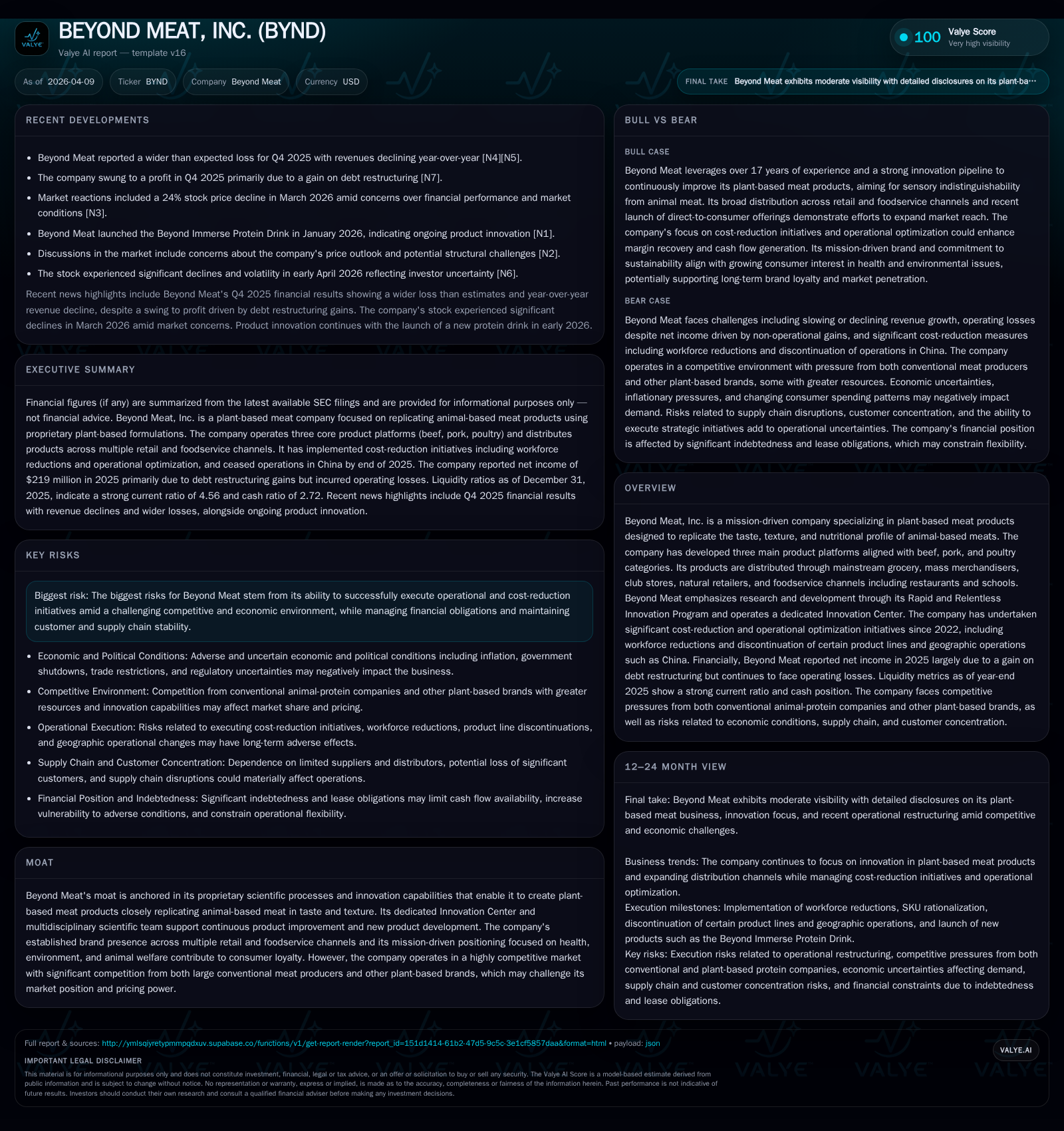
Beyond Meat, Inc. experienced a stark financial reversal in 2025, swinging from multi-year operating losses and net losses to a reported net income primarily driven by a non-recurring gain on debt. This came amid persistent operating income deficits and negative operational cash flows, underscoring underlying profitability challenges. The company’s strategic response hinges on its Rapid and Relentless Innovation Program and operational optimization initiatives aimed at cost reduction, simplification of product lines, and channel realignment. However, it faces significant pressure from intensifying competition, consumer demand softness in the plant-based category, regulatory hurdles, and liquidity constraints. Going forward, the efficacy of Beyond Meat’s innovation engine, execution of its Global Operations Review, and ability to manage capital structure risks will be pivotal in shaping its sustainable growth trajectory.
From Losses to Net Income: Tracking Beyond Meat’s Financial Performance Through 2025
Beyond Meat's financial trajectory over the past four years has been marked by acute losses at the operating level coupled with considerable cash burn. Despite this challenging backdrop, the company reported a positive net income of $219 million in fiscal year 2025 following several years of substantial net losses ($-366M in 2022; $-338M in 2023; $-160M in 2024) as recorded in its latest SEC filing.[F1] However, this profit was primarily driven by a non-recurring gain on debt restructuring rather than improved operating performance.
Operating income deteriorated further to a loss of approximately $334 million in 2025 from about -$156 million in 2024, representing a steep -113.7% year-over-year decline.[F1] Cash flow from operations remained negative at roughly -$145 million for 2025 (-46.7% worse vs prior year), highlighting ongoing challenges converting revenues into cash despite profit on paper.[F1]
Capital expenditures moderated to just over $12 million—an investment level reflecting intensified capital discipline compared to $70 million spent in 2022.[F1] The company's equity position continues to hover deep negative near -$997 thousand at year-end 2025 after progressively worsening balances since 2022.[F1] The combination of sustained operating deficits and shrinking equity results in an approximate return on equity metric that remains heavily negative.
Historical performance (annual)
| FY | Net ($mm) | CFO ($mm) | OpInc ($mm) | Capex ($mm) | Net YoY |
|---|---|---|---|---|---|
| 2025 | 219 | -145 | -334 | 12 | +236.7% |
| 2024 | -160 | -99 | -156 | 11 | +52.6% |
| 2023 | -338 | -108 | -342 | 11 | +7.6% |
| 2022 | -366 | -320 | -343 | 70 |
Source: SEC companyfacts cache [F1].
Capital returns and efficiency (annual)
| FY | FCF ($mm) | ROE% |
|---|---|---|
| 2025 | -157 | -21968.3 |
| 2024 | -110 | 26.7 |
| 2023 | -118 | 65.9 |
| 2022 | -391 | 179.9 |
Source: SEC companyfacts cache [F1].
Financial trends underscore significant operational losses despite bottom-line improvement via one-time gains.
Innovation as Moat: The Role of Research & Development in Product Evolution
Beyond Meat's competitive edge fundamentally rests on its proprietary scientific platform designed to replicate animal meat's sensory attributes using plant-based ingredients. Its Rapid and Relentless Innovation Program drives continuous refinement across beef-, pork-, and poultry-aligned product platforms. Centralized research occurs within its dedicated Innovation Center housing experts from chemistry to biophysics working alongside process engineers.[S1][S27]
This innovation pipeline aims not only at improving taste and texture fidelity but also simplifying ingredient lists—a growing consumer demand for “clean label” products—and entering adjacent categories such as plant-based beverages exemplified by the launch of Beyond Immerse through its direct-to-consumer Beyond Test Kitchen channel in early 2026.[S6] The focus on research-backed differentiation remains critical given intensifying market competition and customer appetite for novel alternatives.
Competitive Headwinds: Positioning Against Conventional and Alternative Proteins
Beyond Meat operates within an increasingly crowded arena where conventional meat producers like Tyson Foods and JBS aggressively push their own plant-based lines backed by deeper pockets and supply chain scale advantages.[S4] Competing pure-plays such as Impossible Foods innovate rapidly while next-generation protein formats including mycelium-based substitutes (Quorn), fermentation-derived meats (Meati), and cell-cultured clean meat technologies add layers of complexity.
Pricing pressures are manifesting as competitors leverage cost advantages; concurrently consumer demand softness in plant-based categories amid inflationary environments compounds revenue challenges. There is evidence of category maturation or weakening demand influencing cautious promotional tactics including targeted discounting to stimulate trial but squeezing margins.[S4][S18]
Operational Restructuring and Cost Initiatives: Objectives and Risks
Since initiating a Global Operations Review in 2023,[S6] Beyond Meat has embarked on significant cost-cutting efforts focusing on operational efficiency gains and margin enhancement. These include workforce reductions,[S1] exiting product lines deemed non-core or unprofitable,[S22] notably ceasing China operations in early 2025 incurring severance and asset impairment charges,[S22] adjusting pricing architecture mostly upward within U.S. retail/foodservice channels,[S4] inventory liquidation programs reducing stock carry costs,[S6] optimizing manufacturing capacity utilization,[S8][S22], and rationalizing real estate holdings.
While these actions aim to preserve cash and improve profitability metrics over time,[S6] they introduce execution risks including potential sales disruption from lessened channel breadth or consumer pushback on price hikes alongside possible damages to brand perception or employee morale.[S6]
Revenue Composition: Channel Strategy and Geographic Retrenchment
Distribution remains diversified across major U.S. grocery chains (mainstream), mass merchandisers like Walmart/Costco transitioning select products from refrigerated fresh meat cases into frozen aisles—a move sparked debate about impact on consumer perceptions—and natural retailers.[N14][S1]
Foodservice outlets including restaurants and schools continue as important channels with tailored offerings. The Beyond Test Kitchen direct-to-consumer platform launched late 2025 serves as an experimental market entry leveraging data analytics with limited releases.[S1]
Geographically beyond North America operations have contracted with the strategic exit from China finalized by early-to-mid-2025 per management’s disclosures due to profitability challenges there.[S22]
These shifts reflect a more concentrated go-to-market approach aimed at maximizing returns from high-potential segments while curtailing cost-heavy expanses.
Capital Structure, Liquidity, and Cash Flow Dynamics
As of year-end 2025 Beyond Meat held approximately $204 million in cash & equivalents against current liabilities near $75 million yielding a strong current ratio around 4.56 indicating solid short-term liquidity buffer.[F1]
However overall shareholder equity remains negative nearing one million dollars below zero reflective of cumulative historical losses signifying stressed balance sheet conditions.[F1] The company refinanced significant debt issuances through exchange offers completed in late-2025 replacing some obligations with longer dated notes (2030 Notes), backed by restricted covenants limiting dividends/distributions or incurring senior liens.[S7][S12][S13]
Despite positive net income recognition driven largely by one-time gains the core business continued generating negative operating cash flow surpassing $140 million shortfall in fiscal year '25—contrasting with the company's free cash flow needs demanding further capital management vigilance.[F1]
No dividends were declared nor have share buybacks occurred recently consistent with cautious capital allocation focused primarily on deleveraging efforts alongside operational turnaround financing.[F1]
Looking Ahead: Market Factors to Watch and Potential Growth Catalysts
Going forward investors should monitor key milestones including broader commercialization success of newly introduced products such as plant-based beverages which could complement the core meat offerings if consumer acceptance scales favorably.[N11][N14]
Tracking margins recovery will hinge significantly on pricing strategy effectiveness balanced against volume retention amid stiffening competition.[S6] Regulatory developments remain salient risks especially evolving restrictions on terminology usage for plant-based products as enacted recently by certain European jurisdictions constraining marketing claims once standard within the sector.[S5]
The outcome of Nasdaq listing compliance issues linked to delayed filings may influence investor confidence though no immediate trading suspension occurred as of April '26.[S3] Complementary technological innovations emerging from continued R&D investments remain a vital upside possibility to restore differentiation.
Ultimately the interplay between continued innovation momentum versus operational execution capabilities amidst macroeconomic headwinds will define Beyond Meat's trajectory toward establishing more durable profit streams.
This analysis synthesizes data solely from publicly available SEC filings ([F1], [S#]) alongside relevant news disclosures ([N#]). It refrains from investment recommendations or subjective valuation speculation.
Disclaimer: This is research-only, informational analysis and not investment advice. It may include AI-generated interpretation and general industry context. Always verify important details using primary sources.

Comments