
T3 Defense’s Revenue Decline and Integration Challenges Amid Aerospace Pivot
T3 Defense is executing a strategic shift from fintech to aerospace and defense, facing significant operational and liquidity pressures during its acquisition-driven growth.
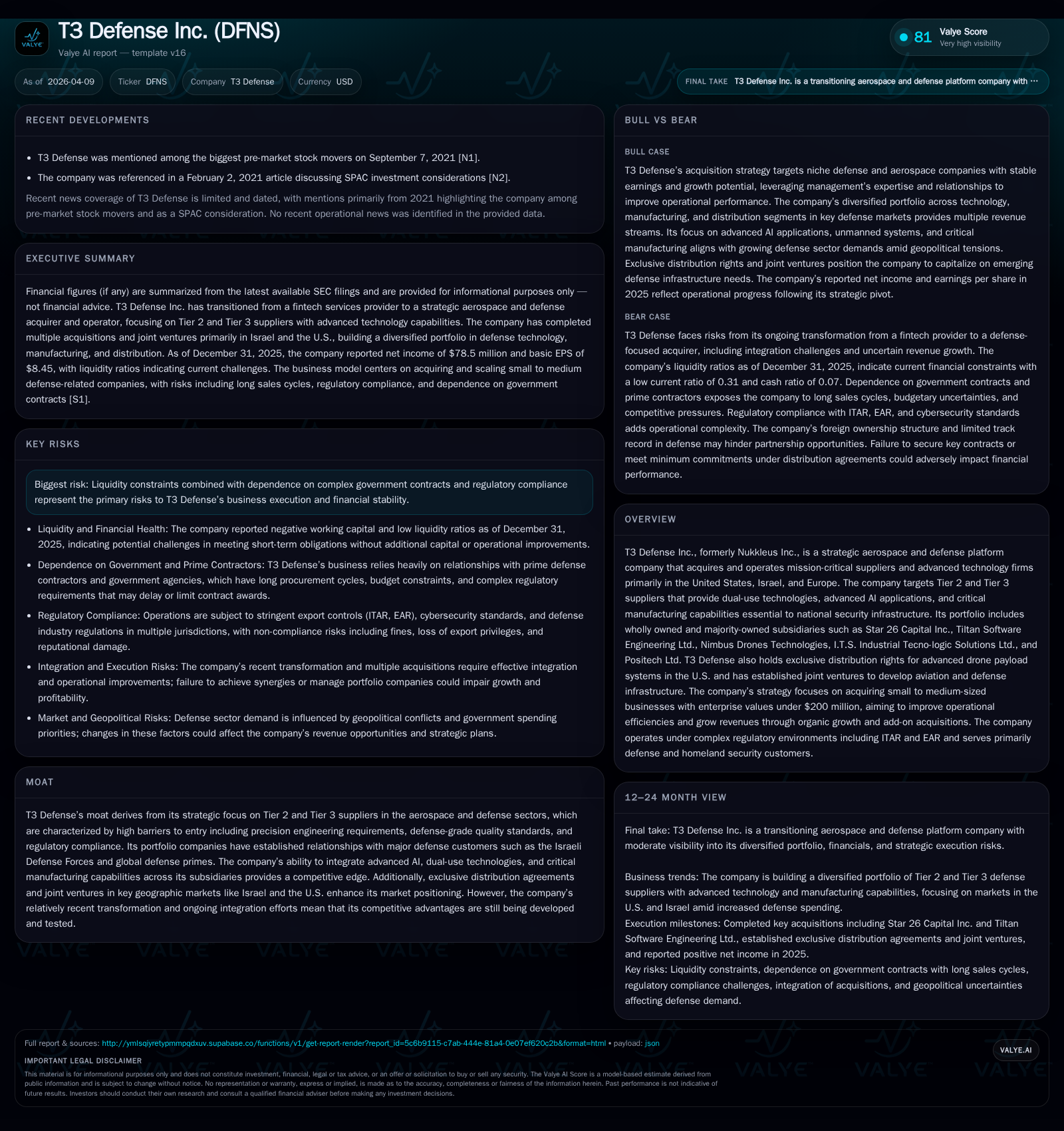
T3 Defense Inc. has transitioned from a financial technology provider to a holding company focused on Tier 2 and Tier 3 aerospace and defense suppliers across the U.S., Israel, and Europe. The company’s FY2025 results reveal steep revenue declines and mounting operating losses amid liquidity constraints and an unproven defense industry track record. Growth depends on integrating newly acquired subsidiaries, securing contracts in a highly regulated environment, and managing complex geopolitical and compliance risks. Despite negative working capital and equity deficits, management relies on an equity line of credit, subsidiary cash flows, and capital markets execution to sustain operations.
Company Background and Strategic Shift
T3 Defense Inc., formerly Nukkleus Inc., completed a significant transformation from a fintech firm providing blockchain-enabled payment solutions primarily serving retail foreign exchange clients into a platform focused on aerospace and defense acquisitions starting late 2024 [S1]. This strategic pivot targets acquiring and integrating Tier 2 and Tier 3 suppliers with advanced technologies critical to national security infrastructure, especially those based in the U.S., Israel, and Europe [S15].
Its portfolio includes Star 26 Capital Inc., Tiltan Software Engineering Ltd., Nimbus Drones Technologies, I.T.S. Industrial Tecno-logic Solutions Ltd., Positech Ltd., as well as exclusive U.S. distribution rights for drone payloads through BladeRanger Ltd. [S15][S14].
Historical Performance: Revenue Decline during Rising Losses
Financial data indicates substantial disruption during this transition. Revenue declined from $21.3 million in FY2023 to approximately $5.9 million in FY2024—a nearly 72% decrease—primarily due to termination of legacy fintech contracts such as those with Triton Capital Markets Ltd., coupled with nascent contributions from new defense subsidiaries [F1][S7].
Operating losses deepened from about $17.5 million in FY2023 to $32.6 million by the end of FY2025 [F1]. Net income turned positive in FY2025 at $78.5 million; however, this gain appears driven by non-operational items rather than core profitability [F1]. Operating cash flow remained negative at roughly $6.2 million in FY2025, underscoring ongoing cash consumption during integration phases [F1].
Balance sheet metrics highlight liquidity stress with negative working capital near $30 million at year-end 2025—largely reflecting warrant liabilities that do not require cash settlement—and stockholders’ deficit around $15.6 million [F1][S7]. Cash & equivalents stood at roughly $2.6 million.
Historical performance (annual)
| FY | Rev ($mm) | Net ($mm) | CFO ($mm) | OpInc ($mm) | Rev YoY | Net YoY |
|---|---|---|---|---|---|---|
| 2025 | 79 | -6 | -33 | +148.9% | ||
| 2024 | 6 | -161 | 0 | -5 | -72.2% | -822.6% |
| 2023 | 21 | -17 | -1 | -17 | -1701.2% | |
| 2022 | -1 | -1 | -1 |
Source: SEC companyfacts cache [F1].
Capital returns and efficiency (annual)
| FY | ROE% |
|---|---|
| 2025 | -397.0 |
| 2024 | 98.4 |
| 2023 | 281.4 |
| 2022 | 24.7 |
Source: SEC companyfacts cache [F1].
Note: Negative working capital is influenced heavily by non-cash warrant liabilities.
Growth Strategy: Acquisitions Focused on Defense Niches
T3’s acquisition strategy concentrates on small-to-medium enterprises within aerospace & defense sectors characterized by high barriers such as ITAR/EAR compliance, precision engineering, and specialized know-how [S15][S9]. Key subsidiaries include:
- Tiltan Software Engineering Ltd.: AI-driven geospatial intelligence platforms including synthetic environments and GPS-denied navigation software [S19].
- Nimbus Drones Technologies: Unmanned aerial systems expertise.
- I.T.S Industrial Tecno-logic Solutions Ltd.: Electro-mechanical manufacturing capabilities serving defense primes.
- Positech Ltd.: High-performance motion control systems.
- BladeRanger Ltd.: Exclusive U.S.-based distributor for advanced drone payloads under multi-year minimum purchase commitments [S14][S16].
Management believes these niche technologies combined with regulatory complexity create competitive advantages but acknowledges the need for successful integration and market penetration.
Risks Impacting Growth Potential
Several factors constrain T3’s expansion prospects:
- Security Clearances: Approximately 90% of U.S. defense contracts require facility security clearances which T3 currently lacks due to foreign ownership structures complicating eligibility; clearance processes are lengthy (12-18 months) and costly (> $500k annually) [S18][S20].
- Integration Complexity: Rapid acquisition of multiple companies across different countries without prior aerospace/defense experience increases risk of failing to achieve expected synergies; historically most acquisitions fail to meet projections without dedicated integration expertise [S1].
- Contractual Exposure: Fixed-price government contracts carry unlimited cost overrun risks; lack of experience estimating such costs heightens potential financial losses beyond existing equity base [S18].
- Geopolitical Risks: Operations centered in Israel face supply chain disruptions due to regional conflicts; evolving U.S.-Israel trade relations may affect tariffs or export controls impacting product delivery timelines [S20][S25].
- Regulatory Compliance: Strict adherence to ITAR/EAR is mandatory; violations can result in severe penalties including debarment from government contracts affecting core business lines like drone payload distribution [S23].
- Competitive Landscape: Established global defense primes dominate procurement channels limiting immediate access for new entrants lacking long-standing relationships or security credentials [S10][S26].
- Liquidity Constraints: Negative working capital necessitates reliance on external financing including an SEC-registered equity line with monthly draw capacity exceeding projected expenses (~$6.6 million), supported by prior PIPE raises totaling ~$20 million last year [F1][S7].
Capital Allocation and Liquidity Management
Management’s plans to address liquidity include cancellation of a previously contemplated $16 million intercompany note related to the Star acquisition improving balance sheet flexibility; leveraging positive cash-generating subsidiaries such as Rimon Ltd. and Nimbus Robotics; pursuing expanded bank credit lines for portfolio companies; utilizing equity issuance options for obligations if necessary; and drawing on an active equity line of credit approved by shareholders [S7][S16]. No dividends or share repurchases have been declared given priority on sustaining operations.
Key Milestones To Monitor
Investors should watch for:
- Approval and receipt of required security clearances enabling participation in classified programs.
- Revenue growth from acquired companies surpassing break-even thresholds.
- Fulfillment or renegotiation status of minimum purchase commitments under distribution agreements.
- Progress towards positive operating cash flow indicating scaling efficiencies.
- Evidence of realized synergies post-integration improving margins.
- Resolution outcomes related to litigation over acquisition-related fees.
- Expansion into adjacent markets leveraging AI-enabled dual-use technologies.
- Impact assessments of trade policy changes affecting cross-border operations.
- Establishment of prime contractor relationships enhancing contract award prospects.
Conclusion
T3 Defense faces a challenging transformation marked by steep revenue declines amid strategic acquisitions targeting aerospace-defense niches requiring specialized expertise and regulatory compliance uncommon in its fintech origins. Liquidity constraints coexist with ambitious growth initiatives hinging on successful integration, security clearance attainment, contract awards, and managing geopolitical exposures.
While management presents credible plans supported by subsidiary cash flows and capital market access, the company remains exposed to substantial operational risks inherent in fixed-price contracting, foreign ownership limitations, and competitive industry dynamics dominated by entrenched players with decades-long relationships.
This analysis is based solely on publicly available information including SEC filings up through April 9th, 2026; it does not constitute investment advice or recommendations regarding securities mentioned.
Disclaimer: This is research-only, informational analysis and not investment advice. It may include AI-generated interpretation and general industry context. Always verify important details using primary sources.

Comments