
Worthington Enterprises: Balancing Acquisition Expansion and Margin Pressure
The acquisition of LSI Group expands Worthington's industrial footprint while raw material volatility tempers margin gains.
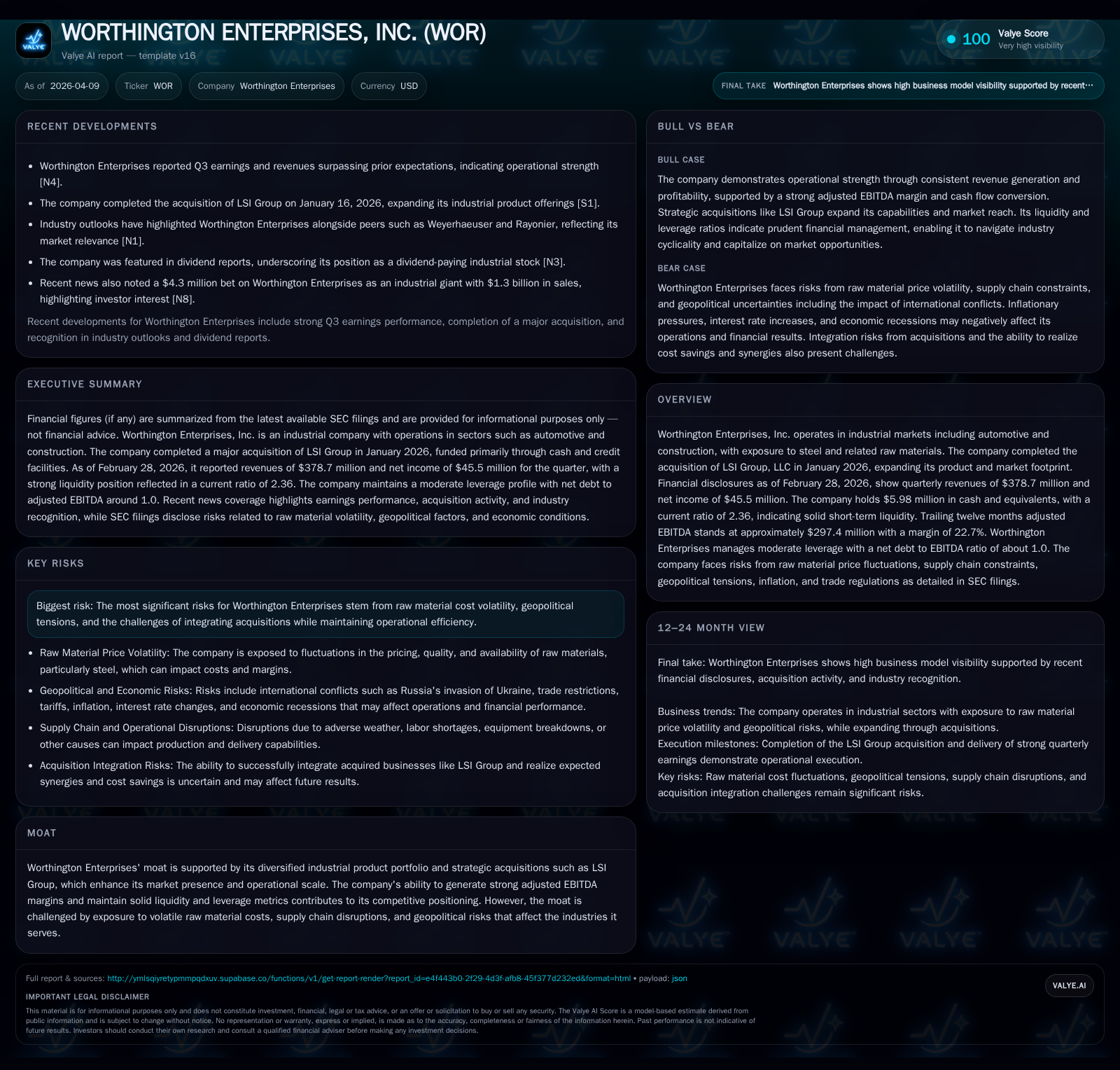
Worthington Enterprises experienced a revenue decline in FY2025 but showcased marked improvement in operating income as margins began to stabilize. The January 2026 acquisition of LSI Group broadened the company's product portfolio within automotive and construction verticals, which may reinforce its competitive moat. However, ongoing raw material cost volatility and supply chain challenges present persistent risks that could pressure profitability. Worthington maintains a moderate leverage profile and pursues disciplined capital allocation blending dividends and buybacks amid integration efforts.
Revenue and Profit Performance: Signs of Recovery After Sharp Declines
Worthington Enterprises entered fiscal year 2025 facing a challenging top-line environment, with revenues decreasing by approximately 7.4% year-over-year to $1.15 billion [F1]. This downturn followed pronounced volatility over earlier years, including a dramatic drop from multi-billion-dollar revenues previously reported for FY2023 ($4.92 billion) to consolidation or reporting scope shifts impacting comparability [F1]. Despite the revenue contraction, operating income saw a significant rebound, increasing by over 85% relative to FY2024 levels, climbing from a negative $73 million loss to a smaller $10.7 million loss in FY2025 [F1]. This nearly halved operating loss suggests emerging operational stabilization, improved cost management, or favorable product mix changes that began to take hold.
However, net income continued to show downside pressure, decreasing by about 13.2% year-over-year to approximately $96 million in FY2025 [F1]. The persistence of net income decline against an improving operating income backdrop indicates non-operating factors or timing differences may be weighing on bottom-line results, including interest expense or tax rate variations noted in filings [S23]. Overall, Worthington appears to be on a gradual recovery trajectory after steep earnings volatility during the pandemic recovery period.
Historical performance (annual)
| FY | Rev ($bn) | Net ($mm) | CFO ($mm) | OpInc ($mm) | Rev YoY | Net YoY |
|---|---|---|---|---|---|---|
| 2025 | 1.2 | 96 | 210 | -11 | -7.4% | -13.2% |
| 2024 | 1.2 | 111 | 290 | -73 | -74.7% | -56.9% |
| 2023 | 4.9 | 257 | 625 | 212 | -6.2% | -32.4% |
| 2022 | 5.2 | 379 | 70 | 329 |
Source: SEC companyfacts cache [F1].
Capital returns and efficiency (annual)
| FY | Buybacks ($mm) | FCF ($mm) | ROE% |
|---|---|---|---|
| 2025 | 31 | 159 | 10.2 |
| 2024 | 180 | 206 | 12.4 |
| 2023 | 180 | 539 | 15.1 |
| 2022 | 180 | -24 | 25.6 |
Source: SEC companyfacts cache [F1].
All figures from SEC companyfacts cache [F1]
Impact of LSI Group Acquisition on Product Mix and Market Footprint
In January 2026, Worthington completed its acquisition of LSI Group, LLC [N1][S3], a strategic move extending the company's footprint across automotive and construction industrial segments [N3][S3]. This transaction aims to bolster Worthington’s product breadth by adding complementary offerings which expand coverage of steel-related raw materials and finished components critical to these sectors.
Management has highlighted integration efforts focusing on leveraging cross-market synergies such as consolidated sourcing efficiencies and enhanced customer base diversification [S3][N1]. Such scale gains are intended to reinforce the company’s competitive moat—which has historically been underpinned by diversification and targeted acquisitions—but filings indicate that achieving expected cost savings and operational improvements depends heavily on smooth integration execution amid complex supply chains [S4][S6].
The expanded portfolio positions Worthington better against fragmented competitors by offering broader solutions in construction materials and automotive components—markets subject to cyclical demands but benefiting from long-term infrastructure investments and automotive platform refresh cycles.
Raw Material Cost Volatility and Supply Chain: Navigating Key Industry Headwinds
Notwithstanding recent operational improvements, Worthington continues to face pronounced risks tied to raw material cost volatility—chiefly steel—and supply chain constraints amplified by global inflationary trends [S4][S5][S8]. The company’s ability to enact timely input price pass-through is critical as sustained raw material inflation pressures margin compression dynamics common across the industrial sector.
Geopolitical tensions associated with ongoing global conflicts such as Russia’s invasion of Ukraine exacerbate sourcing challenges due to potential tariff regime shifts or border disruptions impacting steel flows [S6][S9]. These externalities elevate uncertainty around procurement reliability and cost structures broadly.
Additionally, evolving environmental regulations impose compliance costs that may constrain product use or necessitate capital-intensive adaptations within operations [S4][S8]. Worthington's effort to offset these headwinds through increased adjusted EBITDA margins—reported at about 22.7% trailing twelve months as of early calendar year 2026—reflects some success but highlights limits on sustainable margin expansion amid input cost swings [F1][S2].
Operating Cash Flow Dynamics and Capex Trends Reflect Prudence
In FY2025, operating cash flow declined sharply by approximately 27.7% versus the prior year despite improving earnings metrics [F1], underscoring challenges translating accrual accounting improvements into cash generation—likely attributable to working capital shifts or transitional costs linked with acquisitions.
Capital expenditures showed even more pronounced restraint with nearly a 40% reduction year-over-year to just over $50 million in FY2025 [F1]. This capex discipline signals cautious asset investment amid uncertain demand forecasts while prioritizing liquidity preservation given ongoing integration costs for LSI Group and macroeconomic headwinds.
Such conservative investment also supports managing borrowing costs within the context of moderate leverage levels reported at about net debt/TTM adjusted EBITDA ratio near unity as of early calendar year quarter-end [F1][S29], balancing growth aspirations against financial flexibility requirements.
Capital Allocation Strategy: Dividends, Buybacks, and Managing Moderate Leverage
Worthington retains an active shareholder return policy combining steady dividends with opportunistic share repurchases totaling roughly $30.9 million in FY2025—a notable decrease from previous years’ elevated buyback levels totaling over $180 million in earlier periods [F1][S28][S27].
This moderated repurchase pace aligns with the need to preserve capital during acquisition integration while maintaining net leverage targets near a manageable one times EBITDA ratio reflected in recent disclosures [F1][S29], an indicator of balanced risk tolerance.
ROE hovers around an estimated 10.2%, signaling modest capital efficiency gains after navigating recent operational restructuring phases and cost pressures [F1]. The company’s focused capital deployment prioritizes sustaining dividend continuity alongside measured buyback programs aimed at enhancing shareholder value without compromising balance sheet health.
Outlook and Forecasts: What To Watch Post-Acquisition Integration
Management communication surrounding the LSI Group acquisition emphasizes milestone-driven integration progress expected throughout fiscal 2026, targeting incremental revenue synergies within automotive/construction verticals while guarding against margin erosion amid inflationary risks [N1][S3].
Explicit quantitative guidance remains limited; however, investor commentary points toward close monitoring of adjusted EBITDA margin trends alongside free cash flow trajectory post-cap-expenditure normalization as indicators of sustained operational resilience.
Key focal points include synergy realization timelines—cost savings from combined supply chains—and efficient working capital management amid volatile raw materials pricing environments.
Risk Factors: Geopolitical Tensions and Regulatory Pressures
Worthington’s risk disclosures highlight significant vulnerabilities tied to geopolitical instability primarily driven by conflicts like the Ukraine war affecting steel supply routes and pricing regimes [S4][S6]. Ongoing trade wars or tariff adjustments represent substantive risks that could elevate input costs or disrupt market access.
Additionally, stricter environmental compliance frameworks impose escalating operational expenses under enforced greenhouse gas emission standards and sustainability mandates prevalent across North American manufacturing sectors [S8][S9].
These external pressures compound internal execution risks related to acquisition integrations where failure to achieve timely efficiencies could hamper projected profit enhancements.
This analysis incorporates all referenced financial data anchored strictly on documented SEC filings ([F1], [S#]) and credible news sources ([N#]). It seeks neither investment recommendation nor price forecasting but aims at an informed understanding of Worthington Enterprises' industrial positioning given its recent growth moves against structural market challenges.
Disclaimer: This is research-only, informational analysis and not investment advice. It may include AI-generated interpretation and general industry context. Always verify important details using primary sources.

Comments