
Wallbox N.V. Confronts Revenue Volatility and Restructuring to Sustain Leadership in EV Infrastructure
Wallbox faces financial headwinds amid geographic revenue shifts and a comprehensive debt restructuring while leveraging its technological platform for future growth.
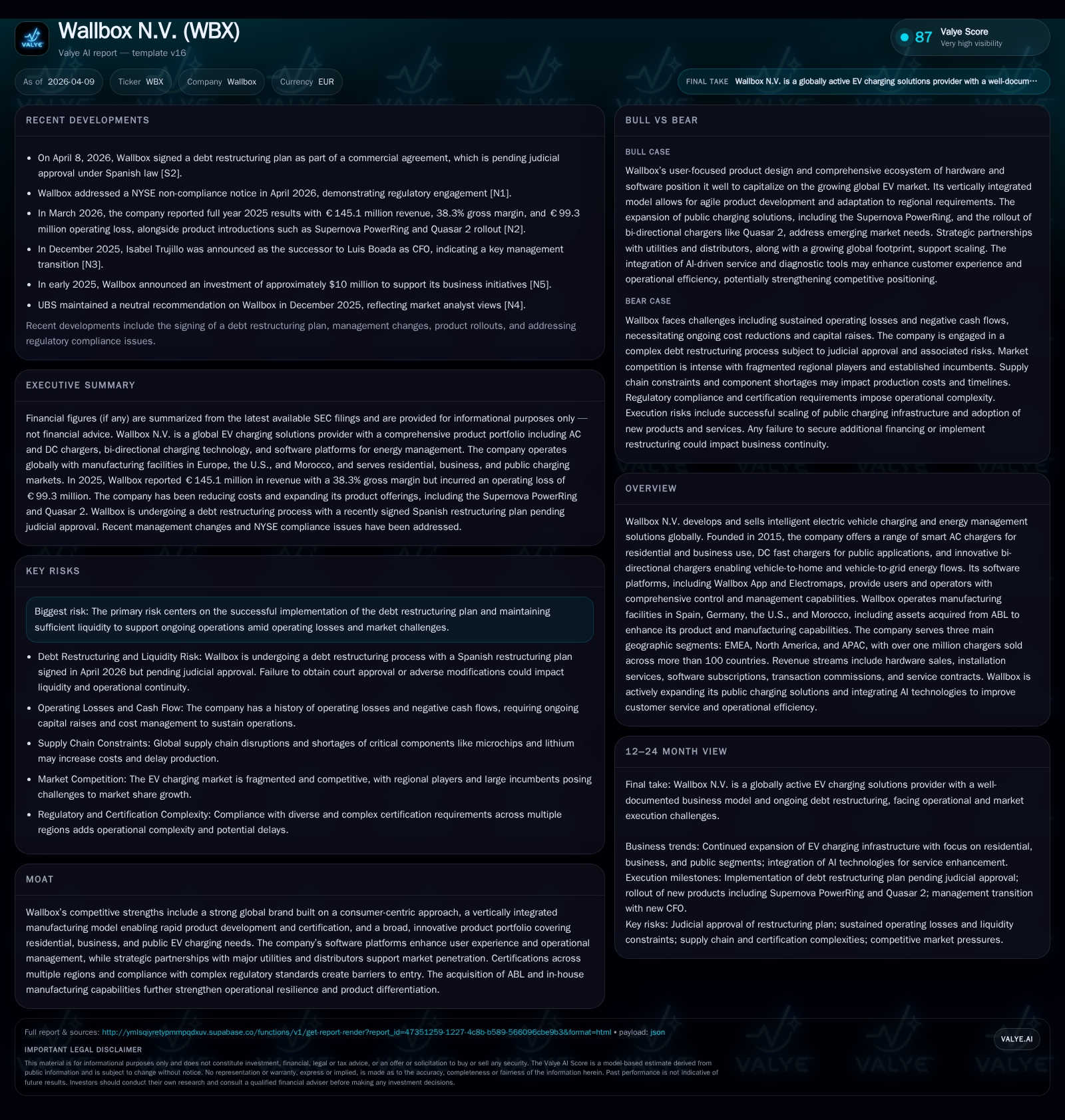
Wallbox N.V. has experienced divergent revenue trends with North American sales growing 16% year-over-year in 2025 contrasted by a 16% decline in its EMEA segment, pressuring overall profitability despite cost containment efforts. The company is undergoing a legally sanctioned debt restructuring under Spanish Insolvency Law to preserve liquidity and support its capital-intensive growth ambitions in the global EV charging market. Wallbox’s vertically integrated model, broad portfolio—including innovative bi-directional chargers—and strategic acquisitions provide a foundation for recovery, yet risks linked to NYSE compliance and operational execution remain relevant. Stakeholders should monitor the implementation of the restructuring plan, expected by mid-2026, and the ability to reach operating cash flow breakeven.
Evolution of Revenue and Profitability: Segment-Level Insights
Wallbox N.V.’s revenue trajectory shows significant regional divergence in fiscal year 2025. The European-Middle East-Africa (EMEA) segment saw a notable contraction averaging a 16% year-over-year decline to €112.4 million, driven primarily by decreases in sales of both AC level 2 chargers and DC fast charging units across their main markets [S1]. This deterioration was partly offset by improvements in cost controls such as optimized inventory spend — down €18.5 million or 21% — alongside workforce rationalization that trimmed employee benefits expenses by approximately 25%. Consequently, EMEA’s operating losses narrowed by about €25.4 million compared to the prior year period [S1].
Contrastingly, North America experienced robust growth with revenues climbing 16% YoY to €43.5 million on stronger AC/DC charger demand and increased fee income from installation services under its Coil brand [S1]. Though this helped reduce segment losses substantially—operating loss decreased by roughly two-thirds—the segment remains unprofitable amid ongoing scale-up expenses.
Despite these dynamics, Wallbox’s total revenue for FY2024 was reported at €163.9 million — marking a healthy overall increase of 14% from FY2023 — supported principally by geographic shifts favoring North America but dampened by EMEA headwinds [F1]. Net losses widened markedly to -€151.8 million as the company invested heavily along product development and market expansion lines.
Technological Edge and Product Portfolio Impact on Market Penetration
Wallbox's manufacturing footprint spans four countries: Spain (Barcelona factory), Germany (post-ABL acquisition facilities), the United States (Texas), and Morocco (Tangier). This vertical integration enables rapid innovation cycles through end-to-end control over design, production, testing, and certification—crucial advantages amidst fragmented certification demands in Europe, North America, and APAC regions [S6][S12].
The product portfolio covers the full spectrum of EV charging needs: residential Level 2 alternating current chargers like Pulsar Plus series cater primarily to home users; Supernova offers DC fast charging solutions aimed at public infrastructure; Quasar debuts as one of the only commercially available bi-directional DC chargers enabling vehicle-to-home (V2H) and vehicle-to-grid (V2G) energy flows that can help balance grid load or supply emergency power onsite [S6][S14].
Complementary software assets include the Wallbox App allowing consumers granular control over residential or commercial chargers and Electromaps—a semi-public charging management platform integrating over one million chargers globally for charge point operators—strengthening user engagement across use cases [S14][S22]. Robust certifications aligned with ISO standards underpin cross-border product deployment creating meaningful barriers to entry.
Financial Restructuring: Scope, Terms, and Implications for Liquidity
Facing liquidity challenges exacerbated by sustained operating deficits, Wallbox executed a comprehensive group-wide recapitalization plan formally signed on April 8, 2026 [S2][S3]. This court-sanctioned restructuring leverages provisions under Articles 614 et seq. of the Spanish Insolvency Law designed to facilitate orderly resolution impacting creditors equitably.
Key components include:
- Conversion of selected debt portions into equity alongside issuance of new shares via private placement targeting approximately €10.6 million capital injection from existing shareholders plus new investors.
- A new syndicated term loan facility totaling circa €57.6 million featuring back-loaded amortization starting Q3 2026.
- A €69.1 million bullet instrument maturing December 2030 carrying payment-in-kind interest preserving near-term cash flow.
- A syndicated working capital line of about €42.8 million maturing December 2028 designed to support operational continuity.
- A shared security package pledging core operating companies’ shares, intellectual property rights, bank accounts, customer contracts establishing creditor parity post-restructuring.
These measures aim to restore solvency metrics vital for maintaining NYSE listing compliance while enabling investment capacity needed for growth initiatives despite ongoing market uncertainties [S4][S7][S9][S19].
Forward Outlook: Growth Opportunities Amid Constraints
Wallbox’s management articulates confidence in long-term market fundamentals fueled by accelerating EV adoption globally aligned with tightening regulatory CO2 targets. Expansion plans focus on deepening penetration in North American markets leveraging newly commissioned Texas plant capabilities alongside public infrastructure deployments utilizing Supernova chargers partnered with utilities like Iberdrola and Florida Power & Light Company [N1][N2][S6][S13].
However, liquidity constraints coupled with stock price volatility that has triggered NYSE noncompliance notices temper near-term optimism [N2][S1]. The company must execute its judicial restructuring promptly—with milestones expected during H1–H2 2026—to preserve exchange listing status while delivering operational breakeven progress visible through improving gross margins due to enhanced manufacturing efficiencies.
Careful monitoring will be required around structural indicators such as quarterly earnings results showing sustainable positive cash flow from operations or successful completion of capital raises outlined in the restructuring plan negotiated with lenders.
Capital Deployment: Evaluating ROE, Cash Flows, and Shareholder Returns
Financial evidence indicates Wallbox posted an approximate -243% return on equity based on FY2024 net losses of -€151.8 million versus equity base of about €62.6 million emphasizing severe profitability pressures tied initially to scaling efforts among evolving product lines [F1]. Capital expenditures amounted modestly to circa €1.44 million highlighting relatively restrained investment focused primarily on manufacturing asset enhancements at existing facilities rather than greenfield expansions [S4][S8].
With negative operating income prevailing over consecutive years accompanied by restricted free cash flows compounded by refinancing needs during restructuring phases—Wallbox prudently suspended dividends and share repurchases prioritizing balance sheet restoration ahead of shareholder returns [F1][S27]. Liquidity metrics as of mid-2025 show cash reserves (€27.3m) providing some runway though dwarfed by current liabilities (€152.6m) underscoring dependence on successful debt servicing reconfiguration plus new capital inflows [F1][S16].
Operational Efficiencies Driving Margin Improvements
Despite top-line volatility induced by regional sales shifts coupled with supply chain cost pressures sector-wide Wallbox has demonstrated operational discipline through several cost reduction initiatives apparent in FY2025 results:
- Inventory-related expenses contracted notably reflecting leaner stock positions aligned with demand variability control efforts.
- Headcount rationalization achieving some ~25% reduction in employee benefit costs indicating workforce optimization without undermining essential R&D functions.
- Other operating expenses also trimmed meaningfully sustained through stringent budget governance deployed since early 2023.
- Production processes benefited from engineering innovations focused on supplier diversification plus internal validation reducing reliance on expensive external testing while raising quality benchmarks.
Such efficiencies underpin incremental gross margin improvements necessary when scaling complex hardware platforms amid intense competitive pricing pressures typical within the Level 2 AC charger ecosystem alongside emerging DC fast charger segments [S1][S8].
Risks from Regulatory Compliance and Market Listing Status
A salient risk overlay concerns Wallbox’s non-compliance with NYSE listing standards attributable chiefly to prolonged depressed market capitalization falling persistently below the $50 million threshold sustained over rolling periods triggering formal notification in early 2026 [N2][S1]. The listed entity is subject to an eighteen-month cure window expiring around August 2027 during which it must restore equity levels or face possible delisting consequences including:
- Material reduction in share liquidity coupled with trading migratory behavior towards less liquid OTC markets risking valuation erosion.
- Curtailed access to institutional capital markets hindering future fundraising capacity particularly vital for technology-driven scaling enterprises.
- Potential triggering of contractual breaches across various debt instruments exacerbating refinancing complexities.
- Reputational damage impinging relationships with customers/suppliers/partners alongside challenges recruiting critical talent under equity-compensation structures.
- Loss of eligibility for certain government incentive programs tied explicitly to national exchange listings limiting addressable opportunity sets.
Management remains engaged proactively liaising with NYSE authorities aiming for early compliance demonstration via solidifying balance sheet repairs complemented by operational improvements mitigating these risks if successful execution ensues timely [N2][S1].
Monitoring Key Milestones in Restructuring Progress
Stakeholders should prioritize tracking:
- Court approvals for the Spanish insolvency restructuring scheduled imminently following filing post-April signing evidencing judicial consent essential for implementing agreed terms [N1][N2][S3].
- Completion status of anticipated equity bridge loans together with private placement closings targeted around September 2026 aligning cash flow inflection timing according to disclosed commitments.
- Quarterly financial reporting reflecting trajectory towards improved gross margins propelled by manufacturing efficiencies coupled with quarter-over-quarter narrowing operating losses signaling underlying business stabilization.
- Implementation pace regarding integration synergies from ABL acquisition as well as geographic expansion initiatives notably within emerging APAC markets where localized certifications are pivotal [N1][N2].
Historical performance (annual)
| FY | Rev ($mm) | Net ($mm) | Rev YoY | Net YoY |
|---|---|---|---|---|
| 2024 | 164 | -152 | +14.0% | -35.4% |
| 2023 | 144 | -112 | -0.3% | -78.5% |
| 2022 | 144 | -63 | +101.4% | +71.9% |
| 2021 | 72 | -224 |
Source: SEC companyfacts cache [F1].
Capital returns and efficiency (annual)
| FY | ROE% |
|---|---|
| 2024 | -242.6 |
| 2023 | -74.8 |
| 2022 | -37.1 |
| 2021 | -170.7 |
Source: SEC companyfacts cache [F1]. Note: Operating losses reflect segment disclosures comparing FY2025 vs FY2024; ROE calculated using latest annual net income divided by latest annual equity value as reported.
This analysis synthesizes publicly disclosed data up through April 2026 concerning Wallbox N.V.'s financial performance, strategic positioning across global EV charging markets, recent restructuring efforts under Spanish law aimed at restoring solvency metrics required for continued NYSE listing compliance, and operational efficiencies supporting margin improvement goals amid industry supply chain challenges.
Disclaimer: This is research-only, informational analysis and not investment advice. It may include AI-generated interpretation and general industry context. Always verify important details using primary sources.

Comments