
Xanadu Quantum Technologies Ltd: From Photonic Pioneers to Nasdaq Contender
Xanadu leverages its photonic quantum computing breakthroughs and strategic capital to advance commercialization amid inherent technology and funding challenges.
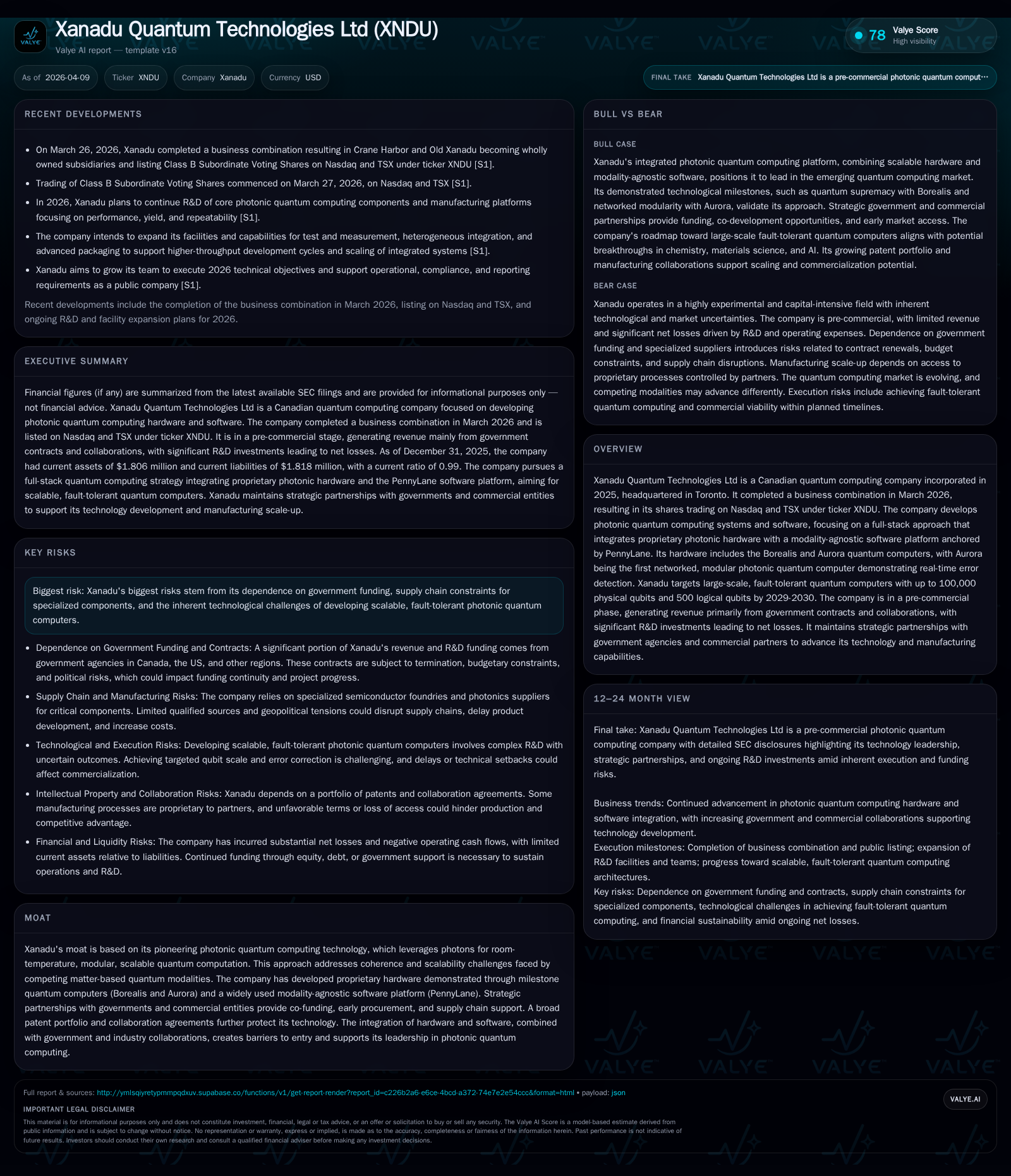
Xanadu Quantum Technologies Ltd, a Canadian photonic quantum computing innovator, transitioned to public markets in early 2026 following a business combination. The company is still pre-commercial, generating modest revenue primarily from government contracts, while incurring growing net losses driven by significant R&D investments. Xanadu aims to develop scalable, fault-tolerant quantum computers with ambitious qubit targets by 2030, navigating supply chain and funding complexities. Capital raised via a $302 million PIPE post-merger provides a runway for continued technology advancement and market validation.
Historical Financial Performance and Growth Drivers
Xanadu Quantum Technologies Ltd's financial trajectory reflects its foundational stage as a pre-commercial quantum computing pioneer. The company’s revenues are modest, stemming largely from government contracts and collaborative projects geared toward advancing their photonic quantum computing platform [S1][S16]. In the fiscal year ended December 31, 2025, net income was approximately -$12 million [F1], evidencing continuing operating losses typical for an R&D-heavy technology company.
The balance sheet demonstrates a current ratio of about 0.99 as of year-end 2025 [F1], indicating near parity between current assets ($1.81M) and liabilities ($1.82M). This tight liquidity position underscores the capital-intensive nature of their operations where working capital management is crucial amidst sustained cash burn.
Capital expenditures have scaled over recent years aligned with strategic investment in hardware infrastructure and test equipment [S11][S25]. Specifically, investments in wafer fabrication capabilities and packaging facilities expanded materially in 2025. This capex focus supports enabling the modular architecture that differentiates their Aurora system. Additionally, intangible asset capitalization includes software development costs central to their integrated software stack.
Historical performance (annual)
| FY |
|---|
| 2025 |
Source: SEC companyfacts cache [F1].
Pioneering Photonic Quantum Technology as Competitive Moat
Xanadu’s pivotal differentiation stems from its proprietary photonic quantum computing technology that uses photons as qubits rather than electrons or superconducting circuits common in competing systems [N1][S1]. Photons enable operation at room temperature along with modular scaling potential — an advantage over matter-based approaches that typically require extreme cryogenic conditions.
The company’s Aurora quantum computer exemplifies this innovation: it is the first networked, modular photonic quantum system integrating real-time error detection mechanisms. Error correction is critical given the fragile nature of qubit states; Aurora’s integration points towards progress on fault tolerance — essential for large-scale utility quantum machines [S1]. Additionally, Xanadu’s PennyLane software platform offers modality-agnostic quantum programming frameworks, broadening customer engagement beyond purely photon-based users to multi-modal quantum application development.
This full-stack approach — uniting custom photonic hardware with open-source commercial-grade software — builds high barriers to entry through specialized IP portfolios, accumulated know-how on chip fabrication processes, optical interfacing, and algorithm co-development with commercial partners [S1][S16]. Government collaborations further cement this moat by facilitating shared funding and early procurement commitments that hedge against competitive risk.
Early Commercial Phase: Revenue Composition and Customer Base
Currently categorized as pre-commercial, Xanadu derives nearly all revenue from government grants, research collaborations, and multi-year contracts focused on co-developing quantum algorithms aligned with core hardware roadmap milestones [N1][S16]. The customer base predominantly consists of national governments, defense agencies requiring secure deployments, and enterprise partners within automotive or energy sectors engaged in joint ventures.
This specialized customer cohort reflects high entry barriers but also leads to revenue unpredictability caused by complex governmental approval chains and funding cycles [S4]. Operating cash flows show volatility correlating with milestone completions rather than sustained product sales—a hallmark of heavy early-stage technological ventures.
The firm plans future transition paths including:
- Quantum-Computing-as-a-Service (QCaaS) subscriptions via cloud platforms,
- Dedicated system sales for sovereign use cases,
- Commercialization of PennyLane enterprise software subscriptions,
- Progressive licensing of IP into adjacent classical technologies domains.
These elements combine hardware access with increasingly software-centric recurring revenue streams designed to broaden monetization opportunities beyond initial government dependencies [S16][S17].
Scaling Challenges: Supply Chain Constraints and Funding Dependencies
Despite breakthrough hardware innovation, Xanadu faces scaling headwinds typical in nascent quantum tech fields. Supply chain bottlenecks affecting specialized photonic components create operational risks which the company mitigates through diversified supplier relationships but remain challenging given the niche nature of these parts [N1][S4].
Their business model hinges heavily on government financing programs such as the Strategic Innovation Fund (SIF) loan totaling Canadian $177.8 million aimed at advancing fault-tolerant photonic computers; these loans are repayable based on future revenue streams capped at 150% of principal extending until potentially after 2048 [S18][S24]. Such arrangements expose Xanadu to uncertainties around contract approvals and long sales cycles tied to public sector budgetary processes.
Technological complexity also underscores scalability hurdles: moving from modular proof-of-concept devices like Aurora toward a projected full system boasting up to 100,000 physical qubits with extensive logical qubit error correction by late decade entails compounded integration risks across optical packaging, classical-quantum control interfaces, wafer fabrication yields, and software orchestration layers [N1][S1].
Strategic Outlook: Product Roadmap Toward Fault-Tolerant Utility Systems
Management outlines an ambitious product target horizon aiming for scalable large-scale fault-tolerant quantum computers featuring approximately 100k physical qubits translating into around 500 logical qubits via error correction codes by 2029–2030 [N1][S1]. Achieving these milestones could unlock transformative computational power for complex problem domains including materials science simulations and cryptography.
While explicit earnings guidance is unavailable at this stage owing to technology development uncertainties, watchers should monitor key progress markers such as:
- Hardware prototype demonstrations advancing functional qubit counts,
- Enhanced error correction benchmarking,
- Market traction outside governmental collaborations,
- Software platform subscription adoption metrics,
- Strategic commercial partnerships announcements.
These signals will illuminate movement beyond the R&D phase toward scalable commercialization paths in a highly competitive tech frontier .
Capital Structure and Allocation: Cash Flow Dynamics Amid High Investment Cycle
Post-business combination in March 2026, Xanadu successfully raised gross proceeds approximating $302 million through a PIPE investment providing substantial liquidity headroom needed for ongoing R&D intensification and commercial scale-up [S4][S18]. Current equity infusion substantially mitigates prior substantial doubts about going concern status posed by historical operating losses.
Despite this capital influx, ROE remains negative—approximately -100% given net income losses as per latest annual filings—reflecting prevailing unprofitable scale-up economics characteristic of leading-edge science firms at this stage [F1]. Operating cash flows remain negative due to front-loaded investment spending exceeding nascent revenues; CFO outflows were $68 million for the year ended December 31, 2025 vs. $41.7 million prior year highlighting accelerating cash burn tied largely to wafer production scale-up and growing personnel costs [S20].
No dividends or share repurchases appear planned given priority allocation toward internal growth initiatives typical of early-stage technology firms borne out by absence of dividend declarations since inception [S27]. Long-term debt includes rising obligations from government-assisted financing structures (e.g., SIF Loan), whose repayments are contingent upon future accrued revenues adding moderate leverage complexity but also preserving access to critical funding sources under favorable terms relative to market alternatives [S24][S4].
Effective capital stewardship will necessitate sustaining funding access complemented by prudent expense management aligned with developmental milestones.
Risks Surrounding Government Dependence and Cybersecurity Oversight
A pronounced risk vector for Xanadu lies in its reliance on government contracts whose renewal depends on political priorities and budget cycles introducing variability into funding predictability impacting operational planning [N1][S22]. Conditions governing repayment instruments like SIF Loan amplify financial leverage sensitivity tied indirectly to revenue attainment thresholds stipulated under loan covenants.
The highly sensitive nature of Xanadu’s technology elevates cybersecurity risk considerations mandating structured governance oversight. The audit committee of the Board actively supervises cybersecurity risk management protocols encompassing incident response strategies confirmed managed by senior executives including COO experienced in information security practices spanning seven years within the firm environment [S22]. This governance ensures responsive mitigation avenues against potential cyber threats that could disrupt operations or risk organizational reputation within a confidentiality-critical sector.
Continued vigilance on both external funding landscapes and internal cyber resilience remains paramount given evolving threat vectors common across advanced technology companies handling proprietary intellectual property.
What to Watch: Milestones Indicating Transition From Pre-Commercial Stage
Investors and industry analysts should focus monitoring several leading indicators indicative of successful maturation:
- Delivery updates on next-generation Aurora upgrades enhancing qubit counts and robustness,
- Expansion of non-governmental customer engagements hinting at market diversification,
- Progress claims around logical qubit stability improvements signaling semiconductor-grade fault tolerance capability,
- Subscription uptake rates for PennyLane enterprise tools charting conversion from open-source user base,
- New partnership or regulatory filings evidencing broader ecosystem acceptance.
Such developments would collectively validate Xanadu’s roadmap execution pace bridging disruptive innovation into commercially viable offerings anticipated over the coming four years .
This report synthesizes available SEC filings dated April 9, 2026 ([S1]–[S29]) alongside companyfacts data ([F1]) to provide a grounded overview without speculative projection beyond documented disclosures. Information sourced respects forward-looking statement disclaimers noted by management reflecting inherent uncertainties in emerging quantum computing markets.
Disclaimer: This is research-only, informational analysis and not investment advice. It may include AI-generated interpretation and general industry context. Always verify important details using primary sources.

Comments