
Worthington Steel’s Strategic Growth and Margin Challenges Amid Acquisition and Market Cyclicality
The company advances with acquisitions and expanded automotive sales while grappling with margin compression and capital demands.
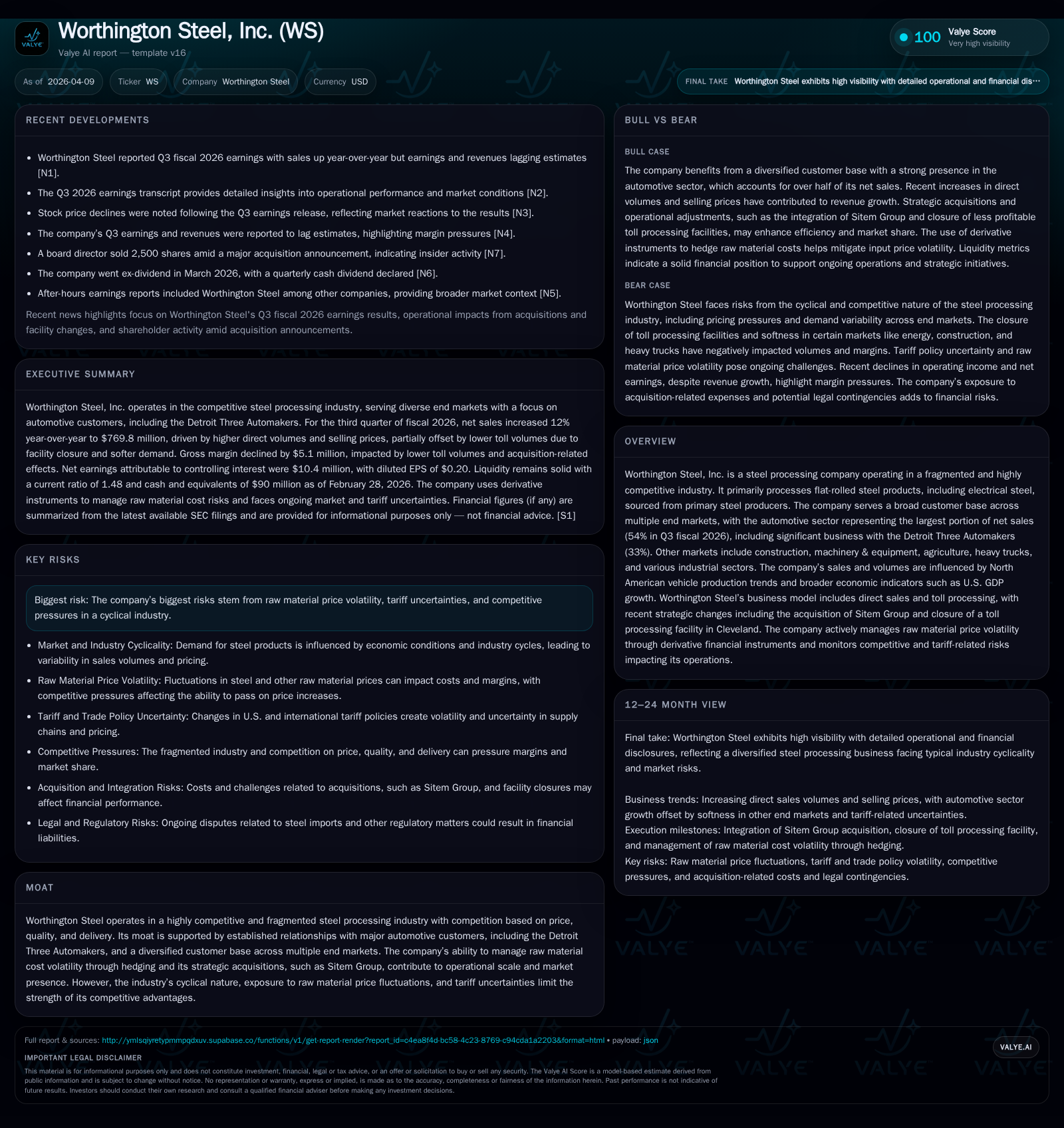
Worthington Steel, Inc. operates in a highly competitive steel processing sector, with the automotive market, particularly the Detroit Three Automakers, accounting for over half of its sales in Q3 FY2026. Net sales increased by 12% year-over-year in Q3 FY2026 driven by volume gains and higher prices, but operating income declined due to lower toll volumes and elevated SG&A expenses linked to acquisition-related costs. The acquisition of Sitem Group expanded scale but introduced margin pressures and incremental debt. Worthington Steel maintains solid liquidity supported by operating cash flow and credit facility availability, funding strategic investments and dividend payments. Future growth depends on sustaining automotive program share gains, integrating acquisitions successfully, managing raw material price volatility, and navigating the cyclical steel processing environment [S2][S4][S5][S11][S15][S16][S17][F1].
Company Overview
Worthington Steel is a leading North American steel processor specializing in flat-rolled steel products including electrical steel sourced primarily from major producers. Its diverse customer base spans automotive—which constitutes the largest segment—construction machinery & equipment, agriculture, heavy trucks, appliances among others [S2][S11]. The company operates via direct sales channels combined with toll processing services.
Automotive remains critical: the Detroit Three Automakers accounted for roughly 33% of consolidated net sales in Q3 FY2026, underpinning volume flows aligned with North American vehicle production trends [S13][S14].
Historical Performance
Annual revenue declined from approximately $3.43 billion in FY2024 to $3.09 billion in FY2025 (-9.8%), while operating income fell more sharply from $194.5 million to $147.0 million (-24.4%), indicating margin pressure [F1]. Net income decreased by 28.4% to $110.7 million [F1]. Despite this top-line contraction during cyclical headwinds, operating cash flow improved 15% to $230.3 million due to working capital management improvements [F1]. Capital expenditures rose 26% to $130.4 million supporting strategic initiatives including expansion projects [F1]. Dividend payouts increased markedly from $7.9 million in FY2024 to $31.9 million in FY2025 [F1].
Recent Quarterly Highlights (Q3 FY2026)
Net sales grew 12% year-over-year to $769.8 million driven by a 4% rise in direct volumes—equally split between legacy operations and Sitem Group acquisition—and a 9% increase in direct selling prices [S15][S16]. Toll volumes declined by 22%, reflecting the May 2025 closure of the Cleveland toll processing facility and softer mill customer demand [S15][S16][S24].
Operating income plunged from $18.3 million to $3.1 million largely due to lower toll profitability and an estimated negative impact of $3.2 million related to integrating Sitem Group operations [S15][S16]. Gross margin softened as higher direct spreads partly offset declines in toll spreads; inventory holding gains contributed positively during fluctuating steel prices [S16][S19]. SG&A expenses increased over 40%, driven by approximately $15 million in acquisition-related professional fees plus a one-time bonus near €4 million (~$4.6M) paid upon closing Sitem Group acquisition [S16][S22]. Asset sales related to the Cleveland facility generated a pre-tax gain of about $6 million improving non-operating results [S26]. Equity income from the Serviacero Worthington joint venture rose significantly by about $16 million compared with prior periods indicating improved performance of unconsolidated affiliates [S17].
Industry Environment
The fragmented steel processing industry is intensely competitive on price, quality, and delivery reliability [S2]. Demand cyclicality closely tracks automotive production schedules where Worthington holds significant market share; raw material cost volatility—especially hot rolled coil pricing—and tariff uncertainties remain key risk factors affecting margins and supply chain stability [S20][N6].
Expanding electrical steel operations through acquisitions like Sitem Group aims at diversifying product offerings into transformer markets alongside core automotive sectors across North America including Canada and Mexico [N5][S27].
Capital Allocation & Financial Position
As of February 28, 2026, Worthington held roughly $90 million cash equivalents plus access to a revolving credit facility permitting up to $550 million borrowings secured against eligible receivables/inventory; net borrowings were about $193 million leaving approximately $150 million available capacity post-borrowing base adjustments [S4][S5][S12].
Operating cash flow totaled $156.3 million over nine months ending February 28, 2026; investing outflows were significant at $170.1 million driven by equity purchases (including Kloeckner shares), capital expenditures supporting capacity expansions, and net acquisitions primarily Sitem Group ($1.6M) [S4][S7]. Free cash flow remained positive near $99 million on an annualized basis subtracting capex from CFO per latest fiscal data [F1].[F1]
Dividend distributions rose substantially reflecting management confidence though no share repurchases occurred during this period signaling focus on reinvestment over buybacks currently [F1][S25]. Debt financing risks relate principally to acquisition funding requirements including bridge loan commitments nearing $1.9 billion for proposed Kloeckner purchase with interest cost exposure amid fluctuating market rates despite recent Federal Reserve easing moves; financial covenant compliance remains intact without dividend or capital spending restrictions so far [S6][N5].
Outlook & Risks
Growth will depend on maintaining or expanding share within automotive customers adjusting program schedules post prior production cuts; successful integration of acquisitions addressing margin headwinds such as those seen with Sitem Group; managing inventory holding gains/losses amid volatile steel prices; navigating supplier consolidation limiting alternate raw material options; mitigating tariff-related supply chain volatility arising from evolving trade policies post recent Supreme Court rulings on Section 232 tariffs [N2][N6][S19][S20].
Non-automotive end markets show varied demand patterns generally aligned with moderated U.S GDP growth rates but are vulnerable especially within energy project segments where solar program reductions have impacted volumes alongside continued weakness observed in heavy truck sectors [S14][S24]. Monitoring Detroit automaker production trends alongside raw material price pass-through effectiveness will be critical for near-term financial performance.
Summary Table: Recent Annual Financial Overview
Historical performance (annual)
| FY | Rev ($bn) | Net ($mm) | CFO ($mm) | OpInc ($mm) | Rev YoY | Net YoY |
|---|---|---|---|---|---|---|
| 2025 | 3.1 | 111 | 230 | 147 | -9.8% | -28.4% |
| 2024 | 3.4 | 155 | 200 | 195 |
Source: SEC companyfacts cache [F1].
Capital returns and efficiency (annual)
| FY | Div ($mm) | FCF ($mm) | ROE% |
|---|---|---|---|
| 2025 | 32 | 100 | 10.3 |
| 2024 | 8 | 96 | 15.7 |
Source: SEC companyfacts cache [F1].
Fiscal years end May 31; figures rounded
This analysis integrates public filings through April 2026 capturing Worthington Steel’s operational metrics amid ongoing strategic shifts and typical cyclical challenges faced by steel processors.
Disclaimer: This document is informational only and does not constitute investment advice.
Disclaimer: This is research-only, informational analysis and not investment advice. It may include AI-generated interpretation and general industry context. Always verify important details using primary sources.

Comments