
Pioneer Acquisition I Corp's IPO Capital Fuels Acquisition Capacity and Near-Term Risks
Pioneer Acquisition I Corp’s strong IPO proceeds underpin its acquisition firepower while time-limited deal execution risks persist.
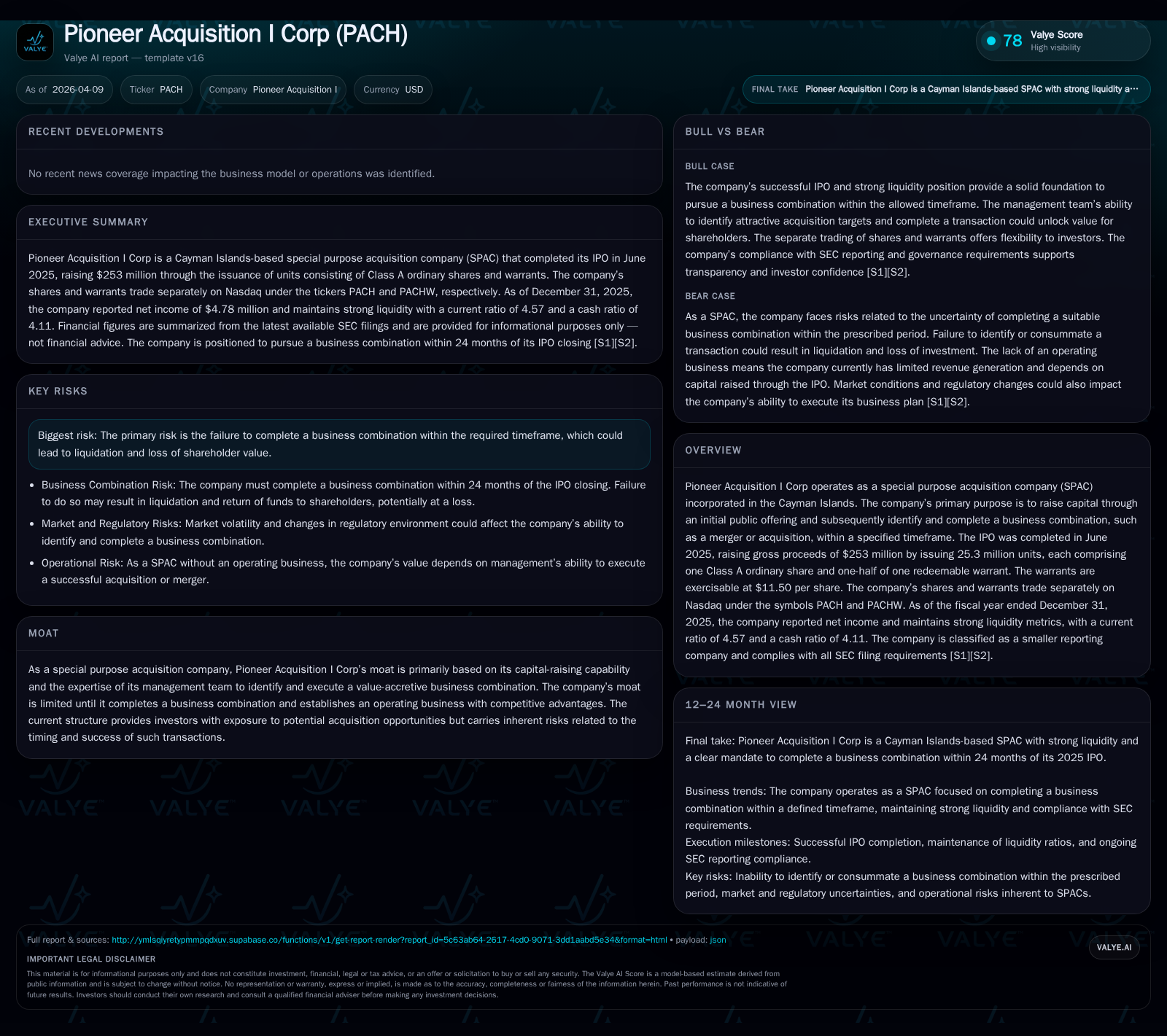
Founded as a Cayman Islands-based SPAC, Pioneer Acquisition I Corp completed its IPO in mid-2025, raising $253 million through units combining Class A ordinary shares and redeemable warrants exercisable at $11.50. With no operating business yet, it reported positive net income for fiscal year 2025 despite negative operating income due to start-up costs. Robust liquidity, reflected in a current ratio of 4.57, provides the capital foundation for imminent acquisition activity. However, the SPAC faces the inherent risk of liquidation if it fails to consummate a business combination within its stipulated timeframe. The company’s real moat lies in management’s expertise to source value-accretive deals before establishing an operational foothold.
From IPO Proceeds to Operating Reality: Analyzing Early Financial Performance
Pioneer Acquisition I Corp completed its initial public offering (IPO) in June 2025, issuing 25.3 million units at $10 per unit to raise gross proceeds of $253 million [S4]. Each unit consists of one Class A ordinary share plus half a redeemable warrant, with each whole warrant exercisable at $11.50 per share [S1]. Concurrently, the company sold private placement warrants to sponsors and underwriters totaling millions more units, aligning stakeholders’ interests [S12], [S17].
Despite having no operating business during fiscal year 2025 — typical for SPACs prior to business combinations — Pioneer reported net income of approximately $4.78 million while showing an operating loss near $560,000 [F1]. This result arises because operating income is burdened by start-up costs such as legal, administrative, and underwriting fees with no offsetting revenues. Meanwhile, net income benefits from non-operating items including interest income earned on funds deposited in the trust account.
Historical performance (annual)
| FY |
|---|
| 2025 |
Source: SEC companyfacts cache [F1].
This table presents key financial metrics from Pioneer Acquisition I Corp's first full fiscal year post-IPO [F1], highlighting characteristic SPAC profiles: absent revenue but positive net incomes driven by trust-account yields.
Liquidity Strength and Capital Structure: Preparing for Future Deals
The cornerstone of PACH's capacity to transact imminently is its liquidity position post-IPO. As of December 31, 2025, current assets stood at approximately $850,498 against current liabilities of about $186,278 — yielding a current ratio of 4.57 [F1]. The majority of these assets consist of cash equivalents secured in a U.S.-based trust account managed under strict investment management agreements that preclude fund access except under specific conditions tied to consummation or failure of the initial business combination [S4], [S18], [S19].
This robust liquidity profile evidences 'dry powder' readiness enabling substantial deal execution leverage without immediate funding constraints.
The capital structure includes Class A ordinary shares trading separately on Nasdaq under ticker PACH, alongside redeemable warrants under PACHW which are exercisable at $11.50 per share [S8], [S21]. Private placement warrants issued to sponsors further solidify incentive alignment while potentially diluting equity upon exercise [S12], [S17]. These combined factors constitute a well-managed equity and equity-option framework typical for contemporary SPACs aiming to maximize capital allocation flexibility.
Risks Embedded in the SPAC Model: Time Constraints and Shareholder Value
Pioneer Acquisition I Corp operates under the classic SPAC mandate requiring identification and completion of a qualifying business combination within 24 months following the IPO closing date [S1]. Failure to meet this 'timebox risk' triggers mandatory liquidation wherein trust account funds—net of dissolution costs—are returned to shareholders [S2], introducing hard downside risk.
SPAC investors additionally face redemption rights exercisable before any merger consummation; such redemptions can influence deal structuring by reducing available working capital post-business combination announcement. The absence of operational cash flow or tangible moat compounds reliance on timely execution and sponsor efficacy.
These factors underscore how investors remain exposed not only to market risks but also structural limitations inherent in SPAC lifecycle dynamics.
Management Expertise as the Driving 'Moat' Before Acquisition
Before establishing operational presence through acquisition, Pioneer’s primary competitive advantage derives from its sponsor group’s ability to source attractive targets amidst a saturated SPAC environment. Management alignment via private placement warrants and sponsorship arrangements fosters commitment toward securing accretive deals that can deliver differentiated value.
This emphasis on 'deal sourcing capabilities' and strategic PIPE (private investment in public equity) placement execution aligns early shareholders’ interests closely with long-term success incentives—a core pillar sustaining any meaningful moat pre-combination.
Forecasting Milestones: What Comes Next in Pioneer’s Path
No explicit public announcements concerning formal target companies or scheduled merger timelines have been released as of latest filings [N#], leaving external observers reliant on regulatory mandated deadlines.
Investors should monitor key upcoming milestones such as:
- Announcement windows approaching the two-year mark from IPO close,
- Shareholder meeting notices for vote approvals once targets are identified,
- Potential partial or full exercise periods for warrants affecting dilution,
- Updates on redemption election procedures pre-deal closure.
Understanding these event horizons is critical given their direct impact on liquidity events and shareholder value realization.
Capital Allocation Strategy: Cash Position, Warrants, Dividends, and Buybacks
Capital allocation remains conservative pending business combination completion. The bulk of IPO proceeds resides within the trust account restricted from operational deployment except for limited permitted expenditures like tax liabilities or dissolution costs [S3], [S15].
No dividends or share repurchases have been issued or contemplated prior to acquisition given fiduciary obligations tied to preserving capital integrity for transaction financing purposes [S9], [S21].
Warrant exercise terms maintain an $11.50 strike price; private placements issued to sponsors potentiate equity dilution but also align sponsor incentive structures toward consummating value-enhancing transactions without prematurely draining trust account resources [S12], [S17].
Overall capital discipline mirrors best practices across smaller reporting company SPACs prioritizing liquidity preservation over return-of-capital strategies ahead of operational phase transitions.
Investor Takeaways: Monitoring Key Upcoming Catalysts
The fundamental investment narrative centers on Pioneer Acquisition I Corp’s prudent capital base stemming from its sizeable IPO proceeds coupled with robust liquidity ratios that provide strong backing for imminent deal activity.
Absent operational revenues or traditional moats until a qualifying combination completes, the company's valuation hinges heavily on management's upcoming announcements around target identifications and shareholder votes.
Key watchpoints include expiration timelines for executing combinations before triggering liquidation risk alongside any movements in warrant structures influencing dilution.
For investors tracking Pioneer Acquisition I Corp up-to mid-2026, performance will largely reflect execution competency navigating these structural mandates rather than organic financial growth.
This report synthesizes publicly filed SEC documents up to April 9, 2026 without speculative assumptions or investment recommendations. It focuses strictly on disclosed facts concerning Pioneer Acquisition I Corp's IPO proceeds utilization, financial performance metrics from its first fiscal year ending December 31, 2025, liquidity profile supporting acquisition capacity, risk factors inherent to the SPAC model including time constraints on closing deals, management's role as pre-merger competitive advantage holder, forecasted milestone monitoring parameters, as well as explicit capital allocation policies related to cash holdings and warrant terms detailed in filings referenced herein.
Disclaimer: This is research-only, informational analysis and not investment advice. It may include AI-generated interpretation and general industry context. Always verify important details using primary sources.

Comments