
Cumulus Media's Strategic Rebuild: Revenue Drivers, Financial Health, and Future Challenges
Analyzing Cumulus Media’s operating evolution, capital pressures, and strategic moves amid a complex media landscape.
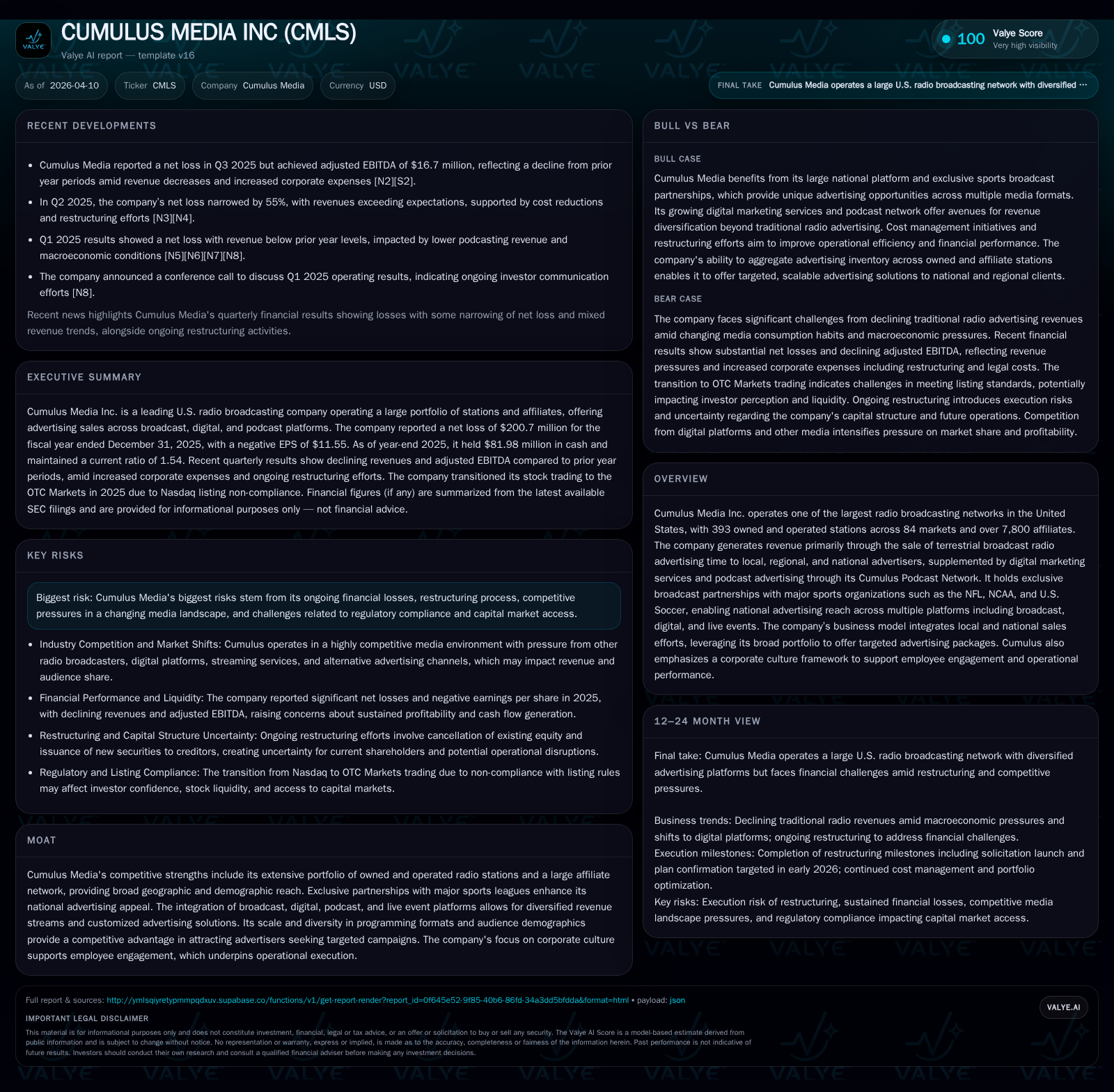
Cumulus Media operates a vast terrestrial radio network with strong national sports partnerships and a growing digital presence. While its broad portfolio and multi-platform sales approach diversify revenue streams, the company has faced deteriorating profitability and operating losses over recent years, culminating in significant balance sheet stress. Its capital structure reveals refinancing challenges amid debt maturities in 2026, prompting active restructuring efforts. Monitoring cash flow trends, podcast growth, and the effective execution of its turnaround strategy will be crucial for assessing near-term sustainability.
From Growth to Losses: A Historical View of Cumulus’ Financial Performance
Cumulus Media's financial trajectory over the past four years exhibits a troubling shift from profitability into deep losses. In fiscal year (FY) 2022, the company reported an operating income of $79.8 million followed by positive net income of $16.2 million. However, this position deteriorated steadily with operating income flipping to negative $41.3 million in FY2023, then plunging further to negative $239.7 million in FY2024 and negative $138.1 million by FY2025 end. Net income mirrored these trends, expanding losses from $117.9 million in FY2023 to $283.3 million in FY2024 before narrowing slightly to a $200.7 million loss in FY2025.
Operating cash flow (CFO) similarly declined from positive $78.5 million in 2022 to negative $21.3 million in 2025 — representing a highly deteriorated operational liquidity situation compounded by capital expenditures near historical lows but still above cash flows leading to free cash flow deficits (approximately -$41.5 million in FY2025). Meanwhile, equity shrank sharply into negative territory at -$191.5 million by 2025's close from a positive base exceeding $408 million three years prior, signaling stress on shareholder value and balance sheet solvency that aligns with evolving restructuring needs [F1].
Historical performance (annual)
| FY | Net ($mm) | CFO ($mm) | OpInc ($mm) | Capex ($mm) | Net YoY |
|---|---|---|---|---|---|
| 2025 | -201 | -21 | -138 | 20 | +29.1% |
| 2024 | -283 | -3 | -240 | 19 | -140.3% |
| 2023 | -118 | 32 | -41 | 25 | -826.1% |
| 2022 | 16 | 78 | 80 | 31 |
Source: SEC companyfacts cache [F1].
Capital returns and efficiency (annual)
| FY | Buybacks ($mm) | FCF ($mm) | ROE% |
|---|---|---|---|
| 2025 | -42 | 104.8 | |
| 2024 | 0 | -23 | -4075.0 |
| 2023 | 8 | 7 | -41.1 |
| 2022 | 32 | 47 | 4.0 |
Source: SEC companyfacts cache [F1].
The sharp contraction followed substantial impairments and restructuring-related charges reported over the last three years reflecting an aggressive response to top-line pressure points amidst broader industry shifts.
Business Model Nuances: Integrating Local Spots, National Sales, and Digital Platforms
Cumulus Media leverages an expansive portfolio comprising approximately 393 owned-and-operated radio stations across 84 U.S. markets plus over 7,800 affiliate stations nationwide. The model integrates local spot advertising—sold directly by market-focused sales teams—with regional and national sales coordinated via Katz Media Group nationally.
Local sales executives engage advertisers with telecast ad inventory including on-air spots complemented by digital marketing products such as geo-targeted display ads and social media management services designed to supplement radio buys locally. National sales bundle inventory across O&O stations and affiliates enabling scale-based packages targeting broad or segmented audiences tailored by geography or demographic category.[S20]
A unique pillar within this structure is exclusive broadcasting rights obtained for marquee live sports programming—NFL games through Westwood One network along with NCAA college sports and U.S Soccer events—which afford Cumulus an elevated platform to attract premium national buyers beyond standard terrestrial radio reach.[S1][S20]
The company's proprietary podcast network further broadens its multi-platform footprint enabling advertisers digital audio placement synergistic with broadcast campaigns producing integrated marketing solutions spanning traditional radio spots to streaming podcasts.
Such diversity allows the company to address shifting listener consumption patterns while packaging granularly targeted advertising solutions spanning multiple media touchpoints within one unified sales approach.
Capital Structure Review: Navigating Debt Maturities and Liquidity Constraints
Cumulus faces critical capital structure pressures centered on refinancing maturing obligations primarily due in calendar year 2026 under its Term Loan credit agreement and Senior Notes.[S4][S5] Responding proactively, Cumulus completed exchange offers during May 2024 converting a large portion of its maturing Term Loan due in September/October 2026 into new senior secured loans due May 2, 2029.[S8][S9]
Meanwhile it executed a similar exchange rolling forward Senior Notes due in mid-2026 into new Senior Secured First-Lien Notes maturing in May-2029 with fixed coupon around 8.00%.[S9]
Despite these extensions alleviating immediate maturity walls through mid-2029 for much principal exposure a material tranche remains outstanding tied to earlier credit facility terms requiring careful liquidity management.[S12] Cash reserves approached nearly $82 million end-2025 but operating cash outflows as well as restrictions stemming from debt covenants complicate flexibility allowing little room for error especially under tightening market credit conditions impacting issuance costs or accessible leverage increments.[S4][S5][S6]
The Company's revolving credit facility usage fluctuates providing short-term liquidity buffers but cannot substitute for long-term deleveraging needed given persistent operating losses coupled with sizeable interest expense burdens averaging nearly $49 million recorded during first nine months of CY25 according to SEC filings.[S18][S19]
Absent continuing cost controls or material revenue improvements refinance risk remains acute potentially exposing Cumulus to renewed market pressure or negotiated concessions unfavorable to shareholders.
Multimedia Revenue Streams: How Sports Partnership & Podcasting Supplement Traditional Radio
Exclusive annual deals granting Cumulus rights to broadcast NFL regular season games via the Westwood One Network provide strategic headline content attracting premier national advertisers seeking mass reach synchronized with high-engagement live sports audiences—an edge rarely replicable fully by localized competitors.[S1]
Complementary NCAA college football/basketball package rights add seasonal diversification while U.S Soccer league rights amplify newer audience segments digitally engaged sustaining advertiser pulls for soccer-centric demographics uncommon among conventional radio platforms.[S20]
Digital growth initiatives also ride on the company’s proprietary podcast network which hosts multiple genres extending advertiser penetration into rapidly growing digital audio consumption categories where ad loads command premium rates relative to conventional AM/FM spot buys.
However this segment recently faced challenges including attrition of certain podcast relationships reducing digital revenue by approximately $1.1 million during Q3 CY25 as per disclosures alongside mild streaming declines partially offset by gains in digital marketing service offerings.[S21] Successful scaling of podcast monetization remains key complementary growth avenue critical given structural headwinds confronting terrestrial spot revenues within consolidated local markets.
Strategic Restructuring Efforts: Progress Amid Cost Pressures and Market Competition
In early Q1 CY26 Cumulus filed material restructuring plans encompassing cancellation of all existing common stock equitably wiping prior equity holders out; concurrently issuing new convertible notes alongside new common shares aimed at stabilizing capital base under Bankruptcy Court supervision.[S14]
Management cites focus on reducing content costs via renegotiated broadcast agreements evidenced by content cost declines surpassing $16 million sequentially led by fewer revenue-sharing obligations plus personnel incentive adjustments reflecting leaner operations.[S21]
Competitive pressures remain relentless from both traditional rivals within saturated broadcaster clusters as well as digitally native platforms siphoning younger demographics ultimately limiting pricing power on core ratecard-based spot revenue sources reducing reinvestment capacity.[S29]
Margins benefit modestly from reduced corporate overhead allocations ongoing since mid-CY25 alongside selective real estate footprint shrinkage facilitating slight SG&A expense moderation despite rising trade/bad debt captured offsetting some gains.[S21]
Together these measures underpin ongoing turnaround efforts though success hinges on consistent execution aligned with revenue stabilization or growth initiatives across expanded integrated sales verticals.
What’s Next? Key Milestones, Watchpoints, and Forecast Considerations
Key near-term milestones encompass upcoming maturities unrelated to recently extended debt instruments demanding monitoring for refinancing path clarity or alternative financing avenues required post-plan confirmation given residual leverage constraints.[N3][S2][S3]
Investor focus should track sequential audience ratings shifts feeding advertiser spending sentiment along with metrics quantifying podcast monetization traction essential for diversifying revenue beyond linear broadcast spot reductions.
Additionally consent milestone completions related to Bankruptcy Court plan approvals projected imminently will materially influence operational stability permitting longer-term resource allocation confidence.[S14][N3]
Externally macroeconomic factors such as advertising budgets influenced by broader budget tightening cycles among key verticals like automotive or consumer discretionary sectors could either cap upside potential or exacerbate revenue pressure points inherent within legacy media exposure sets.
Capital Allocation Dynamics: Cash Flow Trends, Buybacks, and Return Metrics
Share repurchase programs have been suspended since expiration of authorization in mid-2025 due largely to covenant restrictions embedded within evolving debt agreements constraining discretionary capital deployment strategies applicable historically prior such constraints became binding.[F1][S22][S23]
Capex spending demonstrates disciplined restraint hovering near low double-digit millions range annually reflecting scaled back investment consistent with asset right-sizing initiatives though still essential for station maintenance plus technological upgrade requirements affecting audience retention capabilities.[F1][S28]
Operating cash flows have reversed into negative territory worsening sharply year-over-year underscoring operational stresses outpacing capex curtailment thus forcing reliance on financing sources rather than internal funds for funding working capital demands effectively suppressing free cash flow.
Given recurring net losses coupled with severely eroded equity bases showing negative shareholders’ funds indicating negative ROE situation classical for firms undergoing restructuring events,[F1] returns must be viewed cautiously pending clear evidence of sustainable profitability restoration post-restructuring execution.
This analysis synthesizes information from company filings without conjecture outside those evidentiary bounds. Readers should interpret findings within broader sector shifts impacting media companies transitioning from legacy radio models toward integrated multimedia platforms amid rapid audience preference evolution.
Disclaimer: This is research-only, informational analysis and not investment advice. It may include AI-generated interpretation and general industry context. Always verify important details using primary sources.

Comments