
Global AI's Growth Hinges on Agentic AI Platform Development and M&A Amid Liquidity Pressures
Global AI advances its enterprise-grade agentic AI platform while navigating early-stage risks and a strategic M&A program.
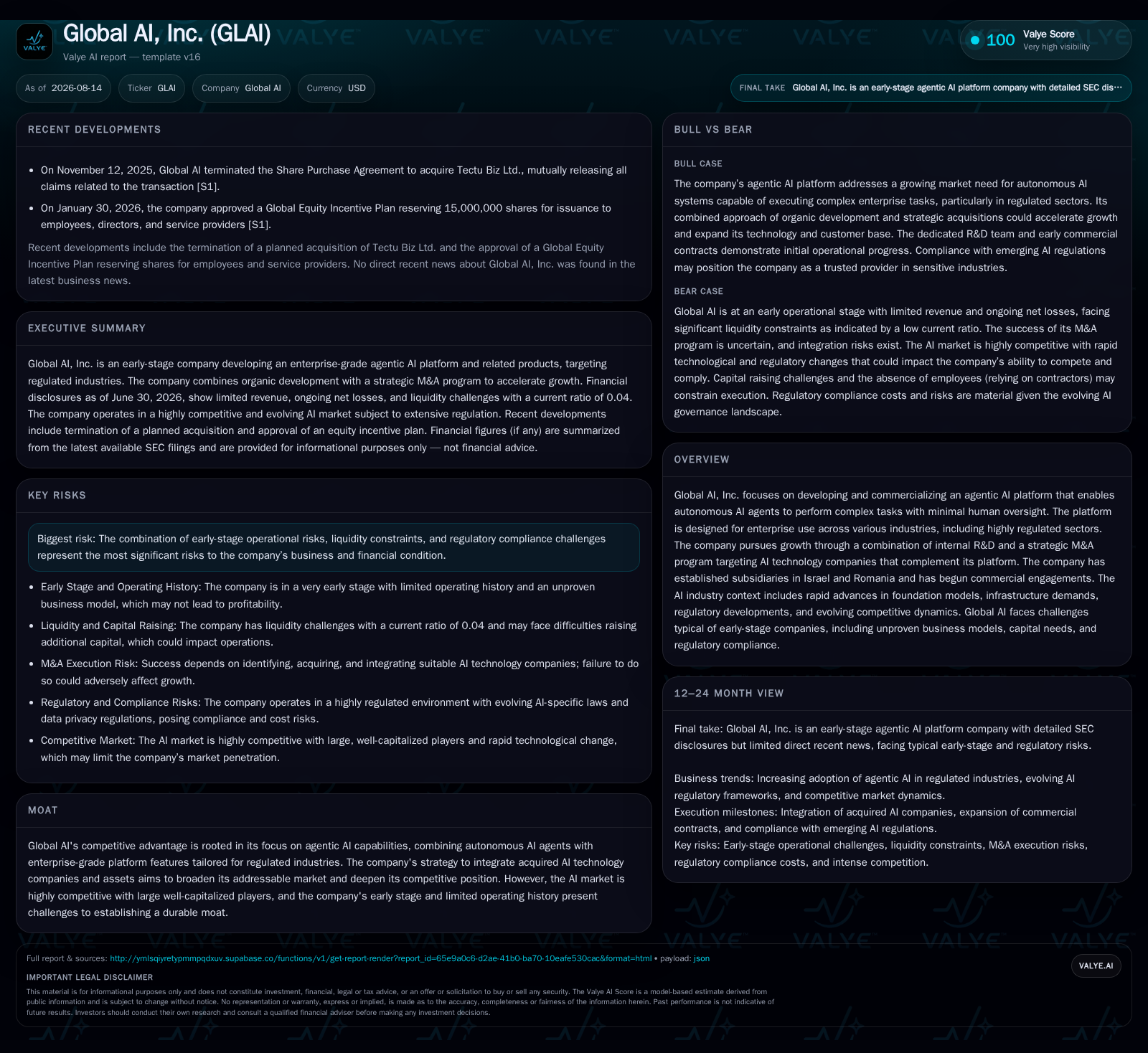
Global AI, Inc. is developing an agentic AI platform aimed at enabling autonomous AI agents to perform complex enterprise tasks with minimal human intervention. The company combines organic R&D and a strategic M&A program to expand its technology offering and market reach. Despite initial commercial engagements in regulated industries, Global AI remains early-stage with limited revenues and substantial operating losses. Its growth prospects depend on successful integration of acquisitions, regulatory compliance, and capital acquisition to sustain ongoing development and commercialization efforts.
Recent Operating Update: Q2 2026 Progress during Capital Infusion
The latest quarterly filing dated August 13, 2026, confirms continued focus on developing Global AI’s enterprise-grade agentic AI platform designed for autonomous multi-step task execution across regulated industries [S2]. Concurrently, the company disclosed a private placement completed with KSY Capital Investments resulting in issuance of 250,000 Class A shares for $500,000 at $2 per share [S3], suggesting ongoing efforts to extend runway during heavy investment.
This infusion aligns with the broader operational context where Global AI has begun commercial activities post-establishment of subsidiaries in Israel (December 2024) and Romania (September 2025), reflecting an emergent international footprint [S1], [S9]. However, revenue remains negligible ($24,896 for full year 2024) with operating losses continuing into late 2025 ($-2.3 million operating income; $-2.37 million net loss) [F1].
Business Model Analysis: Enterprise SaaS with Agentic AI Focus
Global AI’s core offering is an agentic AI platform—a software layer that enables autonomous AI agents capable of reasoning, planning, tool usage, and independent operation within digital/physical environments [S1], [S15]. This transition from passive conversational tools to active problem-solving marks a strategic positioning in the burgeoning agentic AI subsegment within enterprise software.
Revenue generation expects to follow typical Software-as-a-Service (SaaS) dynamics: enterprises acquire license subscriptions or usage-based access under multi-year contracts with renewal incentives. Given its target markets—banking, insurance, healthcare—there is a premium on compliance-heavy capabilities such as data privacy adherence (GDPR/CCPA) and auditability under emerging laws like the EU AI Act [S14], [S27].
The platform monetizes client deployment through factors driving Annual Recurring Revenue (ARR), notably customer onboarding rates, subscription fee levels influenced by seat counts or consumption metrics (API calls or active agents), plus professional services related to integration and governance oversight. Margins in this SaaS-driven model hinge on scale efficiencies in cloud infrastructure usage paired with controlled R&D expenses.
However, Global AI remains pre-scale: lack of historical proof points around ARR growth or retention rates leaves commercial viability uncertain. Early revenues primarily stem from small commercial agreements such as the first Israeli contract signed in late 2024 [S1]. Successful customer adoption will require demonstrating reliability and compliance to reduce churn risk amid competitive alternatives.
Industry Structure and Competitive Positioning
The enterprise AI software space inhabits multiple interlocking layers: foundation model creators (e.g., OpenAI), hyperscale cloud platforms (AWS/Azure), AI platform providers (Palantir/C3.ai), and vertical-specific solution integrators. Global AI situates itself as an integrator/operator upstream delivering proprietary agentic capabilities tailored for complex regulatory environments, a niche presenting both opportunity and barriers.
Competition is fierce given large incumbents with expansive budgets who can bundle foundational model access with cloud services or extensive ecosystems. Furthermore, legacy players embedding limited autonomous features into established enterprise software suites heighten buyer stickiness risks for smaller entrants.
Global AI attempts differentiation through a focused M&A strategy targeting startups possessing complementary technologies aligned with its agentic vision [S1], [S8]. This strategy mirrors industry patterns where inorganic growth accelerates technological breadth but bears integration risk—technical architecture mismatch or talent attrition could dilute value creation.
Growth Drivers: Agentic AI Demand Meets Strategic Acquisitions
Key expansion vectors arise from rising enterprise appetite for automation beyond assistive tools toward fully autonomous agents capable of executing workflows independently. This shift promises labor savings and efficiency gains crucial for sectors burdened by compliance overheads [S10].
Further growth catalysts include regulatory frameworks such as the EU AI Act enforcing trustworthy AI deployments that mandate comprehensive auditing—features well served by Global AI’s governance-oriented platform design [S14]. Regulatory-induced demand can become a competitive moat if effectively addressed.
Complementing organic R&D led by a team of 14 senior specialists [S1], the company’s active M&A program aims to acquire recurring revenue streams alongside talent integrating into its platform roadmap ([S1], [S8]). Successful acquisitions could accelerate ARR ramp-up and diversify product offerings across industry verticals.
Current liabilities markedly exceed current assets suggesting potential near-term funding pressure unless supplemented by capital raises or strategic financing [F1].
- Regulatory Complexity: Compliance costs from emerging international laws governing data use in high-risk AI systems may increase operational expenditures materially and limit product features until certification processes are complete [S14], [S27].
- M&A Integration Risks: Operational distractions from acquisitions could undermine organic development momentum; technical consolidation complexity may delay unified platform delivery; key personnel loss from acquired companies could impair innovation capacity [S7].
- Competitive Headwinds: Well-capitalized incumbents dominate foundation model training capability; the crowded marketplace requires building differentiated products quickly while managing longer sales cycles characteristic of enterprise adoption.
What To Watch Next: Milestones That Signal Traction or Trouble
Several upcoming markers will be instructive:
- Progression of pipeline deals through the M&A program including potential closings cleared under FTC/DOJ scrutiny,
- Quarterly updates revealing ramp in subscription revenues or securing larger enterprise contracts,
- Updates on regulatory compliance certification especially relating to the EU AI Act enforcement deadlines,
- Additional equity or debt financing rounds needed to shore up liquidity amid growing operating expenses,
- Product announcements evidencing successful integration of acquired technologies enhancing autonomous capabilities.
Financial Profile Discussion
As of the latest quarter ending June 30, 2026, Global AI holds $40,559 in cash and equivalents against current liabilities exceeding $7.8 million, creating a critical liquidity mismatch highlighted by a current ratio around 0.04—a severe imbalance indicating immediate funding requirements or asset restructuring must be addressed for continuity [F1]
These financial dynamics typify early-stage SaaS/enterprise AI startups investing heavily upfront while still validating business model viability amidst volatile market conditions.
Conclusion
Global AI pursues a technically ambitious yet capital-intensive path seeking to establish itself within the emerging agentic AI enterprise software domain targeting regulated industry clients demanding autonomy paired with stringent governance frameworks. The dual engine of organic product development backed by selective acquisitions offers potential scale advantages but carries integration complexity.
The rapidly maturing but fiercely competitive landscape dominated by resource-rich incumbents sets a high bar for proving durable competitive advantages.
Investors should monitor product-market fit validation through expanding recurring revenues alongside regulatory compliance achievements while being mindful that persistent operating deficits underline inherent nascent-stage risks tied to entire business model sustainability.
This analysis strictly reflects publicly filed SEC documents up to August 13, 2026 ([S1]-[S29]) complemented by company facts as of June 30, 2026 ([F1]) without projecting financial forecasts or providing investment research views.
Disclaimer: This is research-only, informational analysis and not investment advice. It may include AI-generated interpretation and general industry context. Always verify important details using primary sources.

Comments