
GBT Technologies Q2 2026: CEO Transition and Liquidity Challenges Amid Ongoing Operating Losses
GBT Technologies reports severe liquidity challenges and a CEO transition amid ongoing operating losses in Q2 2026.
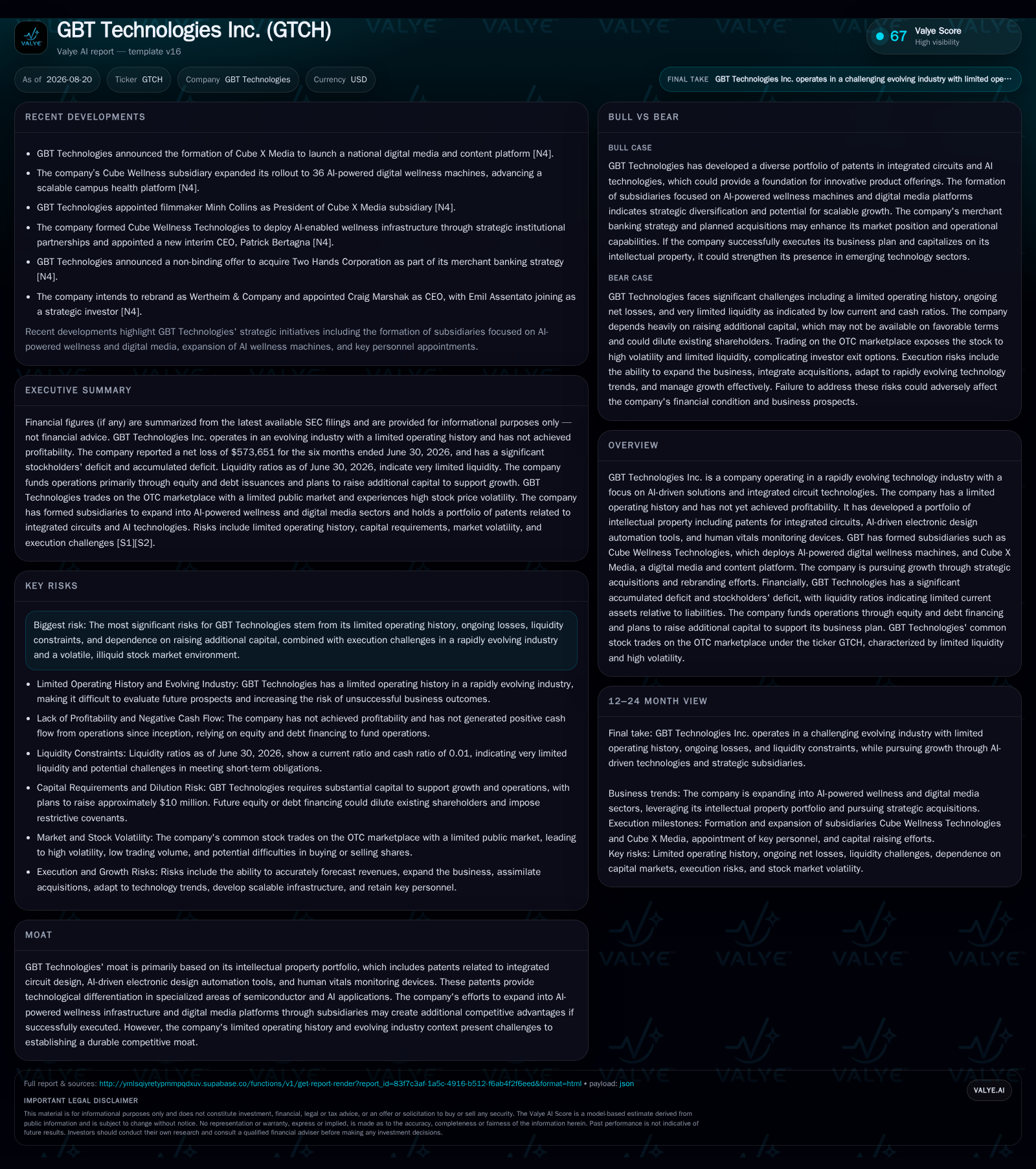
GBT Technologies Inc. appointed Minh Collins as CEO in July 2026 following the resignation of the prior CEO and sole board member. As of June 30, 2026, the company faced a critical liquidity shortfall, with a current ratio of 0.01 due to current liabilities exceeding $10 million against minimal current assets. The company continues to operate at a net loss, reporting $573,651 for the first half of 2026, underscoring ongoing execution and capital risks amid its development-stage AI-driven technology business model.
Q2 2026 Operating and Financial Update
GBT Technologies Inc. underwent a notable leadership change in mid-2026 with the appointment of Minh Collins as Chief Executive Officer effective July 16, 2026 [S3]. Collins previously served as President of Cube X Media, a wholly-owned subsidiary of GBT Technologies. This transition followed the resignation of the prior CEO and sole board member, Patrick Bertagna, signaling a potential shift in operational focus within the company. The appointment of a subsidiary leader to the CEO role may indicate an internal strategic realignment to leverage Cube X Media’s expertise in digital media and AI wellness platforms, potentially aiming to accelerate commercialization efforts in these segments [S3][S1].
Financially, the company reported a net operating loss of $573,651 for the six months ended June 30, 2026, continuing its history of unprofitability [S2]. This ongoing loss reflects the company’s development-stage status and lack of revenue generation. The balance sheet as of June 30, 2026, reveals current assets of $83,652 against current liabilities of $10,953,244, resulting in a current ratio of 0.01 [F1]. This extreme liquidity shortfall signals severe short-term financial stress, indicating that GBT Technologies is unable to cover its immediate obligations through existing liquid assets. Without successful capital raises or operational cash flow improvements, this liquidity crisis poses a critical threat to the company’s operational continuity.
Business Model and Intellectual Property Portfolio
GBT Technologies’ business model centers on the development of AI-driven integrated circuit technologies, electronic design automation (EDA) tools, and human vitals monitoring devices [S1]. The company’s subsidiaries, Cube Wellness Technologies and Cube X Media, expand its scope into AI-powered wellness machines and digital media platforms, respectively. These segments represent emerging technology markets with potential for innovation-driven growth. However, the company remains in a pre-commercial stage, with no finalized products generating significant revenue or positive cash flow.
The company’s intellectual property portfolio, consisting of proprietary patents related to its AI and integrated circuit technologies, forms the foundation of its competitive advantage. This portfolio could enable licensing opportunities or product differentiation if successfully commercialized. Nonetheless, the limited operating history and evolving industry dynamics introduce substantial execution risks. The company has historically funded its operations through equity and debt issuances, as it has not generated positive cash flow from operations.
The working capital deficit is acute, with current liabilities exceeding current assets by over $10 million, yielding a current ratio of 0.01 [F1]. This ratio is far below the generally accepted threshold of 1.0, indicating that the company lacks sufficient short-term assets to meet its liabilities. Such a liquidity position suggests significant short-term financial stress that could impair operational continuity without additional financing. The operating losses and negative cash flow exacerbate this risk, as normal business operations are unlikely to generate sufficient funds to bridge the gap.
The company’s capital structure and liquidity constraints limit its financial flexibility. Without successful capital raises or a turnaround in operating performance, GBT Technologies may face insolvency or be forced to curtail operations. This leadership change may reflect an intent to leverage subsidiary expertise to accelerate commercialization and monetization efforts in these areas. While this could potentially improve operational focus and resource allocation, the impact remains speculative without direct evidence of operational improvements or revenue growth.
This severe liquidity shortfall threatens operational continuity absent successful capital raises or significant revenue generation.
Scenario analysis highlights three plausible outcomes:
Bear case: If GBT Technologies fails to secure additional capital or generate meaningful revenue growth, it may face insolvency or be forced to curtail operations. This scenario is supported by the severe liquidity shortfall and ongoing losses. Confirmation would come from worsening liquidity ratios, announcements of operational cutbacks, or failure to meet debt obligations. Conversely, successful capital raises or revenue growth would refute this scenario.
Base case: The company maintains operations through intermittent capital raises while progressing development of its AI and integrated circuit technologies. Profitability remains distant, but survival is supported by historical funding patterns and ongoing technology development. This optimistic scenario depends on successful product launches, customer adoption, and improved operating cash flow. Confirmation would be quarterly filings showing revenue growth, new contracts, and positive cash flow.
Business Economics and Watchpoints
GBT Technologies’ business economics are heavily dependent on successful commercialization of its AI-driven integrated circuits, EDA tools, and digital wellness devices. Potential customers and partners would pay for technology products and services including AI-driven integrated circuits, digital wellness devices, and related intellectual property. Revenue mechanics would involve product sales, licensing of intellectual property, and digital media platform monetization. However, the company’s limited operating history and ongoing losses mean that these revenue streams remain prospective rather than realized.
Margins and cash flow conversion depend on the company’s ability to scale commercialization efforts and achieve market adoption [S1][S2]. Currently, the company incurs operating losses and negative cash flow due to its development stage and lack of finalized commercial products. Competitive advantage may derive from proprietary patents and technology development, but constraints include limited operating history, evolving industry risks, capital scarcity, and execution risks inherent in technology commercialization
Key watchpoints for investors and analysts include subsequent quarterly filings for revenue and cash flow trends, announcements of capital raises or refinancing, operational updates on product commercialization and subsidiary performance, and changes in liquidity ratios and working capital. Monitoring these indicators will be critical to assessing whether GBT Technologies can overcome its near-term financial challenges and progress toward sustainable operations.
In summary, as of Q2 2026, GBT Technologies faces significant structural challenges. The CEO transition may signal a strategic emphasis on digital media and wellness platforms, but the company’s critical liquidity shortfall and continued operating losses highlight the urgency of securing capital or generating revenue to sustain operations. Without successful execution on these fronts, the risk of financial distress remains high.
Disclaimer: This is research-only, informational analysis and not investment advice. It may include AI-generated interpretation and general industry context. Always verify important details using primary sources.

Comments