
Hotel101 Global Advances Global Growth With Madrid Opening and New Preferred Shares
Recent shareholder approvals for preferred shares and the operational launch of Hotel101-Madrid mark pivotal moments for Hotel101 Global's international expansion and capital flexibility.
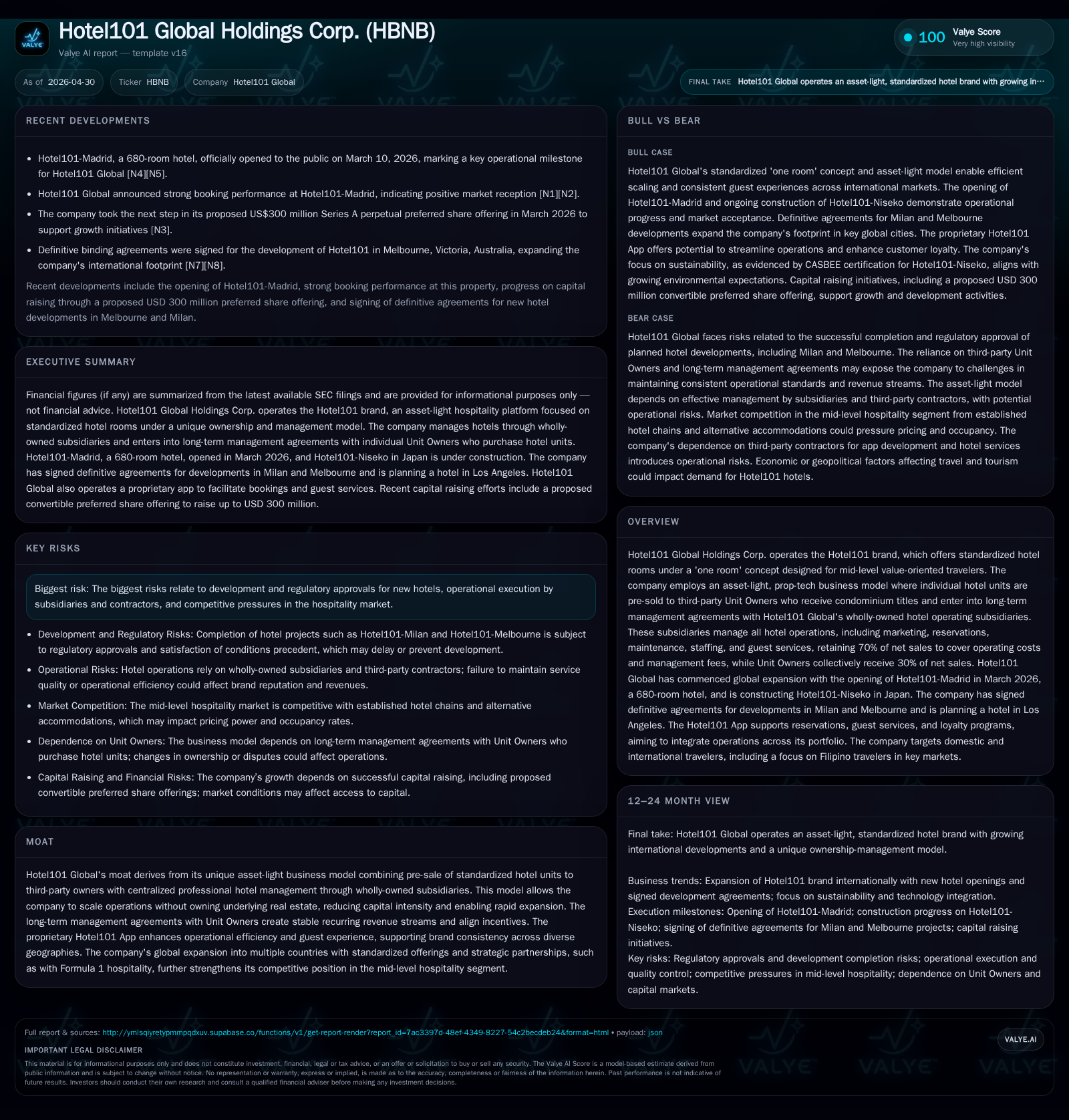
In Q1 2026, Hotel101 Global Holdings Corp. completed the opening of its flagship Hotel101-Madrid, a 680-room property that has shown strong booking performance early on, establishing the company’s foothold in Europe. Concurrently, shareholders approved a share redesignation enabling the issuance of preferred shares, enhancing capital raising capabilities. The company's hybrid condotel model leverages asset-light condominium unit sales to third-party owners combined with centralized hotel operations managed by wholly owned subsidiaries, producing recurring management revenues aligned with unit owner incentives. With ongoing developments in Japan, Italy, Australia, and planned expansion in the US, Hotel101 is poised to scale globally while navigating regulatory approvals and operational complexities.
April 2026 Quarterly Update: Operational Milestones and Capital Structure Moves
Hotel101 Global Holdings Corp. disclosed key developments in late April 2026 filings highlighting the operational commencement and immediate booking traction at Hotel101-Madrid as well as critical shareholder approvals enabling issuance of preferred shares. Hotel101-Madrid opened to the public on March 10, 2026 after construction was reported 96.88% complete as of year-end 2025 [S1]. Shortly after opening, the company announced robust booking performance indicating strong demand for this flagship European location [N1][N2].
On the capital structure front, an Extraordinary General Meeting held April 22, 2026 resulted in unanimous approval from nearly all voting shareholders to redesignate authorized share capital to simplify from Class A ordinary shares into a single class "Ordinary Shares" and empower the Board to issue one or more classes or series of preferred shares with designated rights including conversion, redemption, voting powers, and dividend preferences without needing further shareholder approvals [S3]. This move materially expands Hotel101’s future flexibility to raise capital via non-dilutive or preferential equity instruments suited for growth projects.
These twin developments—the Madrid launch establishing operational scale outside Asia-Pacific and enhanced board-authorized capital tools—set a strategic inflection for accelerating global rollout.
Unique Asset-Light Business Model Driving Recurring Revenue
Hotel101’s business architecture is distinctly hybrid: each hotel consists of standardized room units sold upfront to third-party Unit Owners who receive individual condominium titles. These owners enter into long-term (25–50 year) management agreements with the company’s wholly owned local hotel operating subsidiaries. These subsidiaries retain exclusive operational control over all facets including marketing, reservations, maintenance, staffing, guest services, renovations, utilities and capital spending [S1].
Revenue generated from gross room sales is split monthly on a net basis (after taxes such as VAT or tourism levies) with approximately 70% retained by operators covering operating expenses and management fees while Unit Owners share the remaining 30% distributed equally regardless of whether their unit was occupied in that period. This creates stable recurring cash flow streams anchored on occupancy-driven gross revenue while limiting Hotel101’s real estate exposure since asset ownership risk lies with Unit Owners.
The standardized 'one room' concept simplifies inventory homogeneity supporting streamlined maintenance schedules and branding consistency across markets. It also encourages price stability within mid-level traveler segments that prioritize value but expect quality assurances.
Competitive Advantages in the Mid-Level Hospitality Sector
Hotel101 competes primarily in the mid-tier hospitality sector targeting value-conscious leisure and business travelers. Its moat is derived from the triple-alignment mechanism: Unit Owners benefit passively via rental income from their condo-hotel units; centralized operational control under wholly-owned subsidiaries ensures brand standards are maintained; guests receive consistent accommodation experiences curated by proprietary technology including the Hotel101 App facilitating bookings and service customization across regions [S1].
Unlike traditional full-ownership hotel chains requiring material capital investment in real estate assets or pure franchising models that depend heavily on third parties for brand value delivery with variable quality assurance risks, Hotel101's condotel approach unlocks rapid scaling potential with reduced asset intensity.
Furthermore, multi-jurisdictional presence backed by localized companies helps navigate complex legal frameworks while keeping uniform service attributes intact—a notable differentiator against fragmented local operators or less integrated platforms. Strategic partnerships including hospitality tie-ins related to Formula 1 events add targeted visibility among global tourists critical for occupancy uplift during peak seasons.
Global Expansion Plan and Emerging Growth Catalysts
Following Madrid's opening, Hotel101 has active construction at Niseko in Hokkaido Prefecture targeting completion by December 2026; Niseko boasts CASBEE certification reflecting advanced sustainability standards highly regarded among eco-conscious travelers. The company secured definitive binding agreements for additional large-scale properties in Milan (429 rooms) expected for completion around 2028 with anticipated sales revenues near EUR85.8 million when fully sold [S1][S11][S21]. Similarly significant projects underway include Melbourne (766 rooms) slated for completion around 2029 located centrally within Australia's cultural district offering competitive amenities suited to leisure-business mixed travelers [S21][S22].
Los Angeles remains under planning subject to zoning approvals aiming at capturing domestic US travel demand supported by demographic synergies such as Filipino tourist inflows noted in disclosures [S9].
Marketing networks have been expanded globally with offices spanning Singapore, Philippines, Spain (now relocated to Madrid property), Dubai among others augmenting sales channels primarily focused on pre-selling condominium units to accredited investors aligned with regional compliance norms [S12][S22].
Industry tailwinds include steady post-pandemic recovery fueling urban travel demand especially mid-scale sector where affordability merges with professional service expectations. Real estate market dynamics favor condo-hotel hybrid structures that offer alternative passive income opportunities relative to traditional residential investments.
Risks: Regulatory Hurdles, Operational Execution, and Market Competition
Expansion exposes Hotel101 to development risks—obtaining timely permits while adapting designs compliant with heterogeneous jurisdictional building codes notably across Europe, Asia-Pacific and North America remains complex requiring skilled legal-advisory coordination [S1]. Failure or delay could materially affect project timelines leading to increased costs.
Operational risk arises from reliance on wholly owned operator subsidiaries interfacing daily with contractors; any lapses in maintaining brand quality standards or managing occupancy efficiently can reduce profitability impacting both operator share returns and unit owner sentiment.
Competitive pressures come from established multinational chains entrenched in target cities offering loyalty programs hard to dethrone alongside rising platform-based vacation rentals increasingly popular among younger travelers seeking unique lodging experiences challenging standardized product appeal. Pricing flexibility may be constrained due to fierce competition especially in mature urban markets reducing margin expansion.
Near-Term Catalysts and Key Monitoring Points
Investors should track booking velocity at existing hotels—Madrid’s initial strong booking report is encouraging but stabilization over subsequent quarters will confirm sustainable demand patterns per seasonality effects noted only emerging given limited operational history [N2].
Pre-sale progress within Milan and Melbourne projects will signal market acceptance of unit ownership pricing amidst broader macroeconomic conditions affecting discretionary spending.[S21]
Capital structure moves including timing and scale of preferred share issuances authorized will be pivotal to extending runway for development capex not reliant solely on debt which appears limited as per latest charter amendments enhancing equity flexibility.[S3]
Regulatory updates affecting entitlements especially in US jurisdiction Los Angeles will influence project start dates impacting medium-term revenue growth schedules.[S9]
Ongoing innovations linked to prop-tech app deployment underpinning guest engagement metrics will also indicate operational sophistication levels realized critical for long-term brand loyalty building.[S1]
This analysis adheres strictly to publicly filed data through late April 2026 focusing on operating developments anchored in SEC disclosures without providing investment recommendations.
Disclaimer: This is research-only, informational analysis and not investment advice. It may include AI-generated interpretation and general industry context. Always verify important details using primary sources.

Comments