
WeShop Holdings Commences U.S. Expansion, Leverages Social Commerce Innovation
Latest quarterly disclosures highlight WeShop’s push into the U.S. market amid liquidity tightness, emphasizing its unique equity-linked social commerce platform.
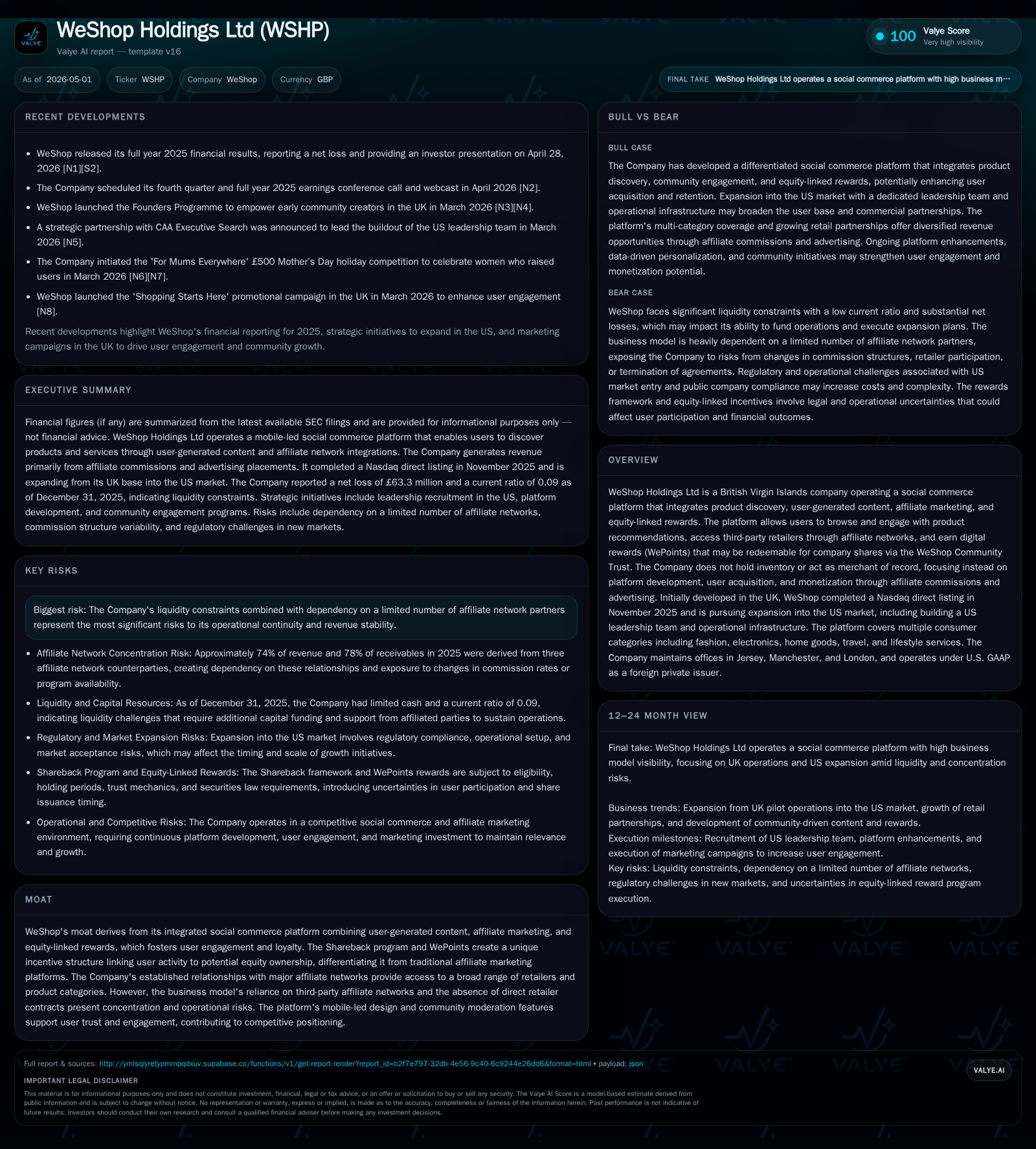
WeShop Holdings reported its full year 2025 operating results in April 2026, confirming ongoing strategic execution following its November 2025 Nasdaq listing. The company is actively building its U.S. operational footprint with leadership hires and infrastructure development, aiming to scale its integrated social commerce platform that combines affiliate marketing and equity-linked rewards. However, liquidity constraints remain a material risk given a stretched current ratio and dependence on a narrow set of affiliate partners. Growth hinges on executing the U.S. launch and expanding user engagement through innovative incentive mechanisms such as the Shareback program.
Latest Quarterly Update Drives Near-Term Outlook
In its April 28, 2026 Form 6-K filing [S2], WeShop Holdings provided its first major interim update since going public via Nasdaq direct listing in November 2025. The disclosure reiterates ongoing investment in operational infrastructure tailored for launching the WeShop social commerce platform in the United States—a strategic inflection point for scaling beyond its UK base. Notably, WeShop has engaged CAA Executive Search to lead U.S. leadership team recruitment [N3], reflecting a deliberate buildout of localized management essential for navigating the complex U.S. e-commerce regulatory environment and competitive landscape.
However, alongside expansion efforts, WeShop signals caution around its constrained liquidity profile with projected cash needs dependent on further fundraising or related-party support [S3]. While the majority of convertible notes were converted into equity during 2025 reducing debt stock [S16], working capital remains tight due to a current ratio approximating just 0.09 as of December-end [F1]. This underscores an urgent need for capital inflows to sustain ongoing platform development, marketing push, and operational costs.
Platform Overview and Business Model Dynamics
WeShop operates an integrated social commerce platform blending product discovery through user-generated content (UGC), affiliate marketing revenue generation, and an innovative equity-linked reward system [S14] [S17]. The core mechanism funnels users from content streams—featuring personalized feeds with tagged products—to third-party retailers via affiliate network links; successful transactions earn commissions payable through these networks back to WeShop.
Distinctively, WeShop’s model includes ‘‘WePoints,’’ digital rewards accruable from qualifying purchases or referral activity that may be converted into company shares under the Shareback program administered via the WeShop Community Trust [S14] [S23]. This equity incentive creates sticky user engagement by aligning users’ shopping participation with potential ownership upside—a stark departure from typical affiliate platforms that offer only monetary or coupon rewards.
Functionally heavy on mobile usage, the platform features social elements such as profiles, following mechanisms, wishlists, and community content sections intended to foster repeat engagement and organic membership growth [S14]. Because it does not hold inventory or process sales directly (no merchant-of-record role), WeShop avoids fulfillment complexity but simultaneously faces commission margin pressure inherent in relying on intermediary affiliate splits.
Competitive Ecosystem and Market Positioning
Within an increasingly crowded field bridging traditional e-commerce giants and emerging social commerce startups, WeShop competes amid legacy players like Amazon or eBay who control extensive retailer relationships alongside newer platforms leveraging influencer-driven discovery [S1]. Its moat lies chiefly in integrating equity participation incentives—a differentiator potentially amplifying long-term loyalty versus conventional commission-only platforms.
However, risk vectors include reliance on limited affiliate network partners rather than direct retailer contracts, introducing counterparty concentration challenges. Moreover, competitors benefit from substantially greater financial resources enabling aggressive customer acquisition spending or deeper integration across retail ecosystems [S1].
User trust is bolstered through community moderation features and transparent affiliation disclosure practices embedded in the platform design, yet brand recognition remains nascent outside initial UK markets.
Growth Catalysts: US Expansion and User Incentives
WeShop’s primary growth thrust centers on executing a successful American market launch throughout 2026 facilitated by newly recruited U.S.-based management [N3] aligned to tailor operations locally [S2]. The Founders Programme launched in Q1 targets early community creators in the UK as proof-of-concept for user engagement initiatives now set for U.S. rollout [N4][N5].
Amplifying this effort is continued enhancement of the Shareback rewards framework that uniquely ties user activity—shopping referrals and purchases—to potential equity stake accumulation over time subject to eligibility rules [S23]. This structure encourages increased platform stickiness quantified by resultant user retention metrics awaiting future reporting validation.
Expansion plans also contemplate broadening retailer reach via new affiliate network integrations encompassing diverse consumer categories such as fashion, electronics, travel services, and lifestyle products—a strategy aimed at elevating average transaction volume per user while growing advertiser tenancy revenue streams inside the app interface [S1].
Risks: Liquidity Constraints and Network Reliance
Despite promising structural innovations, WeShop confronts significant near-to-medium term risks primarily stemming from liquidity limitations evidenced by severely negative working capital dynamics (£554k current assets vs £6.4m current liabilities at year-end) resulting in a razor-thin runway without additional funding injections [F1] [S3].
Furthermore, operational dependence on a handful of large affiliate networks concentrates counterparty risk; failure or termination of any critical relationship could materially disrupt revenue flows given absence of direct retailer contracts. Competitive pressure from well-capitalized incumbents capable of eroding pricing power or rapidly scaling alternative influencer-driven models presents an ongoing threat [S1]. Lastly, successful U.S. expansion hinges on adeptly navigating regulatory compliance costs and achieving effective brand awareness within a new consumer environment—a challenge amplified under tight resource constraints.
Key Monitors: Performance Metrics and Execution Milestones
Investors and analysts will want to closely follow user-related KPIs as soon as they become available post-U.S. launch such as active daily/monthly users (DAU/MAU), average order value (AOV), referral-to-purchase conversion rates and WePoints award/redemption statistics reflecting both adoption depth and economic engagement intensity [S2]. Progression reported against planned management headcount milestones—specifically establishment of executive roles responsible for marketing, compliance and operations—is also indicative of execution momentum [N3].
Commercially, tracking advertising revenue growth rates as tenancy utilization firm up will illuminate monetization effectiveness alongside incremental affiliate commission expansion tied to increasing retailer diversity. Capital formation events—whether new equity raises or incremental borrower facilities—will signal runway extension capabilities vital for sustaining medium-term strategic objectives [S3].
Financial Footprint: Current Snapshot and Capital Needs
Latest financial snapshot
| Metric | Value | Period |
|---|---|---|
| Total debt | 340,072 GBP | |
| 2025-12-31 | ||
| Net debt | 340,072 GBP | |
| 2025-12-31 | ||
| Current assets | 554,123 GBP | |
| 2025-12-31 | ||
| Current liabilities | 6,386,733 GBP | |
| 2025-12-31 | ||
| Current ratio | 0.09x | |
| 2025-12-31 |
Source: SEC companyfacts cache [F1].
Total debt remains modest relative to scale at approximately £340k largely concentrated in notes payable; however current liabilities outstrip assets by more than tenfold culminating in a precarious current ratio near 0.09—highlighting acute liquidity strain without committed external financing support beyond affiliated lenders already providing advance commitments under loan facilities totaling over £1.7 million including recent increments in early 2026 cash advances [F1] [S12] [S16] [S15].
Given ongoing cash burn from technology development costs coupled with marketing outlays essential for U.S. traction-building activities, capital sourcing remains urgent with potential dilutive equity offerings or further related-party lending likely needed absent rapid improvements in operating cash flow metrics.
This analysis synthesizes currently available disclosures without projecting future outcomes or investment advice amid evolving operational developments at WeShop Holdings Ltd.
Disclaimer: This is research-only, informational analysis and not investment advice. It may include AI-generated interpretation and general industry context. Always verify important details using primary sources.

Comments