
Byline Bancorp Strengthens Loan Portfolio Quality and Local Market Focus in Q1 2026
Latest quarterly filings reveal Byline Bancorp's emphasis on credit quality management, diversified commercial lending, and stability via local market specialization.
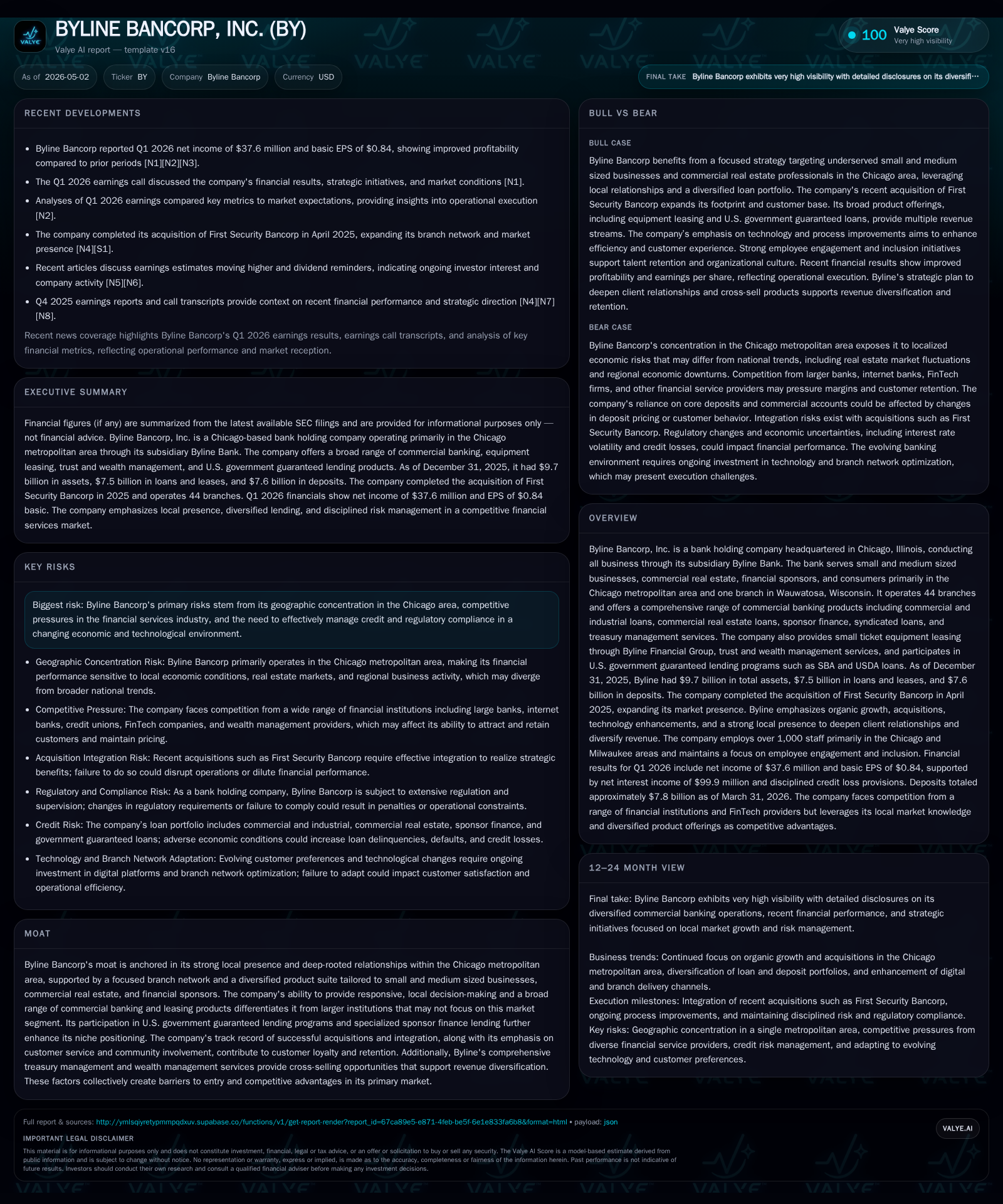
Byline Bancorp’s 10-Q for Q1 2026 highlights incremental growth in securities available-for-sale and a continued focus on managing credit risk amid its $7.5 billion loan portfolio concentrated in Chicago’s small and medium business segment. The bank strategically leverages its local charter and product mix—including commercial real estate, sponsor finance, SBA lending, and treasury management—to maintain differentiation against regional peers. Despite competitive pressures and geographic concentration risks, Byline’s niche in U.S. government guaranteed loans and equipment leasing rounds out its revenue streams. Local decision-making responsiveness and disciplined underwriting underpin its moat while acquisition integration remains a growth avenue. Near-term attention centers on loan credit performance trends, deposit base expansion, and regulatory compliance.
Recent Operating Update
Byline Bancorp's Q1 2026 Form 10-Q filing dated May 1 highlights several key operating details pivotal for assessing its present strategic and financial positioning [S2]. The bank reported an increase in available-for-sale securities at fair value to approximately $1.78 billion as of March 31, compared to $1.52 billion at December 31, 2025. This growth strengthens the bank's liquidity profile amid ongoing market uncertainties.
The filing did not reveal debt issuance or refinancing activity during the quarter; notably, companyfacts data confirms total debt stood at zero as of end-2025 with cash & equivalents near $198 million as of March 31, implying a net cash surplus on the balance sheet [F1]. This conservative leverage posture underpins funding flexibility.
A recent Form 8-K dated April 23 serves as an event update where Byline announced Q1 financial results along with investor presentations emphasizing continued execution against its strategic plan focused on Chicago’s small to medium-sized business community [S3]. Earnings calls around this period corroborate stable earnings trajectories supported by core banking activities [N1,N2,N3].
Business Model Overview
Byline Bancorp is a Chicago-based bank holding company conducting all operations through its subsidiary Byline Bank. The bank's business model centers on commercial banking products tailored to small and mid-sized enterprises (SMEs), commercial real estate developers/investors, financial sponsors (mainly private equity firms), alongside consumer banking services localized mainly in the Chicago metropolitan area plus a single branch in Wauwatosa, Wisconsin [S1].
Revenue generation hinges on net interest income derived primarily from originations of loans across multiple sectors: commercial & industrial (C&I), commercial real estate (CRE), sponsor finance loans supporting leveraged buyouts or recapitalizations in lower middle market companies nationwide, syndicated loan participations, plus government-guaranteed loan programs such as SBA and USDA offerings. Fee-based income arises from treasury management solutions bespoke for SME clients; trust and wealth management services; and small-ticket equipment leasing through wholly owned Byline Financial Group.
This multi-product approach enhances cross-sell penetration within existing client relationships anchoring deposit growth alongside loan origination volume. Notably, commercial deposits constitute a significant portion (43%) of total deposits—with these customers contributing over 85% of non-interest bearing deposit balances—underscoring high transaction volumes that support stable funding costs [S1].
Industry Structure and Competitive Position
Byline operates within the competitive mid-sized regional banking landscape anchored in Chicago—a dense banking market characterized by entrenched large national banks as well as local community banks.
Its moat derives principally from strong localized presence with deep customer ties fostered by responsive local decision-making capability and comprehensive product breadth targeted at SMEs underserved by larger national peers less agile or focused regionally. Its sponsor finance lending niche addresses private equity deals typically underserved by community banks but too granular for major national lenders.
Participation as one of the top SBA 7(a) lenders nationally but foremost in Illinois positions Byline favorably to access government-guaranteed loan pools that mitigate credit risk exposure—a meaningful advantage amid regional economic cyclicality [S1]. The leasing arm diversifies revenue into asset-backed finance orthogonal to traditional cash flow-based lending also raising switching costs.
Recent strategic acquisitions such as First Security Bancorp expand both branch footprint and client base within Illinois tightening market share without diluting operational focus [S1]. However, geographic concentration inherently amplifies macroeconomic sensitivities specific to Chicago-area economic cycles.
Growth Drivers
Market Expansion Through Acquisition
Executed acquisitions bolster scale allowing Byline to deepen client penetration within existing markets while selectively entering adjacent markets without overstretching resources. Successful integration remains critical to leveraging cost synergies and unifying technology platforms.
Cross-Sell Opportunities Within SME Segments
Byline's broad commercial product offering enables enhanced revenue per client through treasury services adoption alongside core lending products providing fee income diversification supporting margin resiliency.
Sponsor Finance Expertise
Specialization in private equity-backed lower middle market loans differentiates it versus typical community banks offering standard C&I financing only. This segment can command premium spreads reflecting higher underwriting complexity yet better risk-adjusted returns given collateralization structures.
Government Guaranteed Lending Programs
Maintaining robust SBA lending volumes stabilizes loan loss profiles due to federal guarantees while fostering strong referral pipelines among entrepreneurs seeking capital.
Technology-Enabled Process Improvements
Digital account opening capabilities extend customer reach beyond branch proximity increasing potential new client acquisition efficiency [S1]. Continuous investment in scalable back-office automation supports profitability gains at scale.
Risks and Watchpoints
- Geographic Concentration: Heavy reliance on Chicago metro exposes Byline to localized economic downturns impacting borrower creditworthiness notably in CRE or SME sectors.
- Credit Risk Management: Maintaining disciplined underwriting standards amid fluctuating economic conditions is crucial; misestimation could mandate increased loan loss reserves adversely affecting profits [S11].
- Regulatory Compliance: Banking regulations continue evolving with heightened scrutiny on anti-money laundering controls and consumer protection laws increasing compliance costs and potential litigation risks [S11,S14].
- Competitive Pressures: Larger banks possess more extensive balance sheets enabling broader product scopes while fintech disruptors challenge traditional deposit gathering posing margin pressure.
- Integration Risk: Acquisitions may strain operational focus if integration challenges escalate causing temporary earnings volatility.
- Interest Rate Sensitivity: While not explicitly detailed recently, margins are typically susceptible to shifts in short-term rates affecting net interest income dynamics.
What To Watch Next
Investors may monitor several key metrics emanating from upcoming quarterly releases:
- Trends in non-performing loan ratios especially across CRE and sponsor finance portfolios indicating emerging credit stress or resilience [S2].
- Deposit growth composition between commercial versus retail segments signaling success of local relationship management efforts.
- Net interest margin (NIM) fluctuations reflecting yield curve dynamics plus deployment into higher-yield loan segments or securities.
- SBA loan originations continuing strength demonstrating sustained access to government-guaranteed low-risk assets.
- Regulatory updates or enforcement actions impacting capital adequacy or dividend capacity given dependence on dividends from the bank subsidiary [S4].
- Progress on cost efficiencies or technology platform upgrades enhancing customer experience or operating leverage.
Financial Profile Summary
Latest financial snapshot
| Metric | Value | Period |
|---|---|---|
| Cash & equivalents | $198mm | |
| 2026-03-31 | ||
| Total debt | 0 USD | |
| 2025-12-31 | ||
| Net debt | $-198mm | |
| 2025-12-31 |
Source: SEC companyfacts cache [F1].
A snapshot from latest filings reveals: FY 2025 |
The absence of debt coupled with substantial liquidity cushions implies balance sheet strength providing flexibility for organic growth or opportunistic acquisitions without immediate capital raises [F1,S2,S4]. Retained earnings underpin healthy equity levels empowering dividend distributions from the banking subsidiary necessary for holding company operations [S4].
Conclusion
Byline Bancorp enters mid-2026 positioned as a locally entrenched regional bank with diversified commercial lending capabilities augmented by specialized sponsor finance expertise and government guaranteed programs serving SMEs predominantly in Chicago. Its growth strategy hinges on prudent acquisitions complementing organic expansion driven by cross-selling comprehensive product suites enabled by technology.
While competitive pressures from larger banks remain constant alongside evolving regulatory environments posing compliance demands, Byline’s demonstrated underwriting discipline and strong relationship banking underpin resilience. Stakeholders should track credit quality trends closely given geographic concentration risks while evaluating progress on deposit base build-out as indicators of sustainable funding cost advantages. Overall, the company’s strategic focus on being Chicago’s preeminent commercial bank aligns it well for continued measured growth provided risk controls remain intact.
This analysis does not constitute investment advice but aims to provide an informed industry perspective based on recent SEC filings and company disclosures.
Disclaimer: This is research-only, informational analysis and not investment advice. It may include AI-generated interpretation and general industry context. Always verify important details using primary sources.

Comments