
Spok Holdings Advances Clinical Communications Amid Q1 Underperformance
Despite missing Q1 revenue and earnings estimates, Spok pursues strategic realignment focusing on integrated communication solutions and cost optimization.
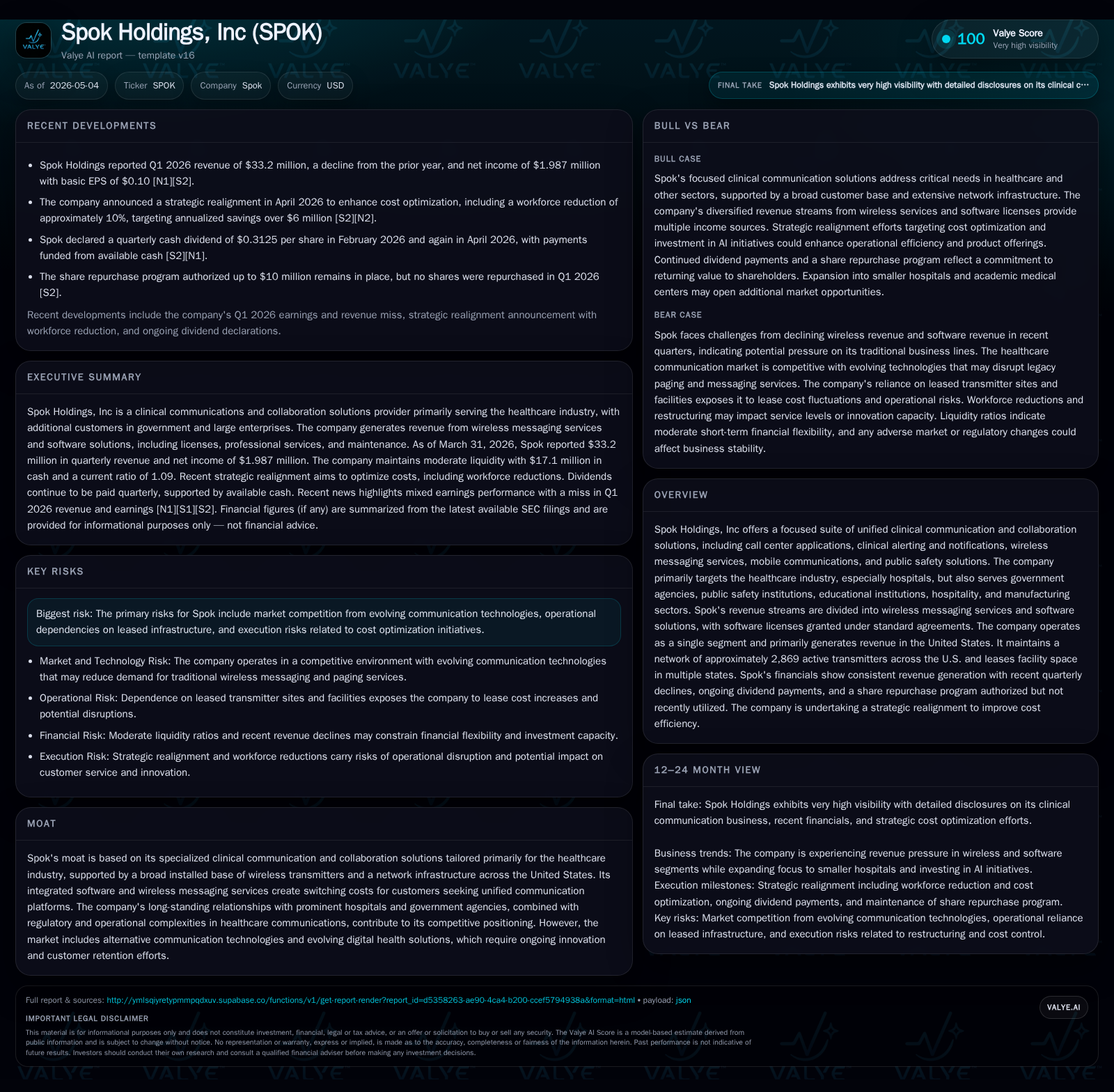
Spok Holdings reported a notable miss in Q1 2026 revenue and net income, driven by declines in both wireless and software segments amid intensifying competitive pressures. The company continues to serve primarily healthcare organizations with unified clinical communication offerings combining wireless messaging with software platforms. Recent strategic realignment aims to reduce workforce and costs by 10%, directing resources towards software innovation and AI enhancements. Spok’s entrenched network infrastructure of transmitters across the US supports switching costs, although dependency on leased sites presents operational risks. Growth catalysts include expanding software bookings and targeting smaller hospitals, balanced against risks from evolving digital health competitors and fixed infrastructure expenses.
Q1 2026 Operating Update: Challenges and Continuities
Spok Holdings’ first quarter of fiscal 2026 underscored persistent headwinds in its dual-segment clinical communications business. Revenue totaled $33.2 million for the quarter ending March 31, down 8.5% year-over-year (YoY) from $36.3 million in Q1 2025 [S2]. Declines were broad-based: wireless revenue dipped 5.3% to $17.5 million while software revenue suffered an even sharper fall of 11.7% to $15.7 million [S2]. This shortfall translated into a steep drop in operating income, which contracted by nearly 60% to $2.4 million from $6.0 million a year prior, partly due to elevated severance and restructuring expenses which quintupled to $322 thousand in the quarter as the company began executing a strategic realignment aimed at cost optimization post-quarter end [S2][S3].
Despite these results being below consensus estimates reported on April 29 by Nasdaq sources [N1], Spok management emphasized that the softness was influenced by transient factors such as timing variability in bookings and transitional cost investments consistent with repositioning efforts [N2]. Bookings for software contracts remain sturdy, bolstered by three new logo acquisitions in recent quarters reflecting incremental strength outside Spok’s traditional large-hospital customer base [S5] but pushing against cyclical delays in contract closing.
The announced workforce reduction of approximately 10%, expected to yield annualized savings exceeding $6 million primarily through payroll cuts, indicates a deliberate pivot to tighten cost controls while channeling resources into innovation within its Care Connect Suite—a flagship clinical alerting and workflow solution—and ongoing AI initiatives focused on enhancing clinical collaboration effectiveness [S3][S2]. These near-term structural changes aim to balance immediate financial discipline with investment in technology roadmaps essential for competitiveness.
Spok’s Clinical Communication Business Model: Software and Wireless Services
Spok operates as a single reporting segment concentrated on delivering clinical communications and collaboration solutions that marry legacy wireless messaging services with modern software platforms tailored for healthcare providers predominantly within the United States [S1][S7]. The wireless component leverages an extensive network comprising roughly 2,803 active transmitters situated across approximately 2,300 leased transmitter sites nationwide—mainly commercial broadcast towers—enabling wide-area paging services essential for urgent notification needs in hospitals [S1]. This physical infrastructure underpins recurring subscription revenues from one-way or two-way messaging plans whose price is driven by geographic coverage choices, device counts, and contract length [S2].
The complementary software offerings encompass licensed applications—including perpetual and term licenses—with related maintenance contracts and professional services for implementation support [S2]. The Care Connect Suite exemplifies software product focus areas encompassing clinical alerting, secure messaging, contact center management, and public safety communications woven together into unified workflows aiming to reduce communication silos among hospital staff.
Revenue generation depends fundamentally on contract renewals yielding recurring maintenance fees plus new license sales positioning higher-margin streams relative to commoditized paging services subject to secular declines [S1]. The integrated platform approach fosters meaningful switching costs given customers’ reliance on unified notification chains ensuring timely patient care coordination amid regulatory compliance demands in healthcare communication workflows.
Industry Dynamics: Competitive Pressures and Market Structure
Within the healthcare clinical communication niche, Spok contends with evolving industry dynamics marked by disruptive entrants leveraging cloud-native SaaS solutions that challenge traditional paging-dependent architectures. Competitors include specialized digital health firms offering secure mobile messaging apps alongside comprehensive care coordination platforms increasingly preferred by IT-savvy hospital systems seeking interoperability and advanced workflow analytics capabilities.
Nevertheless, Spok’s entrenched nationwide paging infrastructure serves as a durable moat due largely to regulatory complexity of emergency alerting protocols requiring reliability standards difficult for pure-software providers to replicate fully without dedicated physical networks [S24][S1]. The leased nature of transmitter sites introduces fixed cost burdens but simultaneously reduces capital expenditure intensity relative to owned towers—a mixed tradeoff underpinning operating leverage dynamics.
Barriers exist given the integration requirements hospitals face when migrating critical alarm notification systems; however, prospects of long-term technological obsolescence from rapid innovation cycles necessitate continuous investment in R&D for product enhancements while maintaining dependable hardware connectivity layers [S24]. This market structure imposes pressure on pricing power but affords modest insulation via the laborious switching processes tied to mission-critical communication functions.
Growth Catalysts: Innovation, Customer Base, and Technology Penetration
Spok’s future growth hinges prominently on broadening adoption of its advanced software offerings anchored by the Care Connect Suite augmented with artificial intelligence capabilities aimed at predictive alerting and workflow automation [S3]. Expansion into smaller hospitals—previously underpenetrated due to longer sales cycles associated with larger institutions—and academic medical centers presents opportunities for faster deal closure rates supported by tailored product bundles addressing their distinct needs [N2][S26].
Software bookings have demonstrated consistency over recent periods, including acquisition of multi-million dollar contracts indicating pipeline strength that should aid revenue stabilization as subscription-based revenues scale proportionally higher relative to wireless services exposed to secular declines [S5]. Cross-selling opportunities into existing government clients and public safety institutions diversify addressable markets incrementally.
Efficient deployment of AI-driven features also offers potential differentiation by improving clinician engagement metrics directly tied to patient outcomes enhancement—a growing hospital priority under value-based care frameworks fostering demand for sophisticated communication ecosystems.
Risks and Constraints: Competition, Infrastructure Dependencies, and Execution
Key risk vectors confronting Spok involve intensifying competition from agile SaaS clinical communication startups eroding traditional paging relevancy faster than anticipated—threatening wireless revenue shrinkage beyond discounted growth gains from software upselling [S24]. Operational dependence on leased transmitter sites evokes vulnerability regarding lease renewals or price escalations potentially inflating fixed costs absent proportional revenue growth.
Strategic execution risk surrounds the ongoing workforce reduction initiative required for cost optimization which may temporarily unsettle service delivery or morale if poorly managed; failure to realize targeted annual savings could stress margins further following Q1 underperformance [S2]. Additionally, protracted sales cycles inherent to healthcare procurement inject uncertainty into near-term bookings visibility complicating resource allocation decisions.
Cybersecurity threats represent another latent challenge given reliance on third-party-hosted data centers underpinning critical applications; breaches could disrupt services or impair reputation adversely impacting client retention amid heightened regulatory scrutiny over protected health information handling.
Catalyst Calendar: Milestones, Guidance, and Investor Focus Points
Investors should monitor upcoming quarterly earnings announcements where updates on strategic realignment progress—including workforce reduction completion—and detailed commentary on bookings trends will provide clarity on trajectory toward margin recovery and revenue growth stabilization [S3]. Regular disclosures around software subscription uptake versus wireless decline ratios remain key barometers reflecting business model transition sustainability.
Dividend declaration patterns continue signaling management confidence in stable cash flows despite near-term operational setbacks; share repurchase activity under a modest $10 million authorization exists though not prioritized currently but remains an optional channel for capital deployment balancing shareholder returns against reinvestment needs [S23][S20].
Any material contract wins notably outside core large-hospital footprints or successful launches of AI-enabled product enhancements would represent tangible inflection points validating innovation thesis embedded within Spok’s long-term outlook.
Latest Financial Snapshot: Liquidity, Capital Structure, and Profitability
Latest financial snapshot
| Metric | Value | Period |
|---|---|---|
| Cash & equivalents | $17mm | |
| 2026-03-31 | ||
| Current assets | $47mm | |
| 2026-03-31 | ||
| Current liabilities | $43mm | |
| 2026-03-31 | ||
| Current ratio | 1.09x | |
| 2026-03-31 |
Source: SEC companyfacts cache [F1].
FY '25 |
As of March 31, 2026, Spok maintained $17.1 million in cash and equivalents supporting liquidity cushions sufficient for operations alongside a low legacy debt footprint around $3.3 million dating back several years ago—effectively resulting in negative net debt indicative of conservative leverage posture [F1][S4]. A current ratio just above one suggests adequate working capital coverage despite tight balances between current assets ($47.2 million) and liabilities ($43.4 million) emphasizing operational funding discipline [F1].
Profitability faced headwinds through Q1 with net income contracting more than half versus prior comparable period due principally to lower top-line combined with elevated severance expenses aligned with cost realignment strategy; however full year adjusted EBITDA guidance maintains a positive outlook reflective of expected savings materialization alongside steady booking flows confirmed earlier last year transitions [N2][S22].
This analysis is based solely on publicly available filings up to May 2026 without investment recommendations or price forecasts. It integrates deterministic SEC disclosures with contextual sector understanding pertinent to Spok Holdings’ market position within healthcare communications.
Disclaimer: This is research-only, informational analysis and not investment advice. It may include AI-generated interpretation and general industry context. Always verify important details using primary sources.

Comments