
Pitney Bowes Faces Secular Volume Declines Despite Operational Efforts and Financial Leverage
Q1 2026 results show stable earnings but ongoing revenue pressure amid structural mail volume decline and leverage challenges.
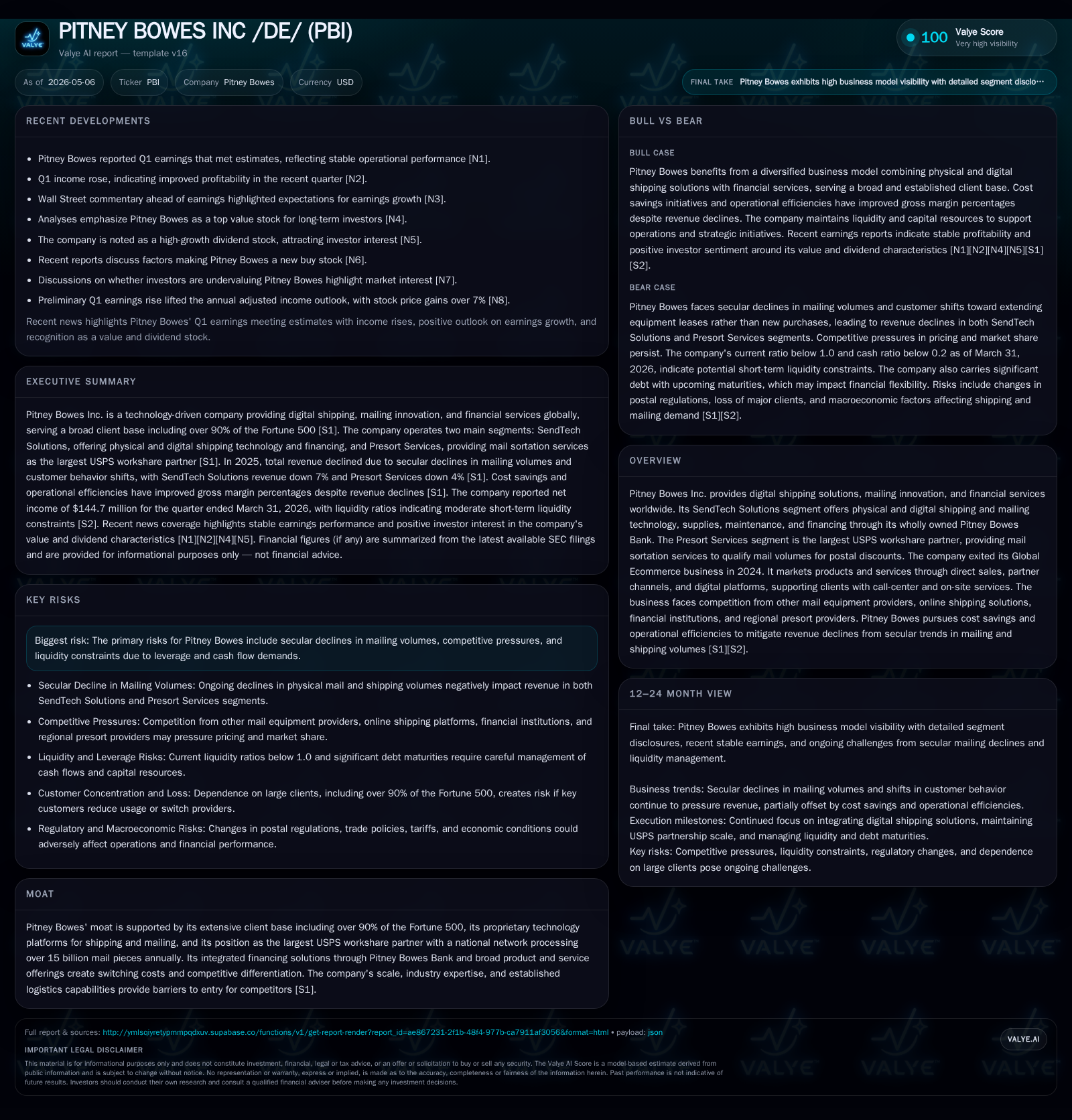
Pitney Bowes' latest quarterly update highlights a continuing contraction in revenue driven by secular declines in mailing volumes and tough competitive dynamics, despite improvements in operational efficiency and margin management. The company anchors its business model on two segments: SendTech Solutions, offering physical and digital shipping technologies plus financing, and Presort Services, the largest USPS workshare partner. Structural headwinds pose growth challenges; financial leverage remains elevated with a current ratio below 1.0. Key drivers include expanding digital shipping APIs and cost controls, balanced against risks from volume erosion and refinancing needs.
Recent Operating Update
Pitney Bowes reported its first quarter 2026 results on May 6, reaffirming ongoing secular headwinds in mailing volumes impacting top-line growth. Total company revenue remained pressured with no material inflection in the declining trend that has characterized recent years [S2]. The company emphasized continued focus on operational efficiencies to offset revenue weakness. Gross margins remained resilient with slight improvement percentage-wise due to disciplined cost control initiatives despite a roughly flat absolute gross margin compared to prior periods.
Notably, the company reiterated no material changes in risk factors or business outlook compared to its full-year 2025 annual report filed February 20 [S2]. The strategic exit from its Global Ecommerce segment was completed in 2024 prior to this period and continues to simplify business focus towards core offerings [S1]. Liquidity remains tight with a current ratio of approximately 0.62 as of March 31, 2026, reflecting constrained short-term coverage amid significant total debt near $2.17 billion [F1].
Management plans to address upcoming debt maturities through refinancing or repayment using available liquidity and operational cash flow [S7].
Business Model
Pitney Bowes generates revenue predominantly from two segments:
SendTech Solutions: Provides an integrated suite of physical and digital shipping technologies encompassing meter equipment, label printers, cloud-based API platforms for postage purchase and multi-carrier shipment tracking. This segment also leverages a wholly owned bank subsidiary granting financing solutions for equipment acquisition and postal supplies purchases. Revenue streams within SendTech consist of services (maintenance contracts, support), products (equipment sales), and financing revenues (credit solutions) [S1].
Presort Services: Positioned as the largest USPS workshare partner nationally, this unit offers outsourced mail sorting services that enable customers’ First-Class Mail and Marketing Mail volumes to qualify for discounted postage rates through optimized submission strategies leveraging proprietary sortation technology [S1].
The company markets directly via sales teams alongside partner channels with digital platform integration steadily growing. Customer retention benefits from entrenched usage by over 90% of Fortune 500 companies who require efficient parcel/mail dispatching with cost certainty and compliance supported by Pitney Bowes’ end-to-end service capabilities.
Margins are structurally higher in the services component due to recurring revenue nature versus capital-intensive equipment sales which face margin compression amid reduced demand. The financing arm adds differentiation through embedded credit solutions enhancing customer stickiness but introduces sensitivity to interest expense dynamics.
Industry Structure and Competitive Position
Pitney Bowes operates within a mature industry marked by persistent volume declines in traditional mailing driven by digitization while simultaneously contending with evolving customer demands for ecommerce-enabled shipping solutions.
Competitive dynamics include legacy office mailing equipment manufacturers competing on hardware innovation and servicing alongside emerging technology-first players offering digital parcel shipping interfaces challenging Pitney Bowes’ pricing power particularly among small-to-mid-market users. Additionally, financial institutions rival its bank-led financing offerings.
However, Pitney Bowes retains competitive advantages through:
- Deep integration with USPS as largest workshare provider handling ~15 billion mail pieces annually,
- Broad patent portfolio and proprietary software platforms enabling seamless shipment preparation across physical/digital channels,
- Large enterprise client base providing volume scale,
- Combined offering of hardware + software + financing creating high switching costs,
- Expanded API ecosystem allowing ecommerce site integration fostering future growth beyond traditional mail.
These elements constitute a defensible moat albeit one challenged by secular industry shifts compressing demand.
Growth Drivers
Concrete growth avenues are concentrated in:
- Digital Shipping APIs: Leveraging platforms that enable online retailers to embed carrier selection, label printing, postage purchasing directly into their checkout flows can drive incremental volume capture as ecommerce penetration deepens.
- Cross-Border Digital Commerce: Expanding capabilities facilitating international parcel logistics could capture share yet not explicitly highlighted post-Global Ecommerce exit.
- Operational Efficiencies: Cost-saving initiatives including workforce optimizations and supply chain rationalization improve margins supporting profitability given stagnant revenue base.
- Financing Solutions Adoption: Encouraging expanded use of Pitney Bowes Bank credit products integrates loyalty while generating steady interest revenues.
- USPS Partnership Expansion: Innovating presort offerings complimentary to modern hybrid physical-digital mail demands may widen customer value proposition within bulk mail strategies.
These growth drivers hinge significantly on successful execution of product development investments scaled appropriately against resource constraints as indicated by sizeable reductions in R&D spend year-over-year noted historically [S1].
Risks / Watchpoints / Growth Constraints
Key risks constraining Pitney Bowes’ growth potential include:
- A sustained secular decline in mailing volumes reducing equipment replacement cycles and presort service demand,
- Competitive pressure on pricing especially from innovative online shipping startups focusing exclusively on digital fronts,
- Reliance on USPS operational agreements subject to regulatory or contractual change impacting cost/volume economics,
- Challenges managing leverage amid ~$1.87 billion net debt position limiting capital flexibility,
- Macro risks such as economic slowdowns affecting small business clients’ spending,
- Execution risks scaling digital offerings fast enough to offset traditional revenue declines,
- Potential further impairment charges if asset utilizations fall faster than anticipated.
Covenant compliance tied closely to leverage metrics necessitates careful liquidity management especially given upcoming debt maturities beyond Q3/Q4 2026 timeframes [S7].
What to Watch Next
Market participants should monitor several key indicators:
- Progress against Q2/Q3 revenue trends evidencing any stabilization or acceleration in SendTech digital shipments,
- Updates on refinancing or repurchasing activities related to March 2027 note maturity obligations,
- Adoption metrics for new API integrations especially among ecommerce merchants indicating pipeline traction,
- Margin improvement signals coming through operating expense discipline versus external inflationary pressures,
- News concerning USPS contract renewals or new postal regulations affecting presort economics,
- Quarterly updates outlining progress against restructuring plans announced earlier years;
- CEO commentary around technological innovations or new financing products unveiled.
Financial Profile Summary
Latest financial snapshot
| Metric | Value | Period |
|---|---|---|
| Cash & equivalents | $303mm | |
| 2026-03-31 | ||
| Total debt | $2.2bn | |
| 2026-03-31 | ||
| Net debt | $1.87bn | |
| 2026-03-31 | ||
| Current assets | $1.13bn | |
| 2026-03-31 | ||
| Current liabilities | $1.82bn | |
| 2026-03-31 | ||
| Current ratio | 0.62x | |
| 2026-03-31 |
Source: SEC companyfacts cache [F1].
As of March 31, 2026:[F1] Liquidity remains tight with more current liabilities than assets; required near-term debt repayments are manageable via liquidity but refinancing execution remains important given the size relative to cash flow generation capacity [F1], [S7]. Income from continuing operations increased significantly year-over-year due to lower restructuring charges and improved operations despite top-line decline pressures [S1]. Interest expense remains a notable drag but has slightly declined from prior periods reflecting refinancing efforts.
Disclaimer: This analysis is for informational purposes derived solely from publicly available SEC filings and company disclosures as cited; it does not constitute investment advice or a recommendation regarding securities of Pitney Bowes Inc.
Disclaimer: This is research-only, informational analysis and not investment advice. It may include AI-generated interpretation and general industry context. Always verify important details using primary sources.

Comments