
Unisys Corp Advances AI-Embedded Digital Transformation Services with Stable Market Position
Unisys’s Q1 2026 results highlight revenue resilience amid investments in AI solutions and legacy platform modernization.
Unisys Corp’s first quarter 2026 filing reveals a continued revenue beat despite a widening net loss, driven by strategic investments in AI integration and managed services. The company’s business model, anchored on its proprietary ClearPath Forward platforms and AI-driven Digital Workplace Solutions, supports its position in complex, regulated enterprise environments. Growth is underpinned by accelerating demand for hybrid multi-cloud transformation and next-generation computing capabilities, tempered by financial constraints around debt covenants and pension obligations. Monitoring contract renewals, SaaS adoption of ClearPath Forward, and customer migration to AI-enabled workflows will be key near-term indicators.
Latest Quarterly Operating Update and Its Implications
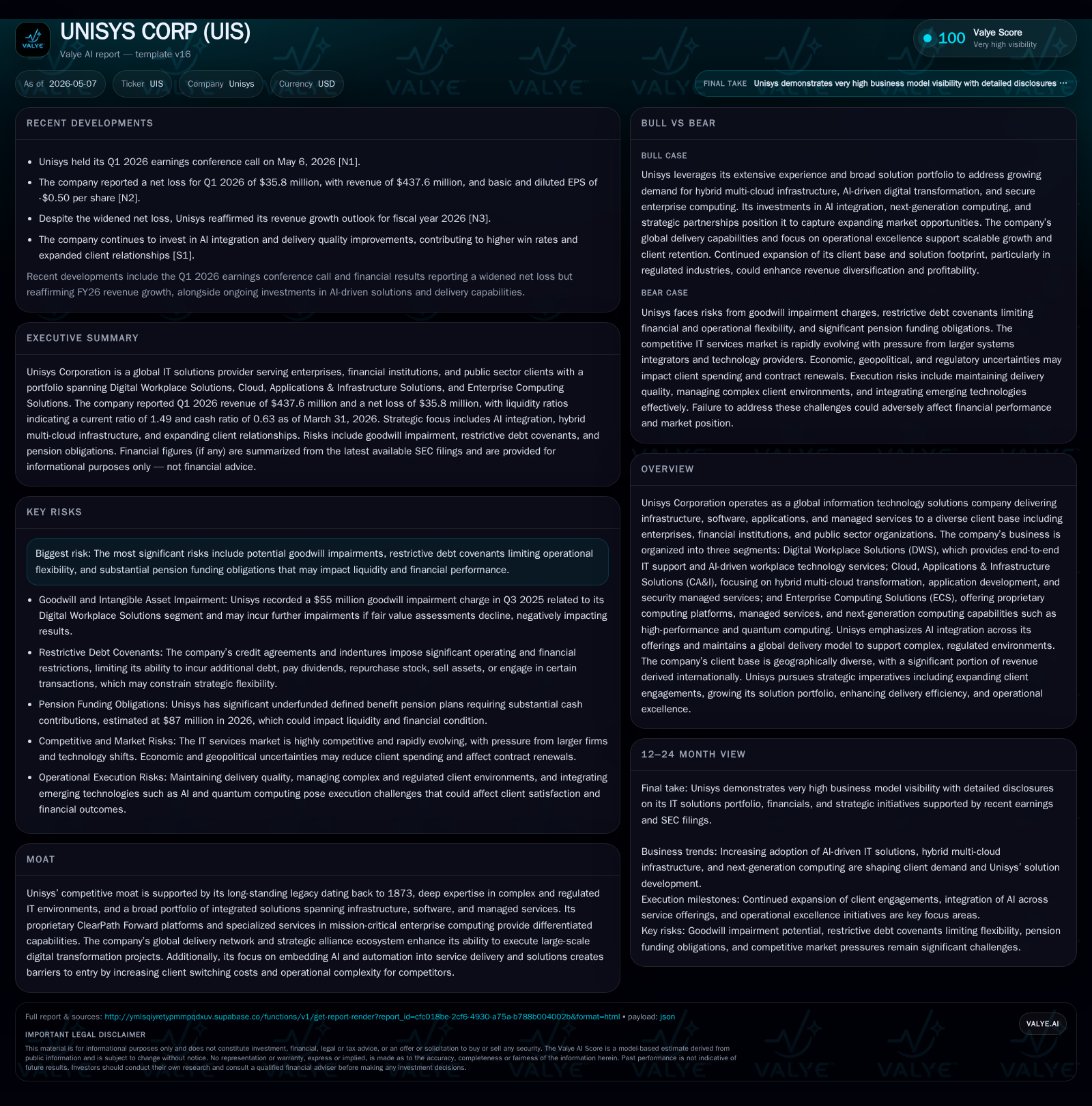
Unisys Corporation reported its financial results for the quarter ended March 31, 2026, with notable top-line resilience against analyst estimates but an expanded net loss reflecting strategic investment intensity [S2][N2]. Revenue strength reflects ongoing momentum in client wins and renewals fueled by growing adoption of its AI-enhanced Digital Workplace Solutions (DWS), Cloud, Applications & Infrastructure (CA&I) managed services, and proprietary Enterprise Computing Solutions (ECS) anchored by the ClearPath Forward platform [N3][S3]. Despite the widened net loss, management underscored confidence in FY26 revenue growth reaffirmed during early May event filings [N3][S3]. There were no material changes to risk factors disclosed relative to the FY25 annual filing [S2], maintaining continuity amid evolving industry dynamics.
This quarterly update illustrates Unisys’s balancing act between near-term profitability pressures—owing to higher R&D spend on embedding AI capabilities—and longer-term positioning to capture structural demand shifts in automation-led enterprise IT modernization.
Unisys Business Model: Integrated IT Solutions Anchored by ClearPath Forward
Unisys's revenues flow through three synergistic business segments:
- Digital Workplace Solutions (DWS): Provides comprehensive IT support including AI-powered workplace technologies that automate routine tasks, enhancing end-user productivity across regulated sectors.
- Cloud, Applications & Infrastructure (CA&I): Delivers hybrid multi-cloud migration services, security managed operations integrating AI for predictive threat detection, application development, and operational finance management.
- Enterprise Computing Solutions (ECS): Offers the proprietary ClearPath Forward suite—a middleware stack tailored for secure mission-critical transactions supporting scalable workloads on-premise or cloud. ECS further encompasses specialized consulting around system modernization including high-performance and emerging quantum computing services [S1][S4][S25][S28].
Revenue generation primarily derives from long-term license renewals for ClearPath Forward OS products recognized upfront upon contract renewal plus recurring managed service fees tied to system operation. The model also includes hardware deliveries when applicable and continuous support offerings recognized over time [S28]. Importantly, investments into SaaS delivery modes for ClearPath seek to reshape consumption patterns but may cause negative timing effects on cash flow during transition phases [S1].
Embedded AI is a defining feature cutting across Unisys's portfolio—applied both within solution stacks to power client digital workforce transformations and within Unisys's own delivery automation frameworks enhancing operational quality and efficiency [S6].
Industry Positioning in Complex, Regulated IT Environments
Unisys occupies a specialized niche focused on technology solutions for enterprises operating under stringent regulatory compliance regimes—financial services, healthcare, government agencies being key examples. Such environments demand flawless uptime for mission-critical workloads alongside robust security controls where Unisys’s proprietary platforms achieve durable client lock-in due to complexity of switching or redesigning business-critical applications [S1][S7].
Complementing technological depth is a global delivery network allowing large-scale rapid modernization projects that integrate legacy systems with hybrid cloud deployments—critical for organizations facing escalating technical debt amidst digital acceleration [S6][S8]. Unisys advances its competitive moat via strategic alliances extending solution breadth; however it contends with pressure from larger systems integrators and cloud-native providers pushing commoditized IaaS/PaaS options. This competitive tension mandates ongoing innovation in embedded AI automation and niche expertise cultivation to defend installed base margins [S7][S8].
Growth Drivers: AI Integration, Cloud Transition, and Next-Gen Computing
Growth levers center on several distinct vectors:
- AI-Embedded Solutions: Rising enterprise appetite for generative and agentic AI use cases aligns well with Unisys’s roadmap embedding AI throughout product lines—from automating workplace workflows to enhancing security operations with predictive analytics [S1][S4].
- Land and Expand Sales Strategy: Initial project wins or advisory engagements cultivate trust enabling expanded mandate wins within the same clients across new geographies or solutions—crucial given the high switching costs intrinsic to complex regulatory IT landscapes [S7].
- Hybrid Multi-Cloud Adoption: Unisys leverages its CA&I segment expertise to assist organizations managing heterogeneous cloud estates requiring seamless integration coupled with compliance oversight—a growing market as hybrid clouds become default architectures in regulated spaces.
- Next-Generation Computing: ECS efforts targeting advanced computing forms—including high-performance clusters optimized for data-intensive AI workloads and early quantum infrastructure managed services—anticipate client demands beyond classical compute paradigms [S4].
These growth themes respond to structural trends rather than cyclical spikes; however execution success hinges on salesforce efficacy converting awareness into booked engagements plus technology evolution pace sustaining solution relevance.
Risk Factors and Strategic Constraints: Debt, Pension Funding, and Competitive Pressures
While Unisys demonstrates strategic clarity in portfolio evolution, notable risks temper outlook:
- Restrictive Debt Covenants: Credit agreements tied to substantial $700 million senior notes impose significant operational limits—from constrained ability to incur new debt or pay dividends to restrictions on asset sales. These covenants cap flexibility needed amid a rapidly changing market landscape [S5][S18].
- Pension Funding Obligations: Elevated forecasted cash contributions toward defined benefit pension plans raise liquidity strain risks potentially crowding out discretionary R&D or acquisitions vital for growth acceleration [S10].
- Goodwill Impairment Potential: Ongoing investments in new offerings may not yield anticipated returns; any impairment charges could materially impact profitability metrics and capital availability.
- Competitive Intensity: Market entrants including large-scale cloud integrators pursue aggressive pricing strategies targeting legacy mainframe refresh cycles. The need to continuously innovate embedded AI differentiators adds cost pressure compounded by high fixed-cost global delivery infrastructure maintenance [S8][S11].
Additionally regulatory compliance burdens heightened by evolving global trade constraints or emerging data/AI laws increase operational complexity adding further cost layers.
Milestones to Monitor: Contract Wins, Renewal Rates, and Technology Adoption Trends
To gauge trajectory consistency analysts should track:
- Contract Win Momentum: Especially evidence of expanding scope within existing clients under ‘land and expand’ programs which signal stickiness of solutions beyond initial onboarding phases.
- Managed Services Renewal Quality: Renewal rates retaining higher-margin recurring revenue streams underpin margin stability; any unexpected churn could presage revenue pressure.
- ClearPath Forward SaaS Adoption: Transition progress under the company's '2050 strategy' reflects readiness for modern consumption models though may temporarily dilute cash flow visibility.
- AI Solution Uptake: Client adoption velocity of embedded AI tools directing automation workflows determines ability to command premium pricing and boost operational efficiency.
Progress against these KPIs will reveal if Unisys can maintain its moat while shifting its portfolio emphasis successfully toward advanced digital transformation use cases.
Consolidated Financial Snapshot
Latest financial snapshot
| Metric | Value | Period |
|---|---|---|
| Cash & equivalents | $380mm | |
| 2026-03-31 | ||
| Total debt | $713mm | |
| 2025-12-31 | ||
| Net debt | $333mm | |
| 2025-12-31 | ||
| Current assets | $896mm | |
| 2026-03-31 | ||
| Current liabilities | $602mm | |
| 2026-03-31 | ||
| Current ratio | 1.49x | |
| 2026-03-31 |
Source: SEC companyfacts cache [F1].
| Metric | Latest Value |
|---|---|
| Cash & Equivalents | $380.2 million |
| Total Debt | $713.3 million |
| Net Debt | $333.1 million |
| Current Assets | $895.9 million |
| Current Liabilities | $602.4 million |
| Current Ratio | 1.49 |
As of Q1 2026-end, Unisys held cash balances sufficient to cover near-term liabilities comfortably with a current ratio of 1.49 providing some buffer despite sizeable total indebtedness primarily from senior secured notes issued for long-term funding needs [F1]. Net debt stands at approximately $333 million indicating moderate leverage aligned with the firm’s mid-cap profile although covenant terms limit capital structure manoeuvrability [F1][S5]. Operating losses expanded this quarter due largely to investments accelerating the future-readiness of core digital offerings rather than underlying revenue erosion per se.
This analysis is based exclusively on public regulatory filings up to May 2026 without offering investment advice or valuation judgments.
Disclaimer: This is research-only, informational analysis and not investment advice. It may include AI-generated interpretation and general industry context. Always verify important details using primary sources.

Comments