
Civista Bancshares Extends Community Banking Reach with Strategic Acquisition and Solid Q1 Results
Civista Bancshares bolstered its regional presence through the acquisition of The Farmers Savings Bank and reported strong first-quarter growth in loans and deposits.
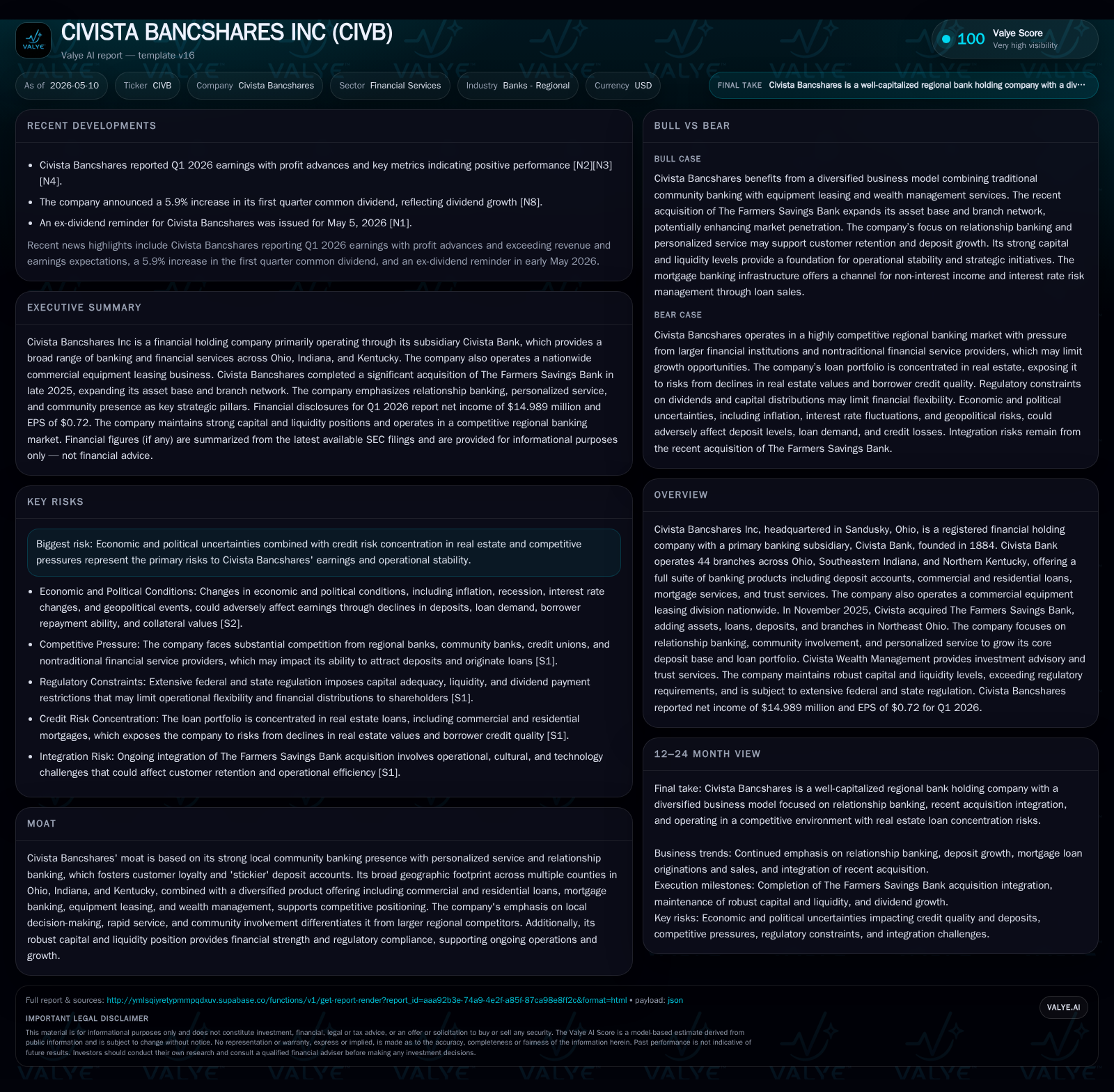
In Q1 2026, Civista Bancshares integrated its recent acquisition of The Farmers Savings Bank, adding significant assets, loans, and deposits while expanding its branch network in Northeast Ohio. The company's net interest income showed upward momentum supported by growth in commercial and residential lending, alongside sustained core deposit expansion. Civista continues to leverage a diversified business model rooted in local relationship banking and complemented by commercial equipment leasing and wealth management services. Key risks include credit concentration in real estate and sensitivity to macroeconomic factors impacting borrower repayment capacity. Looking forward, successful integration of the acquisition and ongoing deposit growth remain critical to sustaining earnings expansion.
Q1 2026 Operating Update: More Than Just Numbers
Civista Bancshares’ latest quarterly filing dated May 8, 2026, reveals a solid operational performance anchored by the strategic acquisition of The Farmers Savings Bank (FSB) completed in November 2025 [S2][S17]. This move added approximately $268.1 million in total assets, $106.2 million in loans and leases, $236.1 million in deposits, and two additional Northeast Ohio branches. Integration progress has been swift, with technology conversions finalized by mid-February 2026 ensuring minimal service disruption post-acquisition and allowing frontline teams to focus on client retention and product expansion efforts [S3][S17].
The loan portfolio expanded notably following the acquisition—with commercial real estate maintaining roughly half of holdings but complemented by growing residential mortgage loans that reached nearly 29% of the total portfolio as of year-end 2025 [S17]. Net interest income demonstrated positive momentum driven mainly by loan volume growth combined with a favorable net interest margin environment amid prevailing monetary policies [S2]. Deposit growth remained robust as core non-maturity accounts increased within their established footprint while benefiting from the FSB footprint extension.
Management commentary at the D.A. Davidson Financial Institutions Conference underscored confidence in leveraging localized decision-making capabilities and relationship banking foundations to sustain earnings growth despite competitive headwinds [S3]. Expense discipline through technology adoption also contributed to efficiency improvements.
Business Model and Portfolio: Community Roots Driving Diversification
Civista Bancshares operates principally through its primary subsidiary Civista Bank which serves Ohio counties along with parts of Southeastern Indiana and Northern Kentucky via a network of 44 branches supplemented by loan production offices. The bank’s business model centers on relationship banking—a strategy focused on personalized client engagement designed to foster loyalty that translates into "stickier" core deposit balances with above-average account sizes [S1][F1]. Deposits form a stable funding base enabling diversified loan origination across commercial real estate (50% of portfolio), residential mortgages (29%), and other commercial loans.
Beyond traditional banking activities, Civista integrates ancillary revenue streams through its mortgage banking arm where fixed-rate residential loans are originated for secondary market sale initiatives enhancing fee income while managing interest rate risk exposure. Its full-service equipment leasing division (CLF), based out of Pittsburgh following a 2022 acquisition, broadens exposure to enterprise customers seeking capital asset financing nationwide [S1][S17]. Additionally, Civista Wealth Management extends investment advisory and trust services catering to individual and institutional clients—a diversification that cushions cyclical pressures on interest-dependent revenues.
The company maintains a conservative liquidity stance supported by readily available-for-sale securities cash equivalents for funding flexibility. Capital levels exceed regulatory standards reflecting disciplined balance sheet management aimed at supporting organic growth as well as strategic acquisitions [S5][S13].
Industry Positioning: Local Strength Versus Regional Competitors
Within the competitive landscape of regional banking—dominated by larger institutions such as Huntington Bancshares—Civista distinguishes itself through deep community ties encompassing multiple counties across three states as well as targeted product breadth that aligns well with customer needs [N4][S1]. Its relatively smaller scale enables nimble local credit decisions enhancing responsiveness versus larger regional peers often encumbered by remote centralized credit committees.
The company leverages personal service coupled with technology integration as part of best practices common among successful community banks aiming for deposit stability amid pricing pressure typical in this sector. Moreover, Civista’s emphasis on 'relationship banking' fosters longer-lived customer engagements reducing attrition risk compared to competitors relying more heavily on standardized digital delivery alone.
Nevertheless, Civista grapples with industry-wide challenges such as rising compliance costs due to evolving regulatory environments including consumer protection laws enforced by CFPB plus cybersecurity threats given increasing dependence on internet-based products [S16][S22]. The bank also competes against emerging nontraditional players such as fintech lenders or captive finance groups which add complexity to deposit attraction and loan origination dynamics.
Growth Drivers: Acquisition-Linked Expansion and Relationship Banking Focus
The November 2025 acquisition of The Farmers Savings Bank stands as the most immediate catalyst for expanding geographic coverage—particularly Northeast Ohio—and scaling deposits which underpin lending capacity [S3][S17]. Post-acquisition branch integration executed rapidly has unlocked opportunities for cross-selling existing Civista products including wealth management solutions to newly acquired customers.
Efforts continue to deepen penetration into commercial real estate lending markets where Civista benefits from local underwriting expertise rendering it competitive on pricing yet prudent on risk. Residential mortgage origination remains a priority leveraging established secondary market sales infrastructure that supports non-interest income growth mitigating pure spread compression risks associated with fluctuating loan yields.
Additionally, corporate culture emphasizing employee engagement aids retention rates at client-facing levels critical for sustaining personalized service levels that underpin long-term client relationships—a key intangible asset often overlooked in regional bank competition [N6]. Marketing campaigns highlighting community involvement further reinforce brand visibility within target markets enhancing customer acquisition pipelines.
Risks and Constraints: Credit Concentration & Macroeconomic Factors
A principal risk resides in Civista’s significant concentration in real estate loans representing roughly four-fifths of its lending portfolio inclusive of commercial (50%) and residential (29%) components—the latter increasingly important but still sensitive to housing market cycles [S2][S17]. Real estate collateral values directly influence credit losses potential particularly if macro conditions induce broad-based depreciation.
Macro factors such as rising inflation pressures, persistent geopolitical trade uncertainties (including tariffs or renegotiations affecting Midwest industrial activity), or recessionary headwinds can adversely impact borrower payment capacity leading to elevated loan delinquencies or charge-offs [S2][S16]. While management employs environmental site assessments during loan origination to mitigate latent environmental liabilities underlying collateral impairments are not fully controllable.
Operational constraints linked to regulatory capital requirements delineate ceilings on growth absent additional equity raises or asset sales despite stable internal capital generation. Heightened regulatory scrutiny also mandates ongoing investments in compliance frameworks especially around consumer protection statutes increasing operating cost bases potentially pressuring margins.
Looking Ahead: Key Milestones and Market Signals to Monitor
Investors should closely follow upcoming quarterly earnings disclosures focusing on net interest margin stability amid shifting rate environments; trends within allowance for credit losses reflecting economic outlook adjustments; deposit growth rates that will indicate success of integration efforts post-FSB acquisition; plus any shifts in mix between demand versus time deposits impacting funding cost optimization [S2][S3].
Additional items include watching regulatory communication around capital adequacy guidelines which could influence dividend policies or strategic transaction flexibility given current capital buffers well above mandatory thresholds but susceptible to risk-weighted asset profile changes [S13][S26]. Furthermore, enhancement or stagnation within CLF equipment leasing performance provides signals about diversification efficacy beyond conventional lending pools.
Monitoring management remarks during investor conferences provides qualitative insights into pipeline strength for new commercial loan originations alongside marketing initiatives effectiveness aimed at broadening customer base within overlapping markets.
Financial Health Snapshot: Supporting Stability Amid Growth
Financially, Civista Bancshares remains well positioned with no material debt outstanding beyond subordinated debentures measured at approximately $104 million bearing average coupon rates near mid-4% range contributing positively to its Tier 1 capital structure [F1][S14]. Total net income for calendar year ended December 31, 2025 was reported at $46.2 million demonstrating profitable scale suitable for incremental reinvestment strategies without undermining balance sheet integrity [F1].
Capital adequacy measures stand strong—Tier 1 leverage ratios were recorded at approximately 11.3% for the holding company level reflecting significant cushion above regulatory minima supporting future growth initiatives while maintaining safety buffers against potential credit losses or liquidity shocks [S13][S19]. Liquidity reserves consisting predominantly of available-for-sale securities alongside nearly $696 million available borrowings under the Federal Home Loan Bank system afford operational flexibility ensuring funding needs are met without excessive reliance on volatile wholesale funding sources.
Overall financial posture equips Civista Bancshares not only to absorb innate cyclical pressures endemic in regional banking but also positions it effectively to capitalize on organic expansion supplemented by judicious acquisitions aligned with its strategic focus.
This analysis presents an objective evaluation based exclusively on publicly available SEC filings and validated news sources concerning Civista Bancshares Inc without offering any investment advice or recommendations.
Disclaimer: This is research-only, informational analysis and not investment advice. It may include AI-generated interpretation and general industry context. Always verify important details using primary sources.

Comments