
Decoy Therapeutics Evolves Clinical Stage Portfolio While Managing Nasdaq Challenges
Decoy Therapeutics reports operational progress and pipeline expansion post-merger, balanced against ongoing Nasdaq listing compliance efforts.
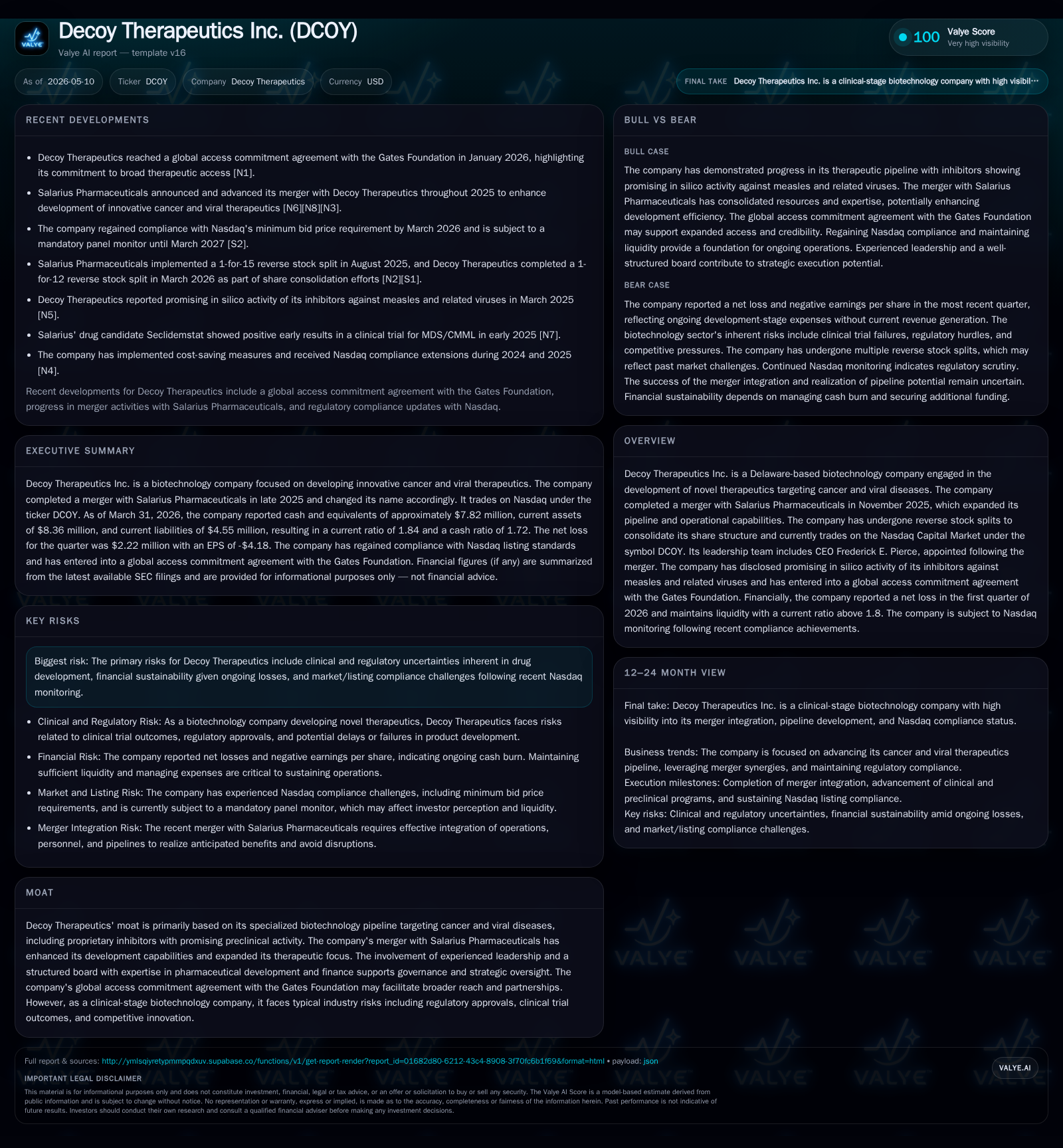
In its latest quarterly filing, Decoy Therapeutics highlights integration and development progress following its late-2025 merger with Salarius Pharmaceuticals, alongside steps taken to satisfy Nasdaq's minimum bid price rule through a reverse stock split. The company maintains solid liquidity supported by a 1.84 current ratio and zero debt, enabling continued R&D investment. Its clinical-stage pipeline focuses on innovative cancer and viral disease therapeutics, enhanced by promising in silico antiviral data and global access engagements. Notable challenges include typical biotech regulatory risks and the residual risk associated with Nasdaq monitoring conditions.
Latest Quarterly Operating Update and Nasdaq Listing Status
Decoy Therapeutics' May 8, 2026 Form 10-Q filing [S2] anchors its current operating profile by affirming steady integration efforts from the November 2025 merger with Salarius Pharmaceuticals. The company addressed critical Nasdaq continued listing concerns through a strategically implemented 1-for-12 reverse stock split effective March 6, 2026 [S19], which restored compliance by pushing its share price above the $1 minimum threshold [S10]. Post-split trading commenced on March 9 under the ticker DCOY [S13]. Although the listing requirements have been met, the company remains subject to Mandatory Panel Monitoring until March 31, 2027 [S10], indicating heightened scrutiny over compliance sustainability.
Financially, Decoy Therapeutics reported $7.82 million in cash and equivalents at quarter-end March 31, 2026 [F1], paired with current assets of $8.36 million against current liabilities of $4.55 million, yielding a robust current ratio of 1.84 [F1]. This liquidity cushion supports ongoing preclinical and clinical activities despite recurring net losses consistent with early-stage biotech profiles [F1]. Importantly, no debt obligations are recorded as of year-end 2025 [F1], eliminating near-term leverage risks.
There were no material revisions to disclosed risk factors compared to the prior annual report period [S2]. The stable risk profile reflects persistent challenges inherent to clinical-stage biotechs compounded by ongoing NASDAQ compliance oversight.
Decoy Therapeutics’ Business Model and Therapeutic Offerings
As detailed extensively in the April 30, 2026 amendment to the annual filing [S1], Decoy Therapeutics operates at the intersection of oncology and antiviral therapeutic development. Its core business model revolves around designing proprietary inhibitors that disrupt pathological targets implicated in cancer progression and viral infections. Revenue generation is contingent upon achieving key development milestones such as IND filings, clinical trial launches, regulatory approvals, and eventual commercialization—none of which have been realized yet given its clinical-stage status.
The merger with Salarius Pharmaceuticals broadened Decoy’s product portfolio by integrating complementary drug candidates and scientific expertise. Notably, some pipeline assets exhibit promising in silico activity against measles virus strains and related viral pathogens—a focus underscored by entering into a global access commitment agreement with the Gates Foundation aimed at facilitating worldwide distribution upon successful development.
This model hinges on securing strategic collaborations for co-development or licensing while advancing candidate molecules through expensive R&D phases without steady revenue inflows. Success depends heavily on differentiated efficacy or safety profiles that could command pricing premiums once in commercial markets.
Competitive Landscape and Industry Dynamics
Decoy Therapeutics occupies a crowded but opportunity-rich sector dominated by innovation-driven biotechnology firms targeting oncology and infectious diseases. Regulatory complexities impose steep barriers: drugs must clear phased clinical trials demonstrating efficacy/safety before marketing approval—a process both costly and uncertain.
Pre-revenue biotechs like Decoy typically lack pricing power until regulatory milestones validate product marketability. Supply chain factors also play roles; scaling up specialized manufacturing for biologics or small molecules requires advanced technical capacity often outsourced or internally developed incrementally.
Competition arises from both established pharma giants equipped with deep resources and nimble startups innovating via novel modalities or platforms. The company’s moat depends distinctly on its unique pipeline compounds—particularly its proprietary viral inhibitors—and strategic partnerships enhancing commercialization possibilities.
Governance quality features prominently with CEO Frederick E. Pierce leading since post-merger consolidation alongside a scientifically knowledgeable board overseeing prudent capital allocation within this high-burn environment.
Growth Drivers: Pipeline Development and Strategic Collaborations
Potential growth catalysts at Decoy stem chiefly from translational advancement of its candidate therapies from preclinical validation towards human clinical trials. Key upcoming milestones likely include IND submissions for select drug candidates whose in silico efficacy has shown promise against measles virus adjuncts—a rarity currently within comparable mid-tier biotech pipelines.
Strategic collaboration engagement represents another critical vector for expansion. The Gates Foundation global access commitment not only evidences confidence but may lower commercial barriers internationally due to philanthropic alignment.
Furthermore, integrating Salarius’ expertise affords economies of scale in research execution plus enhanced threat diversification across cancer and infectious disease treatment indications—broadening investor appeal beyond single-asset risk exposure.
Continuous pipeline renewal through internal discovery or potential licensing deals remains essential to sustaining long-term value creation given inherent attrition rates prevalent in early-stage pharmaceuticals.
Potential Risks and Operational Challenges
Material risks remain centered around ongoing uncertainties tied to drug development cycles: clinical failures or setbacks can abruptly halt progress while regulatory agencies retain wide discretion over approvals. Financial sustainability pressures persist given recurrent net losses highlighted in recent SEC disclosures [F1][S2]. These losses underscore dependence on external financing unless swift developmental successes materialize.
Nasdaq compliance poses non-trivial risks despite remedial actions via the reverse stock split; failure to maintain required bid prices could provoke delisting consequences diminishing stock liquidity and firm visibility [S3,S4]. Moreover, such scrutiny contributes to investor uncertainty impacting share valuation independent of operating fundamentals.
Operationally, managing R&D cost structures without scaling prematurely is crucial to preserve runway amidst volatile funding climates.
Key Near-Term Developments to Monitor
Investors should track several factors closely:
- Updates on Nasdaq monitoring status ahead of March 31, 2027 deadline for panel removal,
- Any announcements regarding IND submissions or Phase I trial initiations,
- Progress reports from Gates Foundation partnership implementations,
- Quarterly disclosures providing insights into cash burn rates versus capital raises,
- Governance changes or strategic pivots evidencing responsiveness post-merger integration success. Added visibility into these developments may help clarify the company’s trajectory toward establishing commercial viability.
Current Financial Position at a Glance
Latest financial snapshot
| Metric | Value | Period |
|---|---|---|
| Cash & equivalents | $7.82mm | |
| 2026-03-31 | ||
| Total debt | 0 USD | |
| 2025-12-31 | ||
| Net debt | $-7.82mm | |
| 2025-12-31 | ||
| Current assets | $8.36mm | |
| 2026-03-31 | ||
| Current liabilities | $4.55mm | |
| 2026-03-31 | ||
| Current ratio | 1.84x | |
| 2026-03-31 |
Source: SEC companyfacts cache [F1].
Decoy Therapeutics' clean balance sheet devoid of debt combined with substantial cash reserves supports ongoing R&D investment needs amid typical biotech net operating losses [F1].
This financial positioning underpins operational flexibility essential for navigating clinical trial complexities while maintaining compliance-related costs associated with Nasdaq oversight programs.
This analysis is based solely on publicly available SEC filings dated through May 8, 2026, company-provided data from Companyfacts as of March 31, 2026, and related official communications without investment advisory intent.
Disclaimer: This is research-only, informational analysis and not investment advice. It may include AI-generated interpretation and general industry context. Always verify important details using primary sources.

Comments