
Grayscale Stellar Lumens Trust Updates Operational Metrics After Pricing Method Shift
The recent adoption of the CoinDesk Stellar Benchmark Rate index redefines GXLM’s NAV calculation and spotlights ongoing premium/discount volatility amid growing regulatory scrutiny.
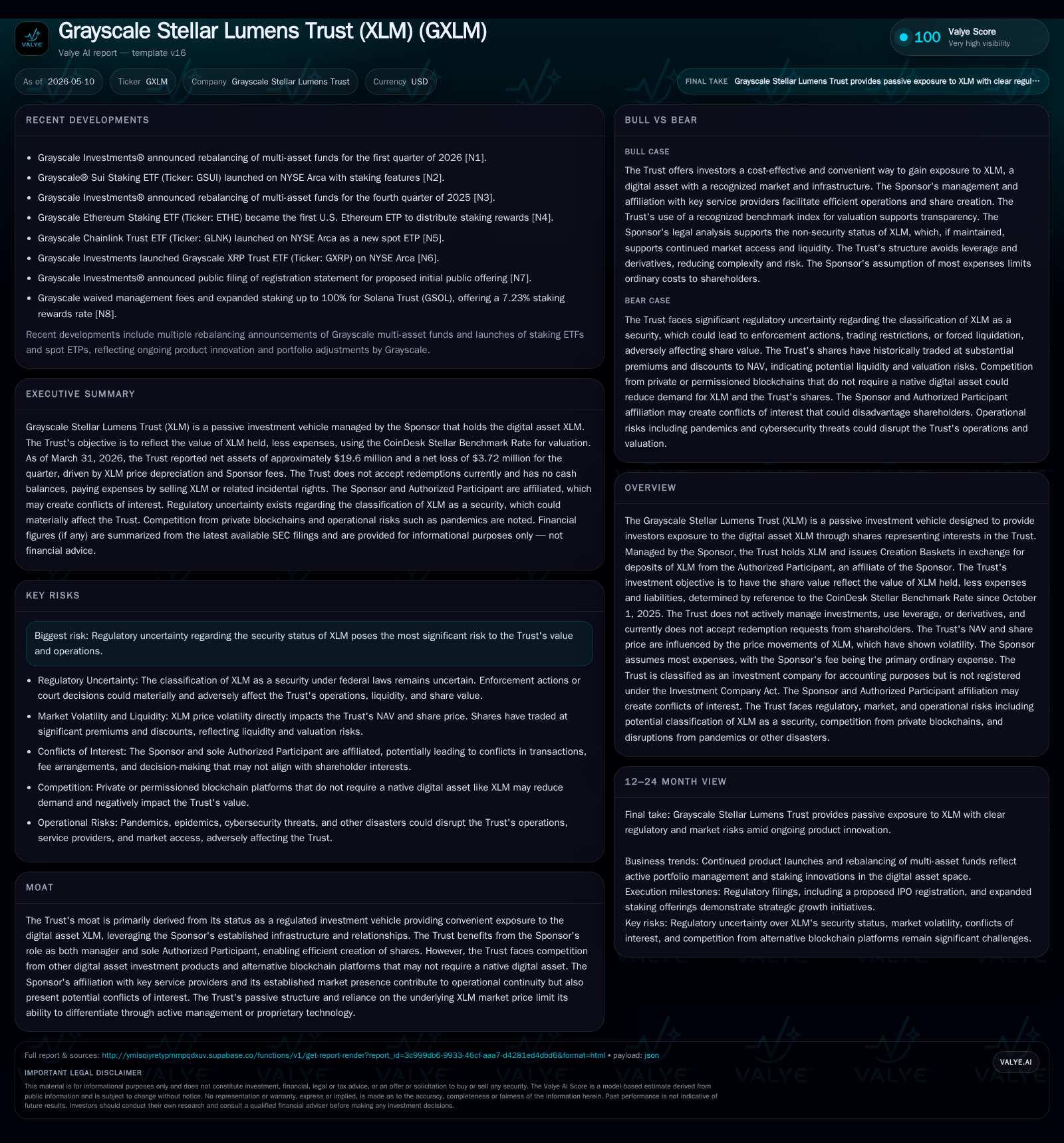
Grayscale's Stellar Lumens Trust (GXLM) refreshed its NAV pricing reference in Q1 2026, switching from the CoinDesk Lumens Price Index to the CoinDesk Stellar Benchmark Rate, aiming for better alignment with market realities. Despite this methodological update, GXLM continues to trade with significant premiums and discounts due to structural features like the absence of redemptions. The Trust operates as a passive vehicle holding XLM without leverage or active management and faces considerable regulatory uncertainty surrounding XLM’s classification as a security. Growth hinges largely on expanding institutional digital asset demand and clearer regulatory frameworks, while key risks include volatility, regulatory shifts, and operational challenges related to liquidity and compliance.
Latest Quarterly Filing Highlights: Pricing Index Transition and Market Impact
The Grayscale Stellar Lumens Trust’s 10-Q filed May 8, 2026 [S2] unveils a pivotal shift in how the Trust values its XLM holdings. As of October 1, 2025, GXLM moved from using the CoinDesk Lumens Price Index (XLMX) to the CoinDesk Stellar Benchmark Rate as its official reference point for net asset value (NAV) calculation. This recalibration aligns GXLM’s NAV per share closer with prevailing market prices from a more comprehensive benchmark source designed to reflect broader trading activity in XLM.
This change matters because previously reported discrepancies between share price on OTCQX markets and underlying NAV — where shares traded at substantial premiums or discounts — persist due to inherent structural factors including the non-existence of shareholder redemptions. Although adopting a new index aims for better valuation fidelity, GXLM continues to experience notable trading spreads relative to NAV, highlighting enduring inefficiencies in price discovery.
By anchoring valuation to the CoinDesk Stellar Benchmark Rate, which integrates multiple venue data points calibrated daily at New York close time, GXLM tightens operational accounting rigor. However, passive structural limitations keep share exchange dynamics detached from underlying asset value movement. This adjustment marks a small but critical evolution shaping near-term trust operations.
Grayscale Stellar Lumens Trust’s Passive Investment Model Explained
GXLM operates fundamentally as a passive investment vehicle structured through a Delaware statutory trust [S1], holding actual quantities of XLM tokens deposited by an Authorized Participant affiliated with the Sponsor. Shares represent fractional ownership interests reflecting pro rata claims on these underlying holdings after deduction of expenses and liabilities.
Unlike actively managed funds or ETFs that employ leverage or derivatives for returns enhancement or risk mitigation, GXLM maintains a pure exposure stance without such overlays [S2]. Investors pay for convenience and regulatory assurance rather than active alpha generation.
Creation Baskets enable share issuance in exchange for deposits of XLM; however, redemption requests from shareholders are currently not accepted [S2]. The absence of redemption facilities limits arbitrage opportunities that typically constrain premiums/discounts versus NAV in actively redeemable funds.
Expense management is noteworthy: while most operational costs are absorbed by the Sponsor—the entity managing and administering GXLM—the Sponsor charges a defined fee paid in XLM against Trust assets [S2]. This setup streamlines expense burden yet introduces potential conflicts where Sponsor interests might not fully align with minority shareholders’. The Trust applies U.S. GAAP fair value accounting guides (ASC Topic 820-10) ensuring NAV reflects current principal market prices determined by reference markets designated per its valuation methodology [S16].
Competitive Set and Regulatory Environment Influencing the XLM Trust
Within digital asset investment vehicles, GXLM competes against other single-asset trusts (e.g., Bitcoin or Ethereum trusts) and diversified crypto ETFs, all vying for institutional investor allocations seeking regulated exposures without direct custody complexities. Alternative blockchain platforms functionally compete as well but do not necessarily require native token ownership akin to XLM’s role within Stellar’s network ecosystem [S19].
Regulatory context looms large. The primary unresolved issue is whether U.S. regulators classify XLM as a "security" under federal laws enforced by SEC or CFTC oversight bodies [S3][S5][S8]. A security designation would impose registration requirements on the Trust and Sponsor potentially necessitating costly compliance expenditures or forcing liquidation unfavorable to shareholders.
Historical precedents including XRP litigation illustrate severe market dislocations following regulatory enforcement [S8]. The Trust acknowledges this risk explicitly; if deemed securities transactions involving XLM were upheld judicially or administratively, it could precipitate dissolution [S9]. Moreover, fluctuating interpretations across federal courts compound uncertainty.
Additional regulatory risks derive from potential money transmitter licensing needs if activities trigger "money services business" designations with attendant compliance obligations leading to extraordinary expenses or withdrawal of key participants [S22][S14]. International regulatory divergence adds complexity with some foreign jurisdictions imposing outright bans or severe restrictions on cryptocurrency activities affecting market liquidity indirectly [S4].
Operational continuity benefits from Grayscale’s established infrastructure—leveraging integrated roles as Sponsor and sole Authorized Participant—which streamlines creation mechanisms but concentrates control [S20]. Ongoing litigation linked loosely through affiliates may introduce reputational risks though presently considered unlikely materially disruptive [S7].
Growth Opportunities Driven by Investor Access to Digital Assets
Growth drivers for GXLM rest predominantly on increasing institutional appetite for regulated exposure vehicles offering simplified access to promising digital assets like XLM without direct wallet management or custody service arrangements [N1][S1]. As adoption of blockchain technology expands across remittances and cross-border payments space—a core use case for Stellar—the demand rationale strengthens.
Regulated trust structures provide cost-effective wrappers that mitigate custody risk perceptions compared to direct holdings on crypto exchanges fraught with hacking risks or insolvency events. Regulatory clarity improvements could unlock additional product development avenues or expand investment mandates enabling allocation increases toward such vehicles.
Absent active management or derivatives usage means GXLM’s growth is structurally tied to total assets under management driven by inflows from investor demand rather than performance differentiation. Further product innovation would be contingent upon evolving regulatory frameworks permitting enhanced features.
Key Risks: Regulatory Status of XLM and Trading Premiums/Discounts
Unresolved regulatory classification remains foremost among risks threatening GXLM’s continuation and valuation integrity [S1][S3][S5][S22]. If U.S. authorities conclusively declare XLM a security or regulate transactions therein as securities offerings, it could result in forced compliance steps beyond current scope—heightened reporting obligations—or abrupt termination detrimental to shareholder value.
Inherent underlying asset price volatility exerts continuous pressure causing NAV swings which combined with Share trading premiums/discounts exacerbates market illiquidity concerns. Absence of a redemption program impairs arbitrage mechanisms that typically tether share prices closely to NAV in open-ended funds [S1][S2]. Persistent wide differentials may deter investor confidence.
Dependence on third-party service providers—including custodians responsible for safekeeping underlying assets—represents operational vulnerability requiring ongoing risk monitoring.[S1]
Potential conflicts of interest from concentration of control within Sponsor structures may misalign incentives regarding expense absorption and strategic decisions impacting minority investors adversely [S20].[S22]
Near-Term Milestones and Signals to Monitor
Stakeholders should monitor forthcoming SEC determinations or legal precedent clarifying XLM’s securities status as pivotal inflection points impacting GXLM viability [S2][N1]. Congressional actions advancing legislation like CLARITY Act variants that segregate digital commodities regulation could reshape compliance landscapes beneficially or impose new costs.
Changes in redemption policies—should redemptions commence—would mitigate premium/discount issues enhancing market efficiency. Tracking shifts in trading spreads offers real-time sentiment gauges around trust perception.
Broader digital ecosystem developments impacting XLM fundamentals—such as adoption levels within financial networks or technological upgrades—will influence underlying asset valuation thus informing GXLM returns projections.
Subsequent quarterly filings detailing sponsor fees adjustments or trust expenses alongside reported realized/unrealized gains/losses help decode operational efficiency trends.[S13]
This analysis reviews publicly available information up to May 2026 focusing on Grayscale Stellar Lumens Trust's reported metrics without providing investment recommendations or speculative forecasts. Readers should consider ongoing developments in regulation and technology that may alter current interpretations over time.
Disclaimer: This is research-only, informational analysis and not investment advice. It may include AI-generated interpretation and general industry context. Always verify important details using primary sources.

Comments