
PRA Group’s Expanding Collections Drive 11% Q1 Revenue Growth Despite Moderate Portfolio Purchases
Strong cash collections and geographic diversification underpin PRA Group’s financial momentum as it leverages proprietary data and compliance expertise.
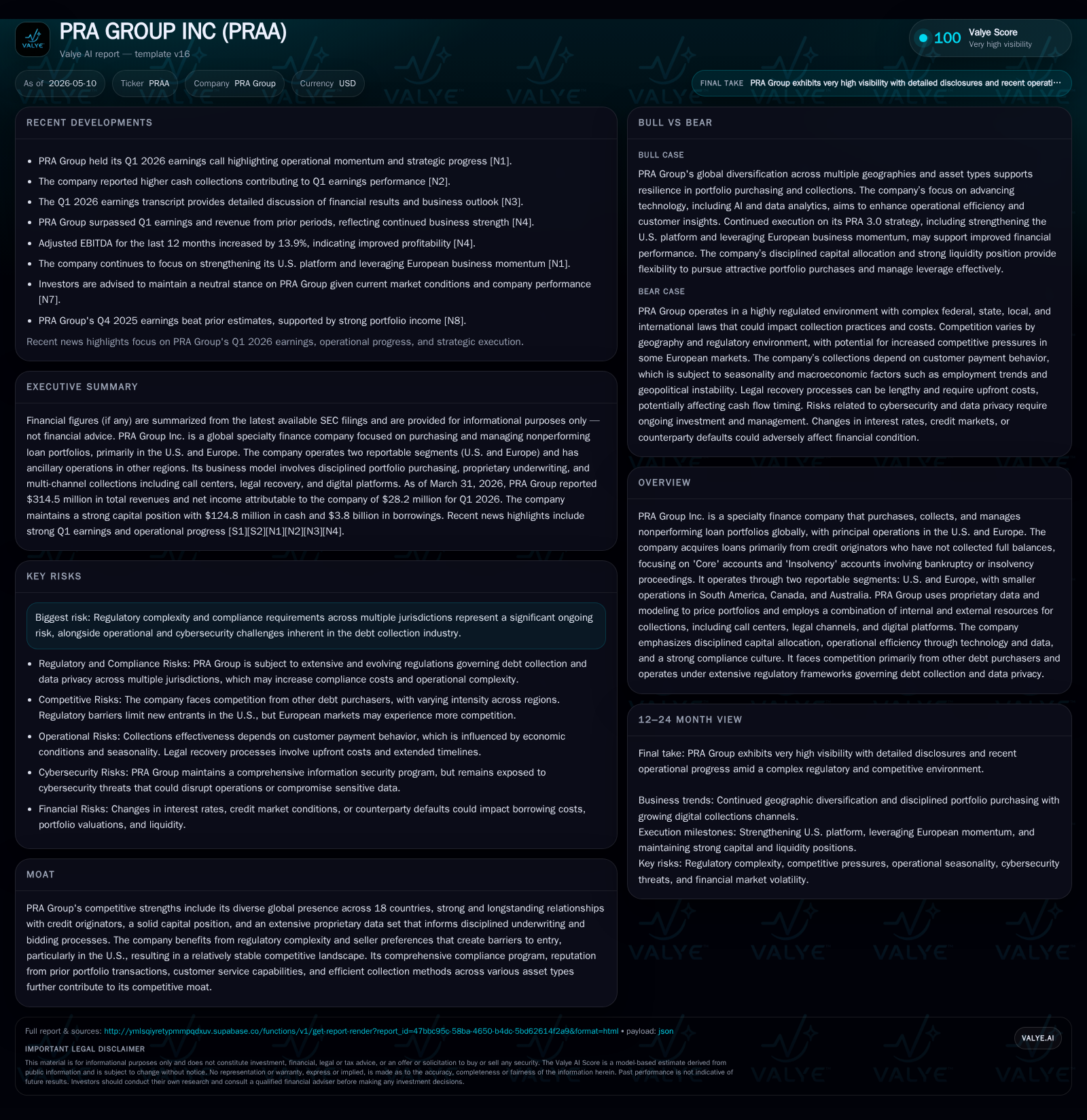
PRA Group reported an 11% increase in cash collections for Q1 2026, surpassing expectations driven by growth in both U.S. legal collections and European markets. While portfolio purchases declined, the company continues to benefit from its diversified global footprint and disciplined capital allocation. PRA's business model centers on buying nonperforming consumer and commercial loans at a discount and extracting value over time through effective collections strategies that leverage proprietary data analytics, legal channels, and multi-format engagement. Regulatory complexity, cybersecurity risks, and evolving market dynamics pose ongoing challenges but also serve as entry barriers. The company’s refinancing of its European credit facility improves liquidity flexibility, supporting stable growth.
Recent Operating Update
PRA Group Inc. reported its first quarter results on May 8, 2026 [S2]. Cash collections for Q1 rose by $54.5 million or 11%, reaching $551.9 million—above the company's expectations for the period. In the U.S., this growth was primarily driven by a $29.8 million uplift in legal collections, reflecting intensified operational initiatives focused on improving collection through judicial channels. European collections increased by $27 million due partly to positive foreign exchange rate shifts alongside strong underlying market performance [S2].
However, the company exercised capital discipline evidenced by a 24% decline in portfolio purchases during the quarter to approximately $221 million, signaling selectivity amid relatively stable market supply conditions forecast over the next 12-18 months [S2][S5]. Notably, estimated remaining collections—a forward-looking measure of collectible principal over time—increased by 9.5% to $8.5 billion, underscoring PRA’s embedded asset value.
Additionally, PRA successfully refinanced its European revolving credit facility extending maturity to April 2031 without terms deterioration or reductions in borrowing capacity [S5][S24]. This supports liquidity positioning as demonstrated by investments rising to $143.4 million with plans for sustained higher liquidity through its banking subsidiary AK Nordic AB within European operations [S2].
Business Model
PRA Group operates as a specialty finance company acquiring distressed consumer and commercial debt portfolios globally, concentrating on nonperforming loans sold mainly by credit originators who have either ceased pursuit or failed at collection - termed "Core" accounts [S1][S2]. A smaller portion involves "Insolvency" accounts tied to bankruptcy or insolvency proceedings across jurisdictions such as the U.S., UK, Canada, and Germany where PRA asserts creditor rights through claims under insolvency plans.
Revenue generation derives largely from portfolio income collected over time from purchased loan receivables net of acquisition cost and operational expenses. The company bids on portfolios through competitive sales processes leveraging proprietary datasets accumulated over more than two decades to inform pricing models that anticipate projected cash flows balanced against collection costs and financing charges [S1]. These acquisitions occur both as spot transactions and forward flow agreements enabling ongoing purchase streams at predetermined criteria.
Collections blend internal resources including call centers utilizing sophisticated segmentation models to prioritize accounts based on propensity-to-pay alongside external vendor partnerships specialized in debt recovery. PRA integrates digital communication platforms with traditional legal actions enabling multipronged payment approaches ranging from immediate full settlements to structured long-duration payment plans accommodating debtor hardship [S1][S2].
Ancillary activities include fee-based services related to class action claims recoveries within the U.S., complementing their core purchase-and-collect operations without material contribution to segment income but broadening service scope [S1][S2].
Industry Structure and Competitive Position
The debt purchasing landscape is characterized by regulatory complexity fragmented across multiple national jurisdictions imposing compliance burdens around collection practices, consumer protection laws, and data privacy requirements [S1]. This fragmentation erects moderate entry barriers benefiting well-capitalized incumbents like PRA Group possessing robust compliance programs and established buyer-seller relationships.
PRA's extensive geographic reach spans 18 countries with significant penetration in U.S. and European markets representing approximately 93% of estimated remaining collections [S2]. This diversification mitigates localized credit cycles or regulatory shocks while enabling the company to allocate capital dynamically across regions based on return thresholds.
Furthermore, PRA's emphasis on operational efficiency through technology adoption—such as predictive analytics for customer engagement prioritization—and an integrated approach combining digital outreach with legal enforcement enhances collection effectiveness while controlling costs [N3][S2].
Growth Drivers
Portfolio Yield Optimization
Increased use of advanced data analytics tools refines debtor targeting improving recovery rates per dollar purchased.
Geographic Expansion & Diversification
While core operations dominate in mature markets (U.S./Europe), incremental growth avenues exist in developing markets (South America, Australia) offering exposure to new client bases and loan types albeit modestly sized currently [S1].
Forward Flow Agreements
These contracts provide predictable volume streams facilitating better capital planning and pricing discipline while mitigating volatility inherent in spot market purchases.
Operational Discipline & Cost Control
Focused efforts under recent leadership embrace expense management combined with scaling automation demand continues driving improved operating margins overtime.
Refinancing & Capital Management
Recent extension of European revolving credit facility enhances funding flexibility allowing opportunistic portfolio acquisitions without incremental liquidity risk [S24].
Risks / Watchpoints / Growth Constraints
- Regulatory Risks: Varied national laws around debt collection necessitate constant investment in compliance risking operational disruptions or penalties if inadequately managed[S1][N1]. Particularly sensitive areas include consumer protection litigation which has increased industry-wide scrutiny.
- Cybersecurity Threats: The nature of handling sensitive financial data coupled with dependence on digital infrastructure makes PRA susceptible to cyberattacks despite robust mitigation programs outlined as part of overall enterprise risk management[S1].
- Portfolio Supply Fluctuations: While current visibility suggests stable loan availability near-term, macroeconomic shifts influencing credit origination volumes or banking sector health could constrict portfolio flow affecting reinvestment opportunities[S5].
- Collections Environment: Changes in borrower behavior during economic downturns or legal framework alterations could hamper recovery rates impacting profitability metrics.
- Legal & Litigation Exposure: Past experience confirms periodic lawsuits involving claims about collection practices require provisioning impacting earnings variability[S9].
What To Watch Next
Investors will focus on subsequent quarterly cash collection trends as leading indicators of operational health given their direct impact on revenue recognition beyond initial portfolio purchases [N2][S2]. Monitoring geographic segment performance will indicate resilience given lingering geopolitical tensions especially energy cost inflation potentially pressuring discretionary payments. Further updates on portfolio purchase volume guidance amid evolving credit conditions will shed light on capital deployment strategy adherence versus opportunistic buying. Demonstrable progress against regulatory compliance benchmarks or any material litigation developments may recalibrate risk perception.[S9][N4] Lastly, enhancements in technology-driven collection efficacy represent catalytic levers for margin expansion worth tracking across earnings calls speeches.[N3]
Financial Profile Highlights (Contextual)
As of March 31, 2026, PRA held approximately $124.8 million in cash equivalents paired with finance receivables net totaling $4.6 billion evidencing substantial asset base supporting core collection revenues [S2]. Investments increased to $143.4 million reflecting higher liquidity levels maintained by its banking subsidiary AK Nordic AB within European operations [S2]. The company successfully refinanced its European revolving credit facility extending maturity to April 2031 without deterioration in terms or borrowing capacity [S24]. For Q1 alone, total revenues increased 16.7% year-over-year reflecting combined effects of stronger portfolio income (+11.9%) and meaningful rise in changes to expected recoveries (+57%), indicating enhanced realization prospects possibly from refined estimation methodologies.[S2] Net income attributable surged dramatically to $28.2 million (~671% increase), driven largely by operating improvements though continuing watchfulness toward operating expenses growing only modestly (+8%) balancing expansion needs.[S2] Diluted EPS gains supported earnings growth narrative.[S2]
This analysis is intended solely for informational purposes grounded in regulatory filings and disclosed facts without constituting investment advice.
Disclaimer: This is research-only, informational analysis and not investment advice. It may include AI-generated interpretation and general industry context. Always verify important details using primary sources.

Comments