
Cannaisseur Group Advances Health and AgTech Integration After $35 Million Asset Acquisition
TCRG's recent quarter marks a transformational pivot from hemp retail to dual-sector operations in health wellness and agricultural technology.
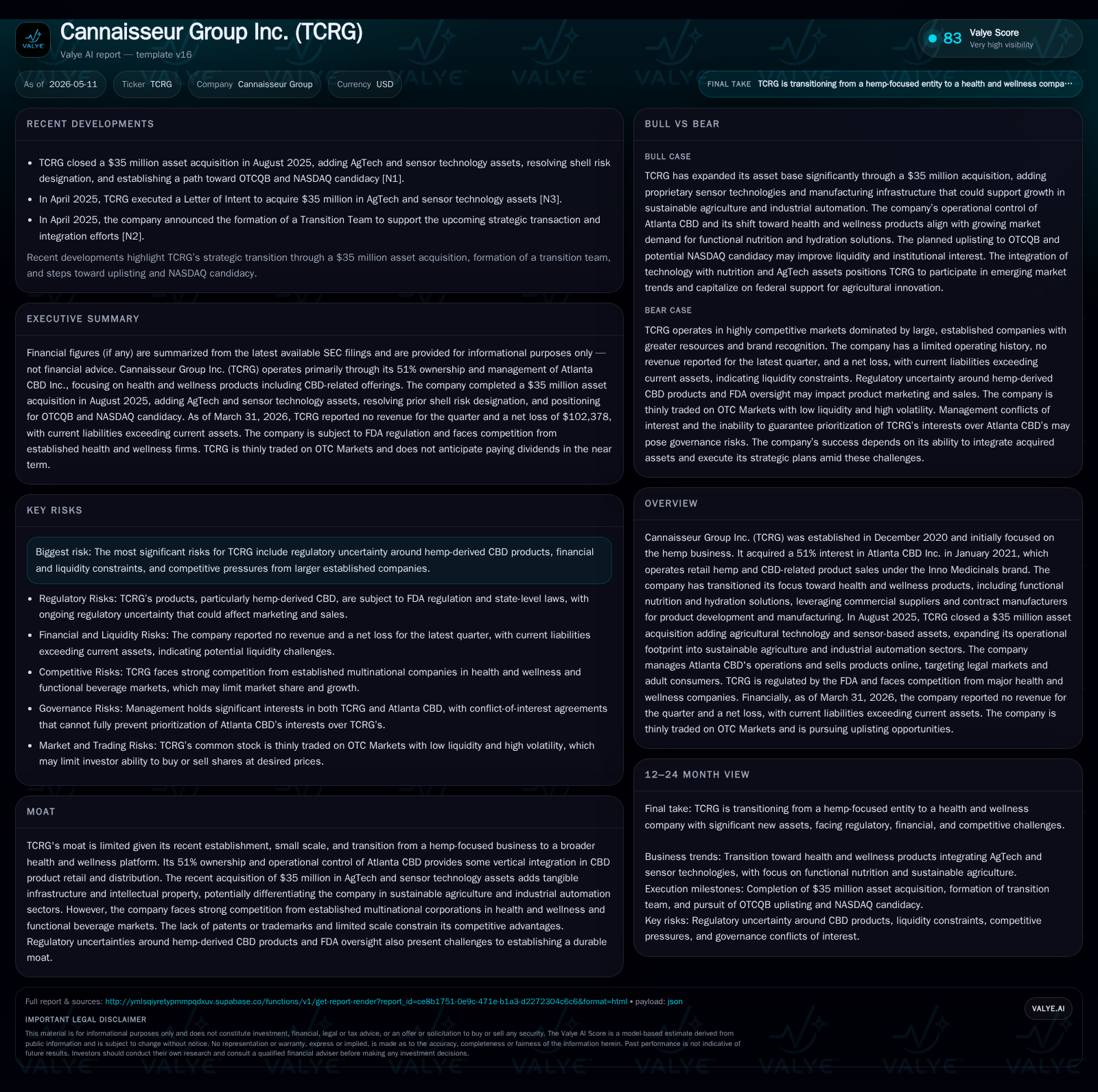
In its latest 10-Q filing dated May 11, 2026, Cannaisseur Group Inc. (TCRG) finalized a pivotal $35 million asset acquisition that expanded its footprint beyond hemp-derived CBD retail to include sustainable agriculture and sensor-based technology. This transaction resolves prior shell status concerns and sets the stage for OTCQB listing ambitions while diversifying revenue streams. The company's business model now encompasses health and wellness product sales via managed retail of Atlanta CBD products combined with advanced AgTech deployments. Despite promising growth catalysts around technology integration and digital health trends, TCRG faces significant regulatory uncertainties related to FDA oversight of hemp-derived products, limited scale, tight liquidity—with a current ratio near zero—and competitive pressures from entrenched players.
Latest Quarterly Developments: Operational Shift Takes Center Stage
The May 11, 2026 10-Q filing [S2] for Cannaisseur Group Inc. (TCRG) does not report revenues yet reflects a company actively reshaping its business profile following a $35 million asset acquisition completed in August 2025 [S4][S8]. This strategic transaction brought substantial agricultural technology assets—including sensor systems applicable to industrial safety, vehicle navigation, and agricultural monitoring—and processing infrastructure for soy-based human nutrition manufacturing onto TCRG’s balance sheet. Critically, this deal resolved the company’s prior shell risk designation and underpins planned uplisting efforts onto the OTCQB market as a precursor to eventual NASDAQ candidacy ambitions [S4].
This move transitions TCRG from a previously narrow focus on hemp CBD product retail into a two-pronged operational platform encompassing both health & wellness product sales (via the majority-owned Atlanta CBD) and high-tech AgTech applications leveraging advanced sensor IP and manufacturing assets. Management emphasizes this as laying the foundation for scalable revenue streams across sustainable agriculture innovation and functional nutrition sectors aligned with federal priorities [S8]. However, disclosures also note current delinquency in periodic filings due to transaction complexity [S8], with ongoing remediation efforts targeting reacquisition of public company information status.
Business Model and Product Offering: From Hemp to Health & Wellness with AgTech Backing
Originally founded in December 2020 with a core concentration on the hemp business, TCRG acquired a controlling 51% interest in Atlanta CBD in January 2021 [S1][S18]. Atlanta CBD operates retail hemp-derived product sales under the Inno Medicinals brand predominantly through direct-to-consumer online channels—https://innomedicinals.com—serving legal adult consumers in states permitting such sales [S23]. Beyond direct sales, Atlanta CBD employs contract drop-shipping arrangements and outsources fulfillment logistics [S7], indicating an asset-light operational structure on the retail side.
TCRG has directed Atlanta CBD's product mix away from pure hemp/CBD extracts toward broader health and wellness solutions including functional nutrition beverages and hydration products targeted at specific wellness goals [S1][S7]. This strategy taps into the growing digital health/wellness market estimated at near $350 billion currently with high projected CAGR rates approaching 19% over the next decade [S7]. However, product formulation remains reliant upon third-party commercial suppliers and contract manufacturers holding requisite regulatory licenses [S7]. This outsourcing model enhances scalability but limits proprietary control over core intellectual property or production capabilities.
Vertical integration is partial—TCRG owns majority control but Atlanta CBD is still partially family-owned—with solid alignment through conflict-of-interest agreements guarding against suboptimal prioritization between entities’ interests [S25]. The combined entity’s revenue stream depends largely on consumer purchases of formulated products via established online platforms complemented by wholesale or potential future retail expansions.
Manufacturing integration expanded significantly post-2025 acquisition which added soy processing facilities underpinned by proprietary operational IP enhancing TCRG’s manufacturing footprint beyond just finished product distribution [S8].
Market Landscape and Competitive Dynamics within Wellness and Agriculture Sectors
TCRG operates at the intersection of rapidly evolving but highly competitive sectors: hemp-derived health products alongside agricultural technology innovation targeting sustainability objectives. Large multinational corporations dominate these spaces, bringing both scale advantages and extensive brand recognition across functional beverage markets, digital wellness platforms, and industrial sensor technologies.
Consumer demand dynamics in functional nutrition/hydration are structurally driven by rising health consciousness, aging populations seeking personalized wellness solutions, clean-label preferences, and digital engagement—trends that favor innovation-led small players but mainly reward those who can establish credible differentiation amid fierce competition [S7].
On the AgTech front, federal incentives aimed at food security, domestic innovation, and resilient farming infrastructure provide tailwinds [S8]. Here TCRG’s newly acquired sensor technologies offer potential entry points into precision farming applications with radar/camera vehicle sensor synergies applicable in industrial automation [S8]. Yet this sector too is crowded by established tech firms investing heavily in R&D.
Despite these opportunities, TCRG's limited scale constrains pricing power; it lacks patent-protected IP portfolios typical of market leaders. Regulatory complexity also tempers prospects given ongoing FDA rulemaking over hemp-derived ingredients' usage in food/dietary supplements potentially imposing testing or marketing constraints [S24][S27].
Key Growth Catalysts: Technology Integration, Market Expansion, and Strategic Acquisitions
The $35 million acquisition transaction creates several strategic growth levers:
- Leveraging sensor-based AgTech assets to penetrate emerging verticals in sustainable agriculture where precision monitoring supports crop yields and resource efficiency aligns with governmental funding initiatives [S8].
- Expanding health & wellness portfolio beyond legacy CBD into functional beverages emphasizing hydration benefits taps into large addressable markets forecasted to grow above 6% annually globally over coming years [S7].
- Increasing direct-to-consumer sales penetration through enhanced e-commerce platforms backed by Atlanta CBD management expertise offering scope for wider market reach before pursuing brick-and-mortar retail presence.
- Pursuing regulatory clarity around FDA classification of hemp-derived ingredients could unlock new commercial formulations if approvals or favorable marketing conditions arise [S27].
These initiatives require precise execution of operational rollouts spanning supply chain optimization through contract manufacturer networks plus effective deployment of acquired manufacturing/IP assets. Leadership transitions introduced alongside acquisition completion spotlight intentions for seasoned management capable of orchestrating these complex integration tasks [S3][S8].
Risks and Headwinds: Regulatory Uncertainty, Financial Constraints, and Competitive Pressures
Regulatory risk remains preeminent—FDA's evolving regulatory stance on hemp-derived CBD products introduces significant uncertainty regarding permissible product claims, labeling requirements, or outright prohibitions potentially impacting go-to-market strategies [S24][S27]. Concurrent FTC scrutiny over advertising claims adds compliance burdens.
Liquidity issues are acute; as of Q1-end March 31, 2026 financials show cash & equivalents at only $45k versus current liabilities exceeding $270k—a current ratio effectively zero—which flags short-term solvency stress requiring rapid capital infusion or cost containment measures [F1][S2]. Operating losses persist reflecting investment phase expenses; no reported revenue for full-year ended December 31, 2025 underscores nascent commercialization stages with heavy costs outpacing income [F1]. Absence of directors & officers insurance heightens governance vulnerability possibly impacting talent retention or future litigation exposure given industry product liability risks typical in consumer health spaces absent robust coverage plans [S5][F1].
Competitive intensity from larger players armed with robust R&D budgets further challenges TCRG’s ability to secure defensible market share absent clear proprietary differentiation or scale advantages.
Upcoming Milestones and Indicators to Monitor
Investors should watch several key developments closely:
- Progression toward OTCQB listing status will signify improved public market standing supporting institutional engagement prospects [S4][S8].
- Operational integration timelines for the August 2025-acquired AgTech assets including ramp-up of manufacturing capabilities will be critical execution markers.
- Expansion trajectory for retail health & wellness lines managed by Atlanta CBD reflecting efficacy of e-commerce scaling efforts.
- Regulatory updates concerning FDA guidance on hemp-derived food/dietary supplements could materially affect product development windows or marketing scope.
- Potential capital raises or equity offerings given liquidity deficits expected to fund growth initiatives without compromising shareholder value excessively.
- Leadership hires or board changes indicating strengthening governance toward executing diversified business strategy.
Financial Snapshot: Liquidity, Debt Profile, and Operating Performance
Latest financial snapshot
| Metric | Value | Period |
|---|---|---|
| Cash & equivalents | $45 | |
| 2026-03-31 | ||
| Current assets | $163 | |
| 2026-03-31 | ||
| Current liabilities | $273580 | |
| 2026-03-31 | ||
| Current ratio | 0x | |
| 2026-03-31 |
Source: SEC companyfacts cache [F1].
| Metric | Value (USD) | Date |
|---|---|---|
| Cash & Equivalents | 45 | |
| 2026-03-31 | ||
| Total Debt | 118160 | |
| 2024-09-30 | ||
| Current Assets | 163 | |
| 2026-03-31 | ||
| Current Liabilities | 273580 | |
| 2026-03-31 |
As reflected above based on most recent SEC data accessed May 11, 2026 ([F1]), TCRG closes Q1 with extremely tight liquidity conditions evidenced by current liabilities outstripping current assets nearly tenfold resulting in a zero current ratio. Operating performance remains loss-making with last full year ended Dec 2025 showing net losses exceeding $1.7 million but these should be viewed as investments supporting the sizeable shift into multi-sector operations involving capital-intensive AgTech assets combined with early-stage health & wellness commercialization efforts. Debt levels are notable but should be considered in the context of the company’s asset base and ongoing financing needs.
Disclaimer: This is research-only, informational analysis and not investment advice. It may include AI-generated interpretation and general industry context. Always verify important details using primary sources.

Comments