
Bank7 Corp.'s Q1 Results Highlight Strength in Community Banking and Credit Management
Q1 2026 filings demonstrate Bank7's solid loan portfolio growth, robust capital position, and liquidity enhancements supporting its community banking franchise.
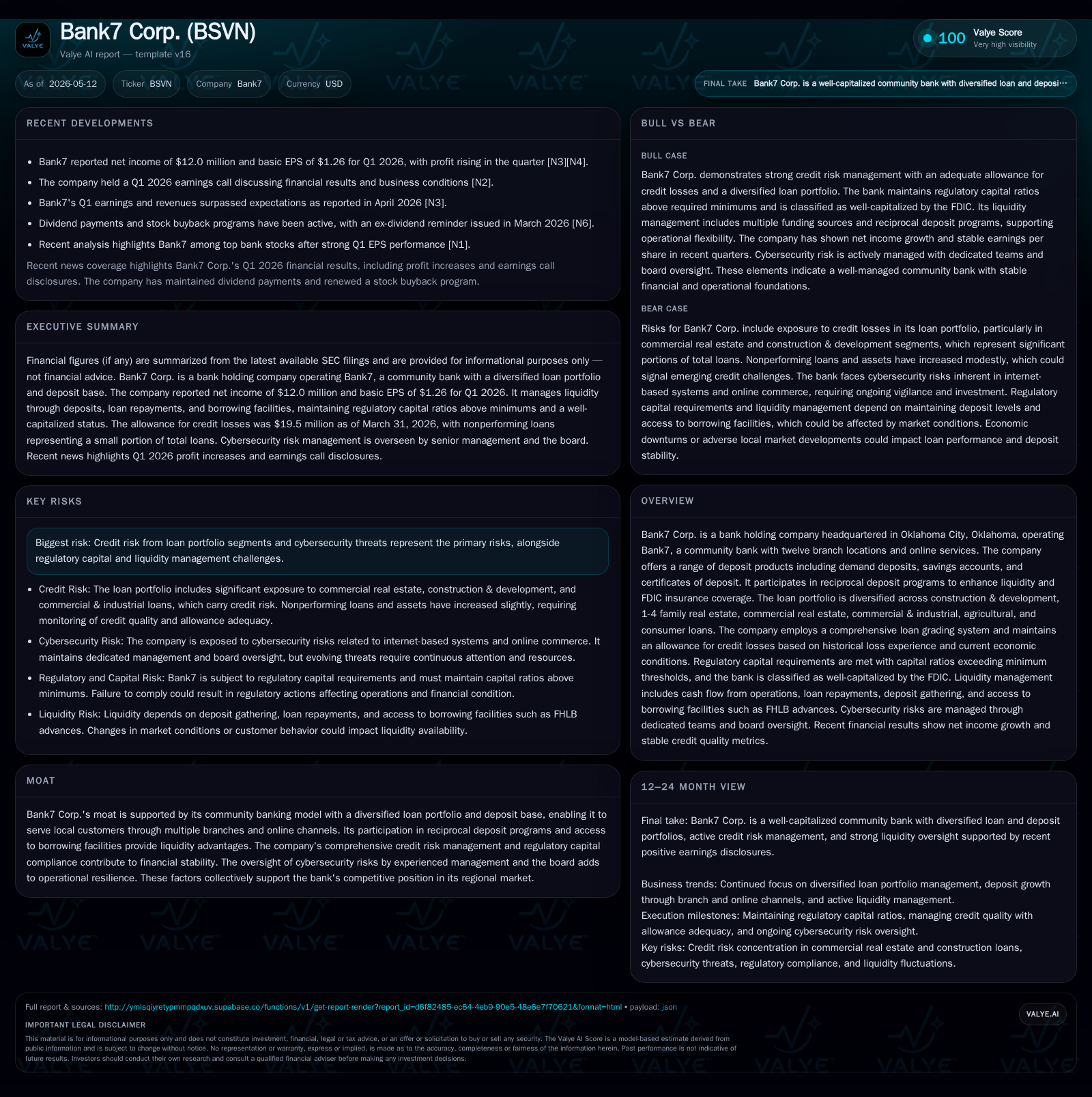
Bank7 Corp.’s latest quarterly disclosures reveal continued operational strength rooted in a diversified loan portfolio and prudent credit risk management. The company maintains regulatory capital ratios comfortably above requirements, sustaining its well-capitalized status. Its liquidity position benefits from reciprocal deposit programs and borrowing capacity with the FHLB and Federal Reserve. These fundamentals undergird Bank7’s competitive positioning within its regional market and frame a cautiously optimistic outlook amid evolving regional lending conditions.
Recent Quarterly Operating Update: Q1 2026 Performance Highlights
Bank7 Corp’s first quarter filing on May 11, 2026 ([S2]) confirms operational momentum reflecting strong execution of its community banking strategy. Q1 earnings surpassed consensus estimates as the bank reported increased net interest income driven by loan portfolio growth across key segments, particularly commercial real estate and construction loans. Credit quality metrics remain stable; nonaccrual loans and watch-list exposures showed limited deterioration. Management highlighted no material changes in asset quality even as economic headwinds persist regionally ([N1], [N2]).
Reciprocal deposits grew to approximately $644 million as of March 31, 2026 ([S21]), representing an increase from year-end levels. Availability of borrowing capacity with the Federal Home Loan Bank (FHLB) topped $218 million; additionally, the bank retains access to over $300 million from the Federal Reserve liquidity facility ([S4], [S9]). Capital ratios are solid with tier 1 capital ratio at about 12.8%, exceeding regulatory minimums, confirming the FDIC's well-capitalized classification that shields the bank against potential shocks ([S6], [S9]).
Bank7's Business Model: Community Banking with Diversified Deposits and Loans
Bank7 operates primarily as a regional community bank based in Oklahoma City with twelve physical branch locations complemented by online banking platforms (, [S1]). The business generates revenue mainly through diverse loan products including construction & development (C&D), one-to-four family real estate, commercial real estate (CRE), commercial & industrial (C&I), agricultural loans, and a smaller consumer loan segment.
The bank’s deposit base is built on a mix of demand deposits, savings accounts, certificates of deposit (CDs), and brokered deposits complemented by active participation in reciprocal deposit programs such as CDARS and ICS. These programs enhance deposit insurance coverage while optimizing funding costs ([S21]). Brokered deposits declined from $205 million at year-end to $135 million at quarter-end, signaling a strategic de-emphasis on higher-cost funding sources.
Revenue mechanics revolve around net interest margin—banks collect interest on loans funded largely by low-cost noninterest-bearing demand deposits along with interest-bearing deposits. Loan volume growth drives interest income expansion while deposit stability supports funding costs. Bank7’s comprehensive loan grading system segments loans into pass, watch, special mention, and substandard categories based on repayment risk factors informed by internal reviews and economic conditions ([S16], [S23]). The allowance for credit losses stood at $19.5 million as of March 31, 2026 reflecting prudent reserving practices calibrated to historical charge-offs adjusted for current risk environment ([S26], ).
Competitive Positioning in the Regional Banking Market
Within its regional footprint, Bank7 occupies a niche as a trusted community financial institution combining localized service delivery through physical branches with digital banking capabilities permitting expanded customer access beyond geographic constraints (, [S1]). Brand trust cultivated through community engagement remains a barrier to entry for competitors lacking similar network depth.
Bank7 complements its market presence with robust liquidity management evident in reciprocal deposit participation which reduces reliance on volatile brokered funds; this comparative advantage provides more flexibility than some peers reliant on wholesale funding sources. Moreover, its multi-layered IT governance structure supervised by senior executives including the COO/IT Manager—with cybersecurity functions managed by dedicated committees—and the Cyber Incident Response Team chaired by experienced leadership ensure vigilant operational risk oversight ([S1]). Such controls serve as defenses against increasing cyber threats endemic to modern regional banks.
Growth Drivers: Loan Portfolio Expansion and Digital Services Adoption
Key growth catalysts for Bank7 include sustained origination activity within commercial real estate — especially other CRE sectors — alongside construction & development loans that collectively accounted for over $900 million in gross loans as of quarter-end ([S2], [S22]). The bank’s ability to expand lending hinges on maintaining high-quality underwriting standards while leveraging available capital and liquidity buffers.
Digital banking is an increasingly critical channel for customer acquisition and retention. Bank7’s investment in online services enhances deposit gathering efficiency while facilitating cross-selling of ancillary products such as CDs and small business loans ([N4]). This multi-channel distribution strategy positions it favorably among technologically adept customers without forsaking personal relationship banking valued by traditional clients.
Management commentary during recent earnings calls emphasized cautious optimism given local market demand dynamics alongside enhanced efforts at loan diversification spreading sector concentration risks ([N1]).
Risks and Constraints: Credit Quality, Cybersecurity, and Regulatory Compliance
While credit quality currently remains stable, the cyclical nature of construction-related lending poses inherent risk should regional economic conditions deteriorate unexpectedly. The loan classification framework flags watchlist concentrations primarily within commercial segments necessitating continuous surveillance ([S16]).
Cybersecurity risks are noted prominently in the annual report’s risk factors section reflecting industry-wide challenges related to fraud, hacking attempts, and identity theft intrusions targeting internet-based systems ([S1], ). Bank7 addresses these via explicit governance structures including periodic board reporting on network health risks.
Regulatory capital compliance represents another ongoing constraint given evolving prudential standards under Basel III frameworks requiring maintenance of specific buffers further compounded by prompt corrective action rules ensuring safety and soundness ([S9], [S29]). Failure to comply could limit dividend payments or strategic flexibility although current capital metrics provide ample cushion.
Upcoming Catalysts and Monitoring Points
Investors should monitor upcoming quarterly earnings releases for indications of accelerating loan originations or shifts in product mix that could impact net interest margins. Attention to changes in allowance for credit losses will signal evolving management views on asset quality.
Deposit growth trends amidst competitive rate pressures warrant close observation since they directly affect funding costs and liquidity positioning. Furthermore, tracking any cybersecurity incident disclosures or regulatory commentary will provide insights into operational resilience or emerging vulnerabilities ([S2], [N3]).
Financial Snapshot: Capitalization and Liquidity Status
As of March 31, 2026 ([S6], [S9]), Bank7 reported total shareholders' equity at approximately $259.8 million reflecting a sequential increase from $251.0 million at year-end 2025. Tier 1 capital ratio stood at roughly 12.82%, well above minimum regulatory thresholds ensuring continued "well-capitalized" status under FDIC guidelines. Total capital to risk-weighted assets ratio was about 15.96%, comfortably exceeding Basel III requirements inclusive of conservation buffers ([S25], [S29]).
No significant long-term debt was recorded consistent with conservative balance sheet management practices minimizing leverage risks while ensuring operational flexibility.
This analysis summarizes publicly filed information without providing investment advice or recommendations. Readers should consult official filings directly for detailed disclosures or seek professional counsel tailored to their specific needs.
Disclaimer: This is research-only, informational analysis and not investment advice. It may include AI-generated interpretation and general industry context. Always verify important details using primary sources.

Comments