
XOMA Royalty Corp Strengthens Liquidity and Revenue Base Prior to Ligand Merger
XOMA Royalty reported improved net income and cash position in Q1 2026 while preparing for a strategic acquisition by Ligand Pharmaceuticals.
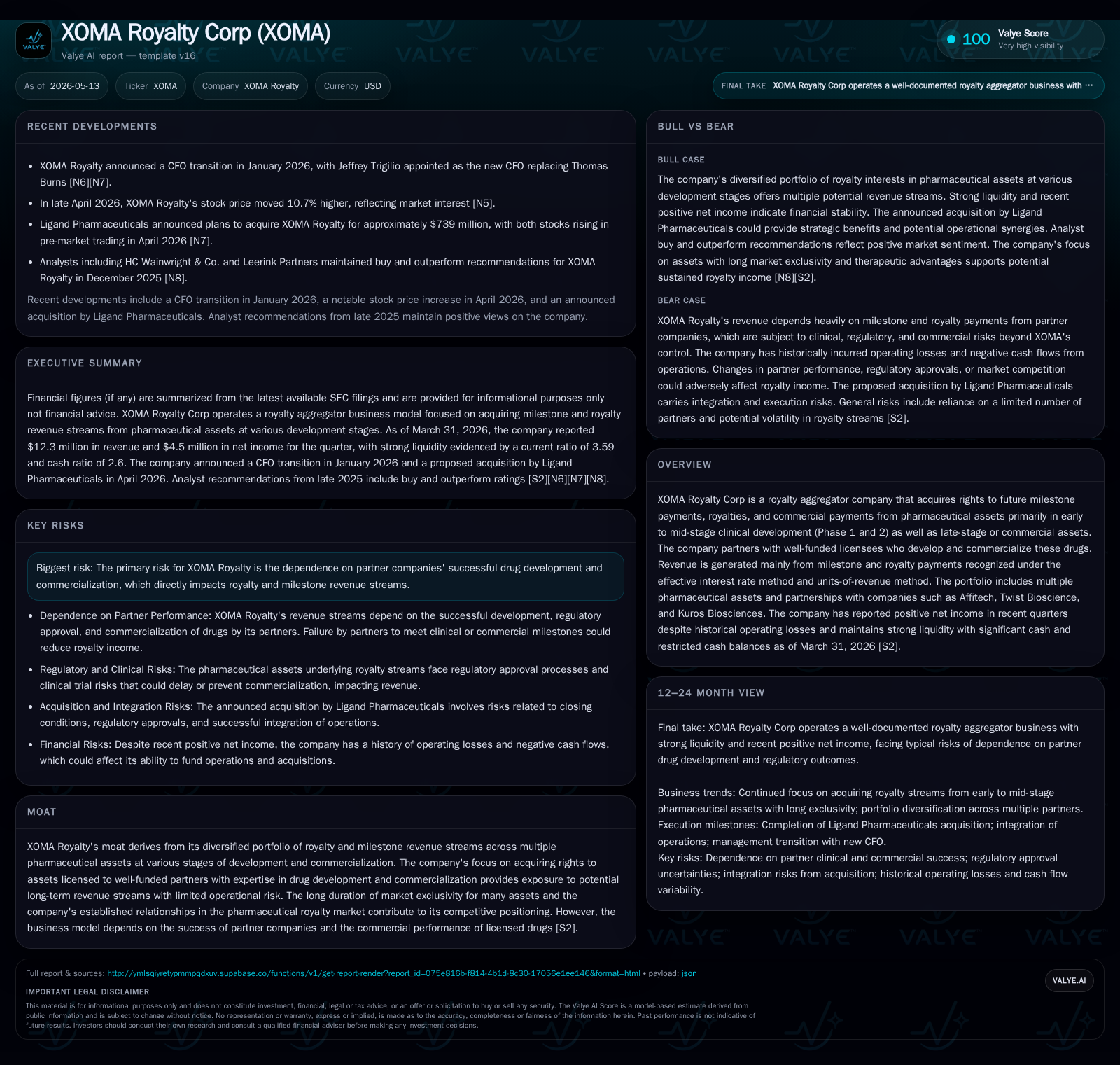
In its latest quarter ending March 31, 2026, XOMA Royalty Corporation showcased solid operational momentum, registering net income of $4.5 million and bolstering cash reserves to $138.7 million. The company’s royalty aggregator model, which centers on acquiring milestone and royalty payment rights from diverse pharmaceutical assets, continues to generate revenue streams with limited operational risk. XOMA's business hinges on well-capitalized licensees advancing drug candidates across clinical phases, with revenue recognized using effective interest rate and units-of-revenue methods. The impending merger agreement with Ligand Pharmaceuticals represents a strategic inflection point. However, dependency on partner commercialization success alongside regulatory and clinical development risks remains key watchpoints.
Recent Operating Update: Solid Performance Ahead of Merger
XOMA Royalty Corporation’s first-quarter financial results for the period ended March 31, 2026, exhibit steady improvement in operational metrics alongside a robust liquidity position [S2]. The company reported net income of approximately $4.5 million for Q1, nearly doubling the comparable period’s $2.4 million — an outcome driven by increasing milestone and royalty income coupled with gains on acquisitions [S16]. Concurrently, total cash and restricted cash balances rose to about $138.7 million at quarter-end from $95.0 million a year earlier [S19][F1], underscoring strong financial flexibility vital for funding ongoing royalty purchases or settling contingent obligations.
A notable event shaping the near-term outlook is XOMA's April 2026 entry into a definitive merger agreement with Ligand Pharmaceuticals Incorporated [S3][N5]. This transaction has received unanimous approval from XOMA’s board indicating confidence in the strategic rationale, although closure depends on customary approvals and market conditions. The pending merger represents a transformational milestone potentially unlocking synergies through consolidation but adds near-term execution risk.
Business Model: Royalty Aggregation with Diversified Risk Exposure
Operating as a royalty aggregator since 2017, XOMA acquires rights to future milestone payments, royalties, and commercial proceeds associated with pharmaceutical assets at various development stages [S2][S1]. These encompass early- to mid-stage (Phase 1/2) pipeline drugs licensed to financially capable partners along with late-stage or commercialized products addressing unmet medical needs or offering therapeutic advantages.
Revenue generation revolves around milestone achievements and sales-based royalties paid by licensees such as Affitech Research AS, Twist Bioscience Corporation, Kuros Biosciences AG, among others [S2]. Recognition aligns primarily with the effective interest rate (EIR) method for purchased receivables tied to expected future payments plus the units-of-revenue method for certain contracts [S2][S16]. This approach smoothens income recognition over time based on underlying asset performance rather than raw cash flows.
This asset-light model confines operational risk by outsourcing development, manufacturing, marketing, and regulatory responsibilities to skilled licensees while retaining exposure linked predominantly to partners’ drug progression success. By diversifying across multiple agreements covering different therapeutic areas and stages, XOMA mitigates specific program failures although systemic biotech sector volatility remains a factor.
Industry Structure and Competitive Position
The pharmaceutical royalty aggregator niche intersects capital markets expertise with biotech innovation cycles. Players like XOMA compete by sourcing discounted royalty streams from early investments or existing revenue-generating products. Distinct from pure R&D biotechs or developers, these companies provide non-dilutive capital solutions enabling small/mid-sized firms to monetize part of their royalty rights upfront.
XOMA’s competitive positioning benefits from its experience in evaluating clinical pipelines’ commercial potential, structuring deals that balance risk/return profiles favorably, and cultivating long-term partnerships with well-funded biotech operators [S1]. The company’s ability to obtain diversified asset portfolios reduces idiosyncratic risk compared to single-drug royalties.
Its moat derives partly from extensive industry relationships facilitating access to attractive royalty opportunities not widely available in public markets. The duration of exclusivity rights typically extends the revenue tail beyond patent expiry due to formulation patents or market barriers.
Growth Drivers
A core growth driver lies in expanding the portfolio through acquisitions of additional royalty rights on promising pharmaceutical assets or late-stage commercial molecules [S2]. The company’s capital strength enables it to participate flexibly in auctions or negotiated transactions for royalties or milestone rights.
Milestone payments hinge on partners achieving clinical trial endpoints, regulatory approvals (FDA or global bodies), and eventual product launches—each representing potential triggers for lump-sum income bursts enhancing short- to medium-term cash flow visibility [S14].
Furthermore, escalation in underlying drug sales volume supports rising recurring royalty streams recognized via the units-of-revenue method—offering structural revenue growth independent from new acquisitions when commercialization succeeds.
The pending merger with Ligand Pharmaceuticals could also act as a catalyst for lifting scale by integrating complementary royalty portfolios or leveraging combined resources for deal sourcing efficiency [S3].
Risks and Watchpoints
XOMA's success is fundamentally tied to its partners' ability to advance candidate drugs through costly and uncertain clinical development paths culminating in market approvals [S14]. Failure or delay at any phase can impair milestone receipts or reduce potential sales-based royalties leading to volatile revenue streams.
Additionally, increases in operating expenses observed this quarter—especially general administration costs—may pressure margins if not controlled amid scaling efforts [S16]. Amortization expense linked to intangible asset basis emerges as another incremental cost needing monitoring.
Regulatory risks including shifting approval standards or safety concerns can abruptly alter project viability impacting anticipated payouts. The ongoing merger introduces execution risk related to integration complexities or potential erosion of standalone strategic options.
Finally, while liquidity remains strong—with unrestricted cash plus equivalents near $85.6 million and total restricted cash at $53.1 million—the company must carefully manage capital deployment across acquisitions versus flexibility needs [F1][S19]. Total debt was last reported historically low relative to cash holdings resulting in a favorable net debt position.
What to Watch Next
Key milestones include progress toward closing the proposed merger with Ligand Pharmaceuticals following stockholder approval processes expected within the next few quarters [S3]. Investor attention will likely focus on updates about deal timing as well as any competing bids.
Operationally important are updates on clinical development timelines for portfolio assets managed by partners such as Affitech's VABYSMO program or Kuros Biosciences' pipelines that may trigger material milestones elevating near-term revenues [S2]. Monitoring trajectory of contributions from recent acquisitions like Generation Bio will provide insight into portfolio integration success.
Financially, forthcoming quarterly filings should clarify patterns in operating expenses alignment post-merger announcement alongside revenue stability across diversified royalty contracts. Continued maintenance of strong liquidity ratios would support sustained investment capacity.
Financial Profile Summary
Latest financial snapshot
| Metric | Value | Period |
|---|---|---|
| Cash & equivalents | $86mm | |
| 2026-03-31 | ||
| Current assets | $119mm | |
| 2026-03-31 | ||
| Current liabilities | $33mm | |
| 2026-03-31 | ||
| Current ratio | 3.59x | |
| 2026-03-31 |
Source: SEC companyfacts cache [F1].
As of March 31, 2026, XOMA Royalty holds $85.6 million in unrestricted cash and equivalents complemented by $53.1 million in restricted cash totaling roughly $138.7 million overall liquidity [F1][S19]. Current assets stand at nearly $118.7 million against current liabilities of approximately $33.1 million delivering a current ratio above 3.59—a healthy buffer for obligations [F1].
While historical total debt information dates back several years at about $9.4 million without recent increments noted explicitly in filings ([F1]), net debt is strongly negative considering cash levels—underscoring balance sheet strength ahead of potential acquisition activity.
Q1 revenues aggregated around $12.3 million came largely from income associated with purchased receivables under both EIR ($9.2M) and cost recovery ($2.8M) methods showing diversity despite modest sequential decline versus prior year quarter [$15.9M] driven partially by contract timing differences [S16]. Operating expenses climbed notably mainly due to general administrative spending jumping around 45% YoY coupled with higher amortization reflecting expanded intangible assets base resulting from acquisitions [S16].
This analysis reflects publicly available information as of May 13, 2026. It is intended solely for research purposes without investment advice or recommendations.
Disclaimer: This is research-only, informational analysis and not investment advice. It may include AI-generated interpretation and general industry context. Always verify important details using primary sources.

Comments