
Nuo Therapeutics Accelerates Wound Care Innovation Following CMS Reimbursement Boost
Nuo Therapeutics advances commercial traction for its Aurix System, leveraging FDA clearance and strategic distribution amid early revenue growth and reimbursement momentum.
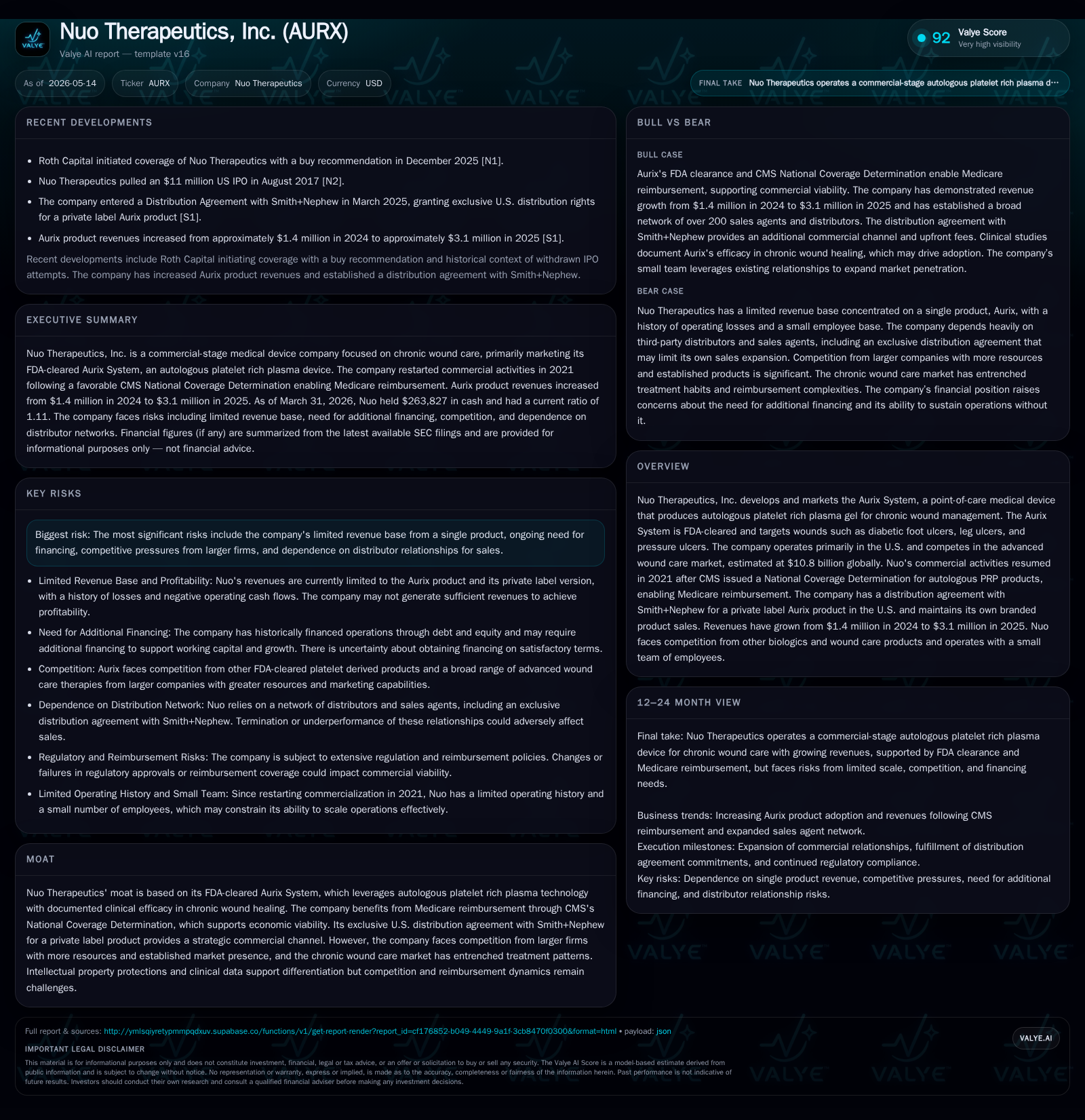
In Q1 2026, Nuo Therapeutics reported continued expansion of Aurix System revenues, supported by a favorable Medicare National Coverage Determination enabling reimbursement. The company’s business model centers on its FDA-cleared autologous platelet rich plasma device addressing difficult chronic wounds, with strategic growth fueled by a private label distribution agreement with Smith+Nephew. Despite a nascent operating history and competitive market dynamics, Nuo leverages clinical differentiation and reimbursement policy to drive adoption in the advanced wound care sector. Key risks include concentrated product exposure, ongoing losses, and dependence on scalable financing.
Recent Operating Update Reflects Early Commercial Gains
Nuo Therapeutics' Q1 2026 disclosure [S2] reinforced steady commercial momentum following their re-entry into the market in May 2022 after CMS’s National Coverage Determination (NCD) enabled Medicare reimbursement. Revenue growth continues on an upward trajectory, having grown product revenues from approximately $1.4 million in 2024 to $3.1 million in 2025 [S1], reflecting increasing clinical adoption of the Aurix System. In addition to direct branded sales, revenues incorporate income from the private label Aurix product supplied to global medical device leader Smith+Nephew under an exclusive U.S. distribution agreement since March 2025 [S26]. The first quarter showed no material changes to risk disclosures [S2], maintaining previously outlined concerns over capital requirements and competitive pressures.
This nascent but positive progression spotlights incremental penetration into chronic wound care providers, predominantly within the U.S., setting the stage for further revenue scaling as Nuo cultivates deeper clinical/end-user relationships.
Aurix System: Innovation in Autologous Platelet-Rich Plasma Therapy
At its core, Nuo Therapeutics’ business model revolves around the Aurix System—a point-of-care medical device cleared by the FDA under Section 510(k) since 2007 [S21]. The device processes a patient's peripheral blood sample to isolate an autologous platelet rich plasma (PRP) gel enriched with naturally occurring growth factors and cytokines that promote angiogenesis and tissue regeneration critical for healing chronic wounds such as diabetic foot ulcers, leg ulcers, and pressure ulcers [S22].
Aurix distinguishes itself from conventional wound care products by harnessing the patient’s own biological material rather than relying on synthetic dressings or externally sourced agents. By releasing bioactive molecules at the wound site via hematogel application, Aurix aims to restore healing balance disrupted in non-healing wounds [S23]. This biological approach targets intrinsic repair pathways absent in standard treatments.
The device’s value proposition includes:
- FDA clearance assures regulatory compliance important for hospital procurement.
- Point-of-care setup allows convenient onsite preparation without complex lab processing.
- Autologous nature minimizes risk of immune reaction or transmission.
- Coverage by Medicare following a favorable NCD enhances reimbursements crucial for provider uptake [S22].
Such features position Aurix strategically as an adjunct or alternative for addressing persistent wounds that burden healthcare systems economically and clinically.
Competitive Dynamics in the Advanced Wound Care Sector
The chronic wound treatment landscape is crowded with competitors spanning pharmaceutical biologics, advanced dressings, bioengineered skin substitutes, and other medical devices [S1], [S7]. Nuo competes principally within the biologics niche offering autologous PRP therapies—one among three FDA-cleared platelet-derived products used widely for exuding wounds.
Key competitive challenges include:
- Established preference patterns among clinicians favoring incumbent therapies supported by longer track records or broader use-case applications.
- Larger companies possessing deeper capital pools for marketing development and expansive salesforces offering bundled wound care solutions.
- Price sensitivity due to budgetary constraints at hospitals and payor-driven cost controls limiting premium therapy adoption.
Nuo’s differentiation rests on the unique autologous preparation mechanism combined with a lean operating model emphasizing select clinical segments where regenerative therapy has high perceived value [S7]. However, switching costs are moderate given availability of alternative biologics; thus incremental clinical outcomes evidence and provider education will be vital for sustainable uptake.
Its partnership with Smith+Nephew introduces a formidable channel partner with broad customer access but also entails risk as Smith+Nephew’s private label product directly competes with Nuo’s branded Aurix offerings [S24]. Maintaining dual-channel alignment requires navigating channel conflict while expanding overall market footprint.
Key Growth Drivers: Reimbursement Momentum and Distribution Expansion
A pivotal catalyst underpinning Nuo’s growth prospects is the CMS National Coverage Determination issued in April 2021 that enables Medicare reimbursement of autologous PRP products including Aurix when clinically indicated for diabetic wounds over extended treatment intervals [S22]. Prior to this decision, lack of coverage restricted addressable market size and economic feasibility for providers. The NCD followed a formal reconsideration request supported by outcomes data collected during CMS’s Coverage with Evidence Development program [S23].
Reimbursement advantages translate directly into:
- Improved provider willingness to adopt biologic options due to viable revenue streams supporting cost recovery.
- Greater confidence among payors regarding effectiveness linked to mandated data collection under coverage conditions.
- Potential acceleration of private payer coverage mirroring Medicare policies.
Complementing reimbursement progress is the strategic alliance with Smith+Nephew that commenced commercial supply in October 2025. Under this five-year exclusive U.S. distribution deal for the private label Aurex product variant [S26][S27], Nuo benefits from upfront fees totaling $1.5 million plus potential performance-based incentives contingent upon securing reimbursement milestones—a structure aligning incentives between manufacturer and distributor while extending sales reach beyond Nuo’s direct commercial capacity.
Furthermore, Nuo sustains efforts to broaden its direct sales footprint via a growing network of over 200 third-party representatives targeting outpatient-focused wound care practices alongside hospital systems [S26]. This expansion aligns well with shifting healthcare delivery trends emphasizing ambulatory care settings where early intervention can reduce hospitalization rates.
Demographic tailwinds such as increasing prevalence of diabetes and aging populations in developed countries underpin long-term demand structurally [S22]. Approximately 1–2% of populations suffer chronic wounds during their lifetime, representing several hundred thousand potential new patients annually justifying sustained market growth assumptions.
Critical Risks: Market Adoption, Financing Needs, and Competitive Pressures
Despite encouraging signals, several significant risks could materially constrain Nuo's trajectory:
- Single Product Concentration: Revenues derive solely from Aurix (including private label), exposing Nuo to vulnerabilities if commercialization stalls or regulatory/competitive setbacks occur [S20].
- Limited Operating History: Commercial relaunch occurred only in late 2021; cumulative adoption remains at an early stage necessitating proving scale economics while navigating unfamiliar operational complexity including manufacturing scale-up for private label supply [S20][S24].
- Ongoing Losses & Capital Dependency: The company reported net losses around $2.5 million in 2025 without profitability visibility yet; cash resources are modest requiring additional financing rounds subject to market conditions which pose execution risks [S20][F1].
- Distributor Reliance & Channel Risks: Dependence on Smith+Nephew's success in establishing its Private Label within competitive channels presents revenue concentration risk; any termination or performance shortfall could adversely impact results significantly [S24].
- Competitive Landscape & Pricing Pressure: Market incumbents benefit from entrenched contracting arrangements and diversified portfolios making price competition acute; switch costs remain low given multiple comparable treatment options [S7][S24].
- Regulatory Environment Uncertainty: Evolving health policy focusing on cost-containment may lead payors or governing bodies to narrow coverage or impose utilization controls restricting therapy volumes; compliance costs related to FDA quality system regulation add ongoing operational burden [S18][S22].
Upcoming Milestones and Industry Catalysts to Monitor
Key developments will shape investor and industry sentiment going forward:
- Quarterly Revenue Trajectory: Continued reporting of top-line revenue will provide indications of scaling clinical penetration beyond initial adopter cohorts following the launch ramp post-2022 [S3].
- Expansion of Sales Channels: Tracking growth metrics from existing third-party representatives as they extend reach into outpatient/private office settings versus hospital-centric deployments will elucidate effective go-to-market strategy execution [S26].
- International Regulatory Approvals: Pursuit or attainment of regulatory clearances from Health Canada, European Medicines Agency or Japanese Ministry could unlock parallel markets but each entails considerable hurdles illustrated by distinct regulatory requirements beyond FDA clearance standards [S6][S13].
- Clinical Data Updates & Publications: Ongoing generation of robust real-world evidence confirming improved healing outcomes relative to standards of care will be instrumental in negotiating further payor coverage enhancements across both government programs and private insurers.
- Reimbursement Policy Evolution: Monitoring potential CMS updates or state Medicaid policy revisions affecting utilization limits or payment levels remains critical given direct influence on treatment economics [S22][S25].
- Smith+Nephew Distribution Performance: Confirmation of minimum purchase commitments adherence and market acceptance of Private Label product will inform sustainability of this revenue stream amid increasing competition within advanced wound care biologics segment [S24][S27].
Current Financial Position: Liquidity and Capital Structure Snapshot
Latest financial snapshot
| Metric | Value | Period |
|---|---|---|
| Cash & equivalents | $263827 | |
| 2026-03-31 | ||
| Current assets | $1520241 | |
| 2026-03-31 | ||
| Current liabilities | $1369238 | |
| 2026-03-31 | ||
| Current ratio | 1.11x | |
| 2026-03-31 |
Source: SEC companyfacts cache [F1].
As of March 31, 2026, available financial data depict a lean balance sheet reflective of early-stage commercialization requiring careful financial stewardship [F1]:
| Metric | Amount (USD) | Period End |
|---|---|---|
| Cash & Equivalents | $263,827 | |
| 2026-03-31 | ||
| Current Assets | $1,520,241 | |
| 2026-03-31 | ||
| Current Liabilities | $1,369,238 | |
| 2026-03-31 | ||
| Current Ratio | 1.11 | |
| 2026-03-31 |
Notably:
- No outstanding debt reduces leverage risks but also limits external capital buffers beyond equity financing routes.
- Current ratio slightly above one indicates marginal ability to cover short-term obligations without liquidity strain but highlights tight working capital constraints given ongoing operating losses.
- Absence of substantial cash reserves reinforces importance of timely successful funding rounds or partnerships to extend operational runway given elevated burn rate implicit in scaling production/distribution infrastructure.
This snapshot complements qualitative concerns regarding the necessity for continuous capital access as articulated repeatedly within management commentary on forward liquidity needs while underscoring flexibility afforded by absence of debt obligations which often impose restrictive covenants at this developmental stage.
Disclaimer: This analysis is based solely on publicly available information including SEC filings through May 14, 2026 ([S1], [S2], [S3]) and validated financial snapshots ([F1]). It does not constitute investment advice or recommendations but provides an informed assessment grounded strictly on disclosed operational facts.
Disclaimer: This is research-only, informational analysis and not investment advice. It may include AI-generated interpretation and general industry context. Always verify important details using primary sources.

Comments