
Biofrontera Inc. Consolidates U.S. Commercial and Clinical Control, Pivoting Toward Growth in Photodynamic Therapy
Recent acquisition of U.S. rights to Ameluz and RhodoLED facilitates integrated strategy to expand dermatology market share.
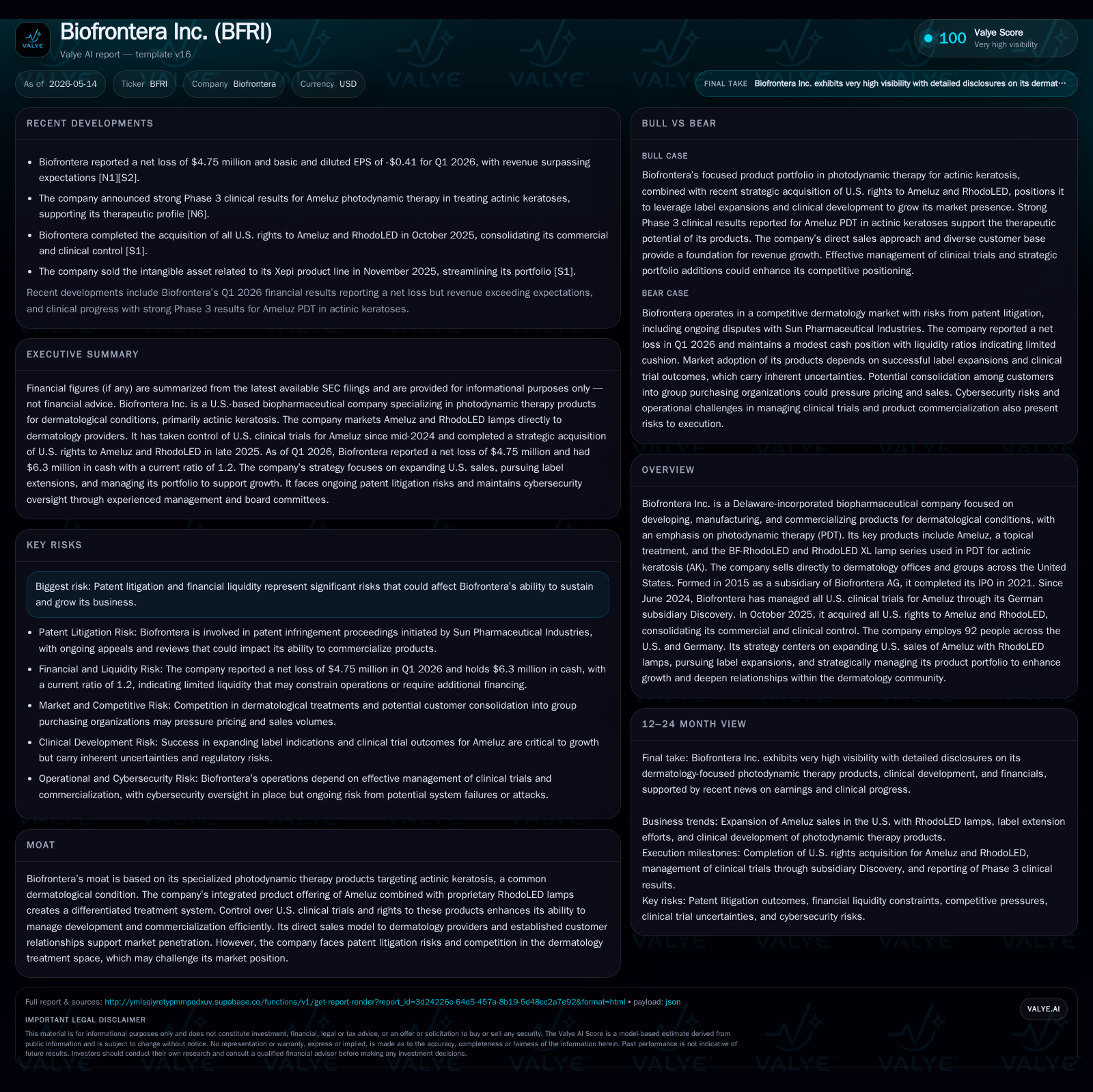
Biofrontera Inc.'s latest 10-Q and supporting filings reveal a pivotal transition after acquiring full U.S. rights to its key products, Ameluz and RhodoLED lamps, in October 2025. This consolidation empowers direct clinical trial oversight and commercial expansion targeting actinic keratosis treatment in dermatology offices nationwide. The firm's business model centers on selling a differentiated photodynamic therapy system directly to clinicians, supported by ongoing R&D for label extensions. While growth engines stem from new indications and expanding the customer base, patent litigation risks and Nasdaq listing price concerns remain key watchpoints ahead of upcoming milestones.
Recent Operating Update
Biofrontera Inc.’s latest quarterly filing dated May 14, 2026 (10-Q) confirms ongoing momentum following its strategic acquisition in October 2025 of all U.S. rights to the photodynamic therapy assets Ameluz and RhodoLED lamps [S2][S3]. This transaction consolidated commercial and clinical responsibilities within Biofrontera’s U.S.-based operations, enabling tighter control over marketing, sales efforts, and clinical development programs previously managed partially by its German parent or partners. Most notably, since June 1, 2024, Biofrontera assumed full oversight of all U.S. clinical trials for Ameluz through its German Discovery subsidiary formed in 2022—a move that aims to optimize trial management efficiency and cost structure [S1].
Despite reporting net losses in Q1 2026, Biofrontera beat revenue expectations according to external news sources [N1], underscoring the underlying commercial traction driven by its specialized offerings within the dermatology treatment landscape.
Business Model
Biofrontera operates a focused biopharmaceutical business model centered on the development, manufacturing, and commercialization of treatments for dermatological conditions emphasizing photodynamic therapy (PDT). Its core product suite comprises:
- Ameluz: A proprietary topical drug specifically indicated for treating actinic keratosis (AK), a prevalent precancerous skin condition.
- RhodoLED Lamps: Devices designed to activate Ameluz via light exposure during treatment sessions.
Revenue is generated predominantly through direct sales of these products to dermatology offices and groups across the United States—constituting an end-to-end drug-device combination sales approach [S1][S13]. The direct sales model facilitates stronger relationships with prescribing physicians while enabling targeted educational support to encourage patient adoption.
Margins are influenced by product mix (drug vs device), pricing agreements with clinics or group purchasing organizations (GPOs), treatment usage frequency per patient, and contract renewals or throughput increases within established accounts. The company also engages in label expansion R&D intended to broaden indications beyond minimally/moderately thick AK lesions on the face and scalp, thereby addressing a larger patient population segment [S1][S7].
Industry Structure and Competitive Position
The dermatology therapeutics market is highly specialized with significant barriers around drug-device integration quality, regulatory approvals for clinical efficacy/safety, and patent protections. Biofrontera’s moat is anchored in its unique PDT system combining Ameluz with proprietary RhodoLED lamp technology—a pairing that differentiates it from competing standalone drugs or laser/light therapy alternatives.
Competition includes established pharmaceutical firms with broader dermatology portfolios as well as emerging entrants developing alternative treatments for AK or related skin conditions. However, Biofrontera's tight coupling of product innovation with direct physician engagement creates switching costs that favor customer retention.
Nonetheless, ongoing patent litigation notably against Sun Pharmaceutical presents uncertainty about long-term exclusivity in this space given current dispute resolution processes underway at the patent trial board level and related courts [S24].
Growth Drivers
Label Expansion and Clinical Development
Biofrontera is actively pursuing additional FDA approvals and labeling extensions for Ameluz designed to capture patients presenting with AK lesions beyond the initial narrow indications—such as those on extremities, neck, and trunk—as well as exploring applications in moderate to severe acne vulgaris via ongoing Phase 2/3 trials managed internally since mid-2024 [S28][S26]. Success in these programs would structurally broaden addressable market size.
Expansion of Direct Sales Footprint
The company’s national commercial team drives growth by acquiring new dermatology clinics as customers while increasing usage depths within existing accounts through therapy awareness initiatives and patient education programs. This organic growth path leverages high retention rates due to efficacy differentiation.
Integrated Device-Drug Offering Advantages
By offering both Ameluz and RhodoLED lamps as an integrated system requiring coordinated use, Biofrontera can command premium pricing relative to generic topical therapies alone. Improving lamp technology continues to be an R&D focus enhancing treatment ease-of-use which aids physician adoption kinetics.
Risks and Watchpoints
Patent Litigation Exposure
The legal disputes with Sun Pharmaceutical involving allegations of patent infringement pose a material risk dimension. The recent Patent Trial & Appeal Board decision invalidating challenged claims mitigates some risk but appeals processes could prolong uncertainty impacting investor sentiment and potentially commercial exclusivity timelines [S24][S9].
Nasdaq Listing Compliance Risk
Biofrontera’s share price has been below required thresholds resulting in Nasdaq providing a compliance extension window ending June 30, 2026. Failure to regain compliance could lead to delisting pressures which may complicate capital raising or liquidity options [S27].
Financial Liquidity Constraints
Although cash balances stood at $6.3 million as of March 31, 2026 with negligible debt levels reported last fiscal year [F1], limited liquidity could restrict investment capacity in R&D or marketing unless supplemented by financing events.
Market Adoption Patterns & GPO Consolidation Impact
The firm faces typical industry risks around potential shifts toward GPO consolidations among dermatology providers seeking cost reductions which may pressure pricing power or alter purchasing behaviors unfavorably [S7]. Adoption pace of photodynamic therapy could also fluctuate depending on alternative therapies' availability.
What To Watch Next
Key upcoming milestones that will shed light on Biofrontera’s growth trajectory include:
- Results from ongoing Phase 3 trials targeting expanded AK indications slated for release later in the year.
- Resolution paths regarding the patent infringement appeals that could clarify competitive exclusivity.
- Q2/Q3 revenue trends reflecting post-acquisition integration synergies between commercial teams managing both drug and device components.
- Efforts or announcements related to Nasdaq listing compliance status approaching June 30 deadline.
- Updates on potential strategic portfolio additions or licensing opportunities aiming at complementary dermatological products leveraging current infrastructure [S1].
Financial Profile Snapshot (as of latest reports)
Latest financial snapshot
| Metric | Value | Period |
|---|---|---|
| Cash & equivalents | $6mm | |
| 2026-03-31 | ||
| Current assets | $13mm | |
| 2026-03-31 | ||
| Current liabilities | $11mm | |
| 2026-03-31 | ||
| Current ratio | 1.2x | |
| 2026-03-31 |
Source: SEC companyfacts cache [F1].
| Metric | Value | Period End |
|---|---|---|
| Cash & Equivalents | $6.3M | 03/31/2026 |
| Total Debt | $296K | 06/30/2024 |
| Current Assets | $13.16M | 03/31/2026 |
| Current Liabilities | $10.92M | 03/31/2026 |
| Current Ratio | ~1.2 |
Biofrontera's financials indicate a modestly positive liquidity position with low leverage allowing operational runway into mid-term despite quarterly net losses reported recently aligned with investment phase typically exhibited by small biopharmaceutical companies post-commercial launch [F1][N1]. The operating income remains negative reflecting continued investment in commercialization and R&D functions necessary for growth acceleration.
Conclusion
Biofrontera stands at a strategic inflection point following consolidation of U.S. product rights empowering unified operational control critical for scaling its photodynamic therapy offerings directed at actinic keratosis treatment. With distinctive drug-device integration as core moat combined with active pipeline development efforts focusing on label expansion amidst patent litigation risks suggests a classic small-cap biotech growth-risk profile compelling careful monitoring around execution milestones, regulatory progressions, litigation developments, and capital market conditions impacting liquidity.
This analysis is provided for informational purposes only without offering investment advice or recommendations.
Disclaimer: This is research-only, informational analysis and not investment advice. It may include AI-generated interpretation and general industry context. Always verify important details using primary sources.

Comments