
Freight Technologies Shifts from Brokerage to AI-Driven SaaS Amid Strategic Restructuring
The company’s recent share consolidation and strategic review of brokerage operations underscore its transition focus on proprietary AI logistics platforms.
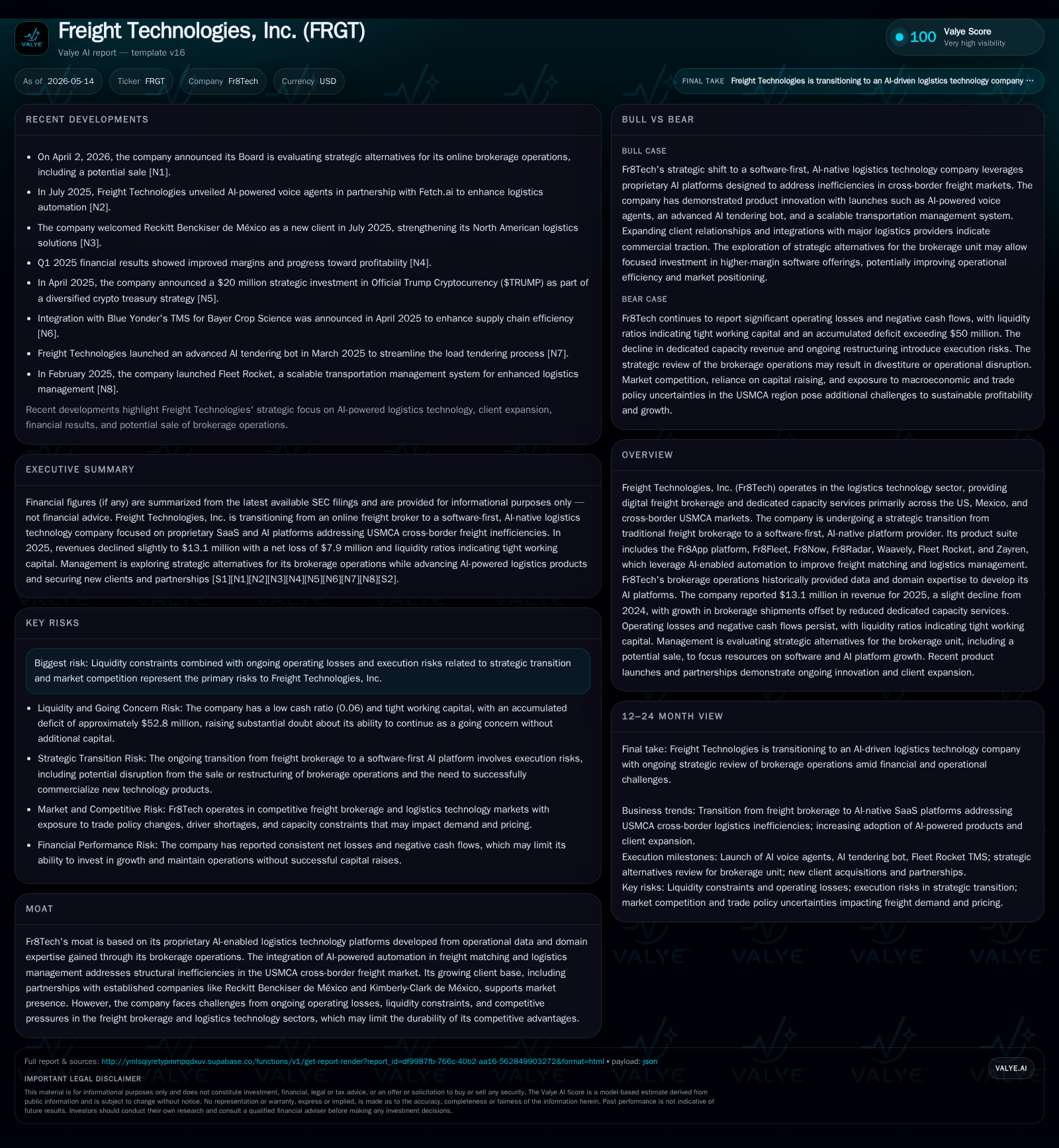
Freight Technologies, Inc. is intensifying its pivot from traditional freight brokerage to a software-first, AI-native logistics technology provider, formalizing agentic AI adoption across operations and exploring strategic alternatives for its core brokerage business. Despite a slight revenue decline in 2025 to $13.1 million driven by reduced dedicated capacity, growth in its spot market platform and ocean container brokerage products signal traction for its AI-powered SaaS offerings. Liquidity remains constrained with operating losses persisting, but management is focused on scaling proprietary platforms like Fr8App, Fleet Rocket, and Zayren to address structural inefficiencies in the USMCA freight markets.
Recent Operating Update
Freight Technologies completed a significant reverse stock split on April 27, 2026, consolidating every five ordinary shares into one to elevate its share price above Nasdaq’s $1 minimum bid requirement [S2]. This tactical move was necessary during ongoing stock price pressure and signals efforts to maintain listing compliance while aiming for improved market perception.
A month prior, on April 21, 2026, the company announced the formal institutionalization of agentic AI across its organization through the Fr8Tech AI Transformation Framework (FATF) [S3]. This framework centralizes executive oversight and aligns with industry-recognized voluntary standards including ISO/IEC 42001:2023 and NIST's AI Risk Management Framework. The FATF initiative underscores Freight Technologies’ commitment to embedding sophisticated AI governance as it transitions away from being primarily a freight broker toward becoming a technology-driven logistics solutions provider.
On April 2, 2026, Freight Technologies disclosed that the Board initiated an evaluation of strategic alternatives for its online brokerage operations which have historically been the core revenue driver [S7][N1]. The process contemplates potential sale options as the company focuses capital investment and development resources on proprietary SaaS platforms that leverage its AI capabilities.
Business Model Overview
Freight Technologies historically operated as an over-the-road digital freight broker primarily servicing the USMCA trade corridor encompassing the United States, Mexico, and cross-border lanes. Its revenue traditionally derived from brokering shipments—matching shippers with carriers—and managing dedicated trucking capacity services targeted at specific customers.
Recently, management is repositioning the company as a software-first operator with a comprehensive suite of proprietary AI-enabled platforms:
- Fr8App: A digital spot market freight brokerage platform providing real-time matching with automated workflows.
- Fr8Fleet: Dedicated capacity services offering contracted trucking solutions.
- Waavely: An ocean container brokerage service addressing containerized cargo demands.
- Fleet Rocket: An AI-powered fleet management tool enhancing operational efficiency and utilization.
- Zayren & Zayren Pro: Advanced compliance and document automation suites targeting customs clearance workflows especially for Mexican regulatory environments.
- Fr8Radar: A platform offering predictive analytics and visibility for supply chain monitoring.
Revenue flows consist of transaction-based commissions from freight brokerage activities (spot market and dedicated service contracts), subscription fees for SaaS products like Fleet Rocket and Zayren Pro, plus usage-based fees tied to analytics or document processing volumes. Margins vary substantially; spot market volumes tend toward thinner margins overshadowed by higher-margin SaaS subscriptions anticipated as recurring revenue streams once scale is achieved.
Industry Structure and Competitive Position
The North American freight industry remains sizable but fragmented with entrenched inefficiencies across cross-border US-Mexico logistics. Compliance complexity combined with fluctuating trade policy regimes amplifies demand for digitized customs processing solutions such as the DODA Smart system Freight Technologies launched in early 2026 [S1].
Competition spans traditional freight brokers commoditized by price sensitivity alongside emergent technology providers attempting to disrupt via digital marketplace platforms. Freight Technologies’ moat hinges on integrating domain expertise gained through years operating brokerage services with advanced AI models driving automation in freight matching and customs compliance. This unique blend enables addressing structural supply-demand imbalances more effectively than pure tech startups lacking operational knowledge or legacy brokers slow to innovate.
Established partnerships with companies like Reckitt Benckiser de México and Kimberly-Clark de México validate commercial relevance in key customer segments. However, the company's ongoing operating losses imply it has yet to achieve critical scale or margin profile necessary for robust competitive insulation.
Growth Drivers
- Transition to Software-First Model: Leveraging historical operational data from brokerage services as training inputs for proprietary AI algorithms creates sustainable differentiation as SaaS platforms mature.
- Expanding Cross-Border Compliance Solutions: With Mexico’s evolving customs regulations effective January 1, 2026 (including DODA documentation reforms), Freight Technologies’ automated compliance tools unlock new customer segments among importers/exporters and customs brokers seeking digitization [S1].
- AI Integration Scaling: Implementation of FATF bolsters R&D productivity enabling accelerated feature delivery across software portfolio supporting customer retention/growth.
- Increasing Spot Market Volumes: While dedicated capacity declined by around a third in 2025 due to specific client factors, spot market revenue grew by approximately 8%, reflecting improving demand elasticity within transactional freight matching [S1].
- Ocean Container Brokerage Expansion: Waavely’s contribution complements land-based offerings broadening total addressable market exposure.
Risks and Watchpoints
- Liquidity Constraints: Cash & equivalents stood near $347k end-2025 against total debt just under $2.45 million as of mid-2024 leading to net debt exceeding $2.1 million [F1]. Operating losses ($5.9 million in 2025) continue to strain cash flow with net working capital approximately break-even (~$31k) raising ongoing going concern issues [S6][S17].
- Execution Risks on Strategic Transition: The shift away from core brokerage operations towards nascent SaaS products entails execution challenges including customer adoption lags, technology integration complexities, and competitive responses.
- Brokerage Sale Uncertainty: The ongoing exploratory review process may create operational distraction; any divestiture would materially alter historical revenue base creating comparability challenges [S7].
- Market Competition Intensity: Larger incumbents or well-funded tech entrants could erode pricing power or accelerate innovation cycles beyond Fr8Tech’s capability given constrained resources.
- Regulatory Environment Volatility: Changes in customs laws or trade policies within the USMCA region could impose unforeseen compliance costs or delay technology adoption timelines.
What To Watch Next
Investors and stakeholders should track:
- Progress updates regarding potential sale or restructuring plans related to the online brokerage division.
- Adoption rates and contract wins tied to newer SaaS platforms such as Fleet Rocket and Zayren Pro indicating commercial scalability.
- Quarterly operating metrics signaling volume trends on both spot market freight matching and dedicated capacity sectors.
- Cash flow dynamics against capital raises or debt refinancing efforts clarifying liquidity runway.
- Regulatory developments impacting customs compliance solutions particularly within Mexican jurisdictions where DODA Smart operates.
Financial Profile Briefly
Latest financial snapshot
| Metric | Value | Period |
|---|---|---|
| Cash & equivalents | $346718 | |
| 2025-12-31 | ||
| Current assets | $6mm | |
| 2025-12-31 | ||
| Current liabilities | $6mm | |
| 2025-12-31 | ||
| Current ratio | 1x | |
| 2025-12-31 |
Source: SEC companyfacts cache [F1].
For fiscal year ended December 31, 2025:
This reflects declining revenues from prior years ($13.7M in ’24 to $13.1M in ’25), sustained operating losses despite cost cutting initiatives, reliance on financing activities (equity issuance / convertible notes), low cash buffers relative to debt burden creating tight liquidity conditions [F1][S1][S6][S19].
This analysis synthesizes publicly filed reports through May 14, 2026; it does not constitute investment advice but aims to provide informed perspective on Freight Technologies’ strategic direction amid operational challenges transitioning toward an AI-driven logistics technology model.
Disclaimer: This is research-only, informational analysis and not investment advice. It may include AI-generated interpretation and general industry context. Always verify important details using primary sources.

Comments