
FGI Industries Expands Brand Footprint and Channel Penetration Amid Stable R&R Market Dynamics
Latest quarterly disclosures highlight FGI's strategic focus on branded product growth and channel diversification within a resilient kitchen and bath industry.
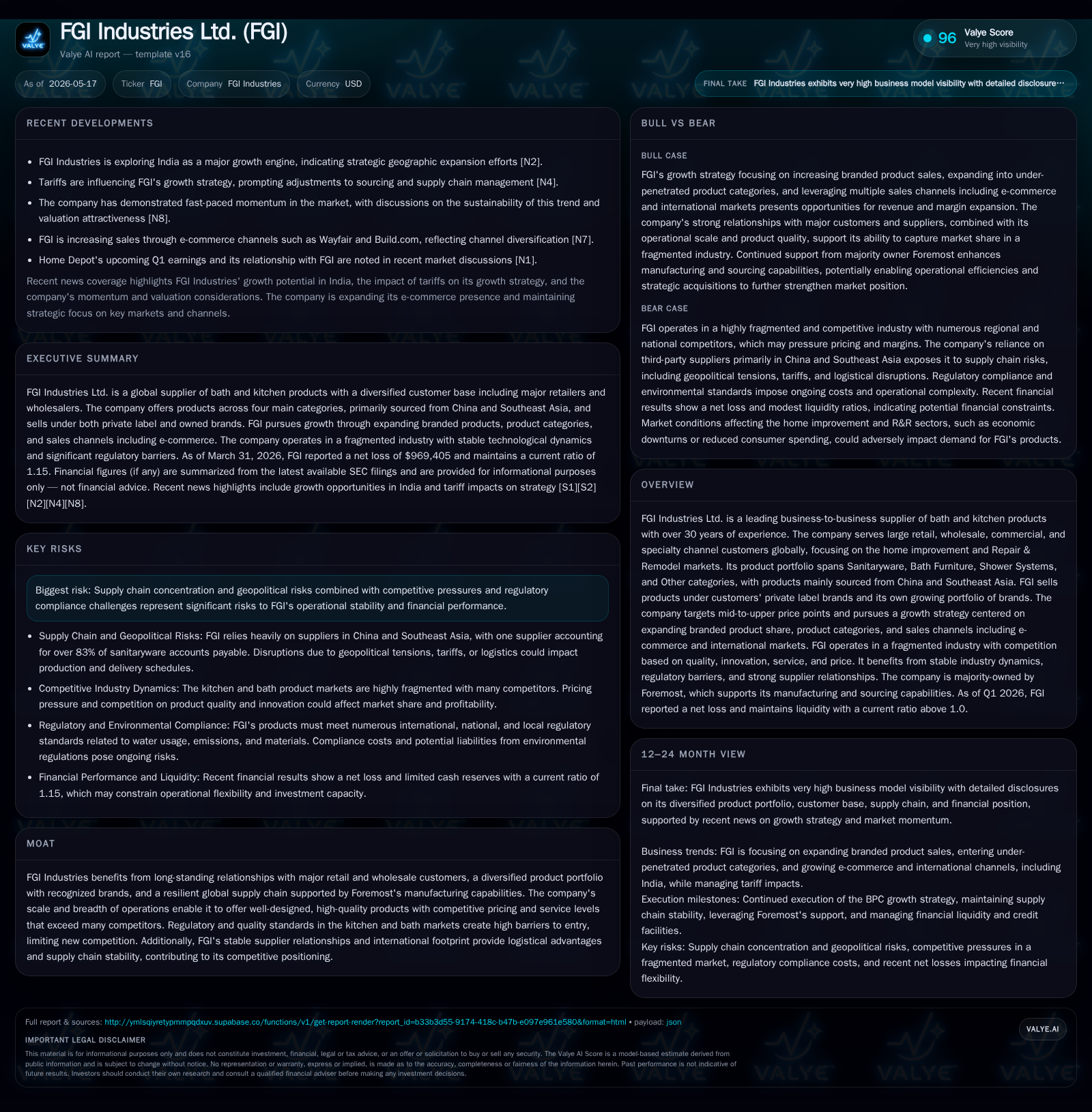
FGI Industries Ltd. reported its first quarter results in May 2026, underscoring continued execution of its growth strategy centered on expanding branded products, product categories, and sales channels including e-commerce and international markets. The company operates in the conservative, fragmented kitchen and bath supply market with strong competitive positioning due to longstanding customer relationships and a resilient supply chain. Growth prospects are tied to repair and remodel market trends, product innovations like electronic toilets, and expansion into under-penetrated categories. Supply chain geopolitics and regulatory compliance remain key watchpoints.
Recent Operating Update: Q1 2026 Results Anchor Strategic Progress
FGI Industries Ltd. filed its latest quarterly report on May 15, 2026 [S2], supplemented by an event-driven disclosure the prior day detailing its financial results as of March 31, 2026 [S3][S24]. These filings reaffirm the company's steady execution of a multi-year plan targeting revenue growth through expanding branded products alongside a strong private-label base. While detailed numeric growth metrics were not explicitly disclosed for Q1 alone, management emphasized ongoing investments in brand building, product innovation—including Jetcoat shower systems and intelligent toilets—and channel diversification efforts like increased e-commerce penetration.
This aligns with the broader strategic narrative established in the April 10 annual report (10-K) that serves as the backbone of FGI's business overview [S1]. This balance-sheet posture underpins sufficient liquidity while moderating leverage influences during exposure to global supply chain complexities from geographic concentration risks [F1][S27].
Business Model: Multifaceted Revenue Mechanics Embodied in BPC Strategy
FGI’s primary revenue mechanism involves B2B sales: it supplies large retail chains (e.g., The Home Depot), wholesalers like Ferguson, commercial distributors serving contractors, specialty dealers, and fast-growing e-commerce platforms such as Wayfair [S22][S25]. Customers pay for a broad portfolio spanning four major product categories—Sanitaryware (toilets, sinks), Bath Furniture (vanities, cabinets), Shower Systems (enclosures, walls), and Other (custom cabinetry)—often under private labels but increasingly under FGI-owned brands like Foremost®, contrac®, Jetcoat®, avenue®, rosenberg®, and Covered Bridge Cabinetry® [S1][S25].
Pricing power is derived from differentiated product offering quality calibrated against mid-to-upper price points that meet contractor reliability requirements. Volume drivers are primarily linked to housing market repair & remodel activity heavily concentrated in North America but growing internationally. The mix shifts favorably toward branded sales which offer higher gross margins but require shared marketing expenses.
Supply chain coordination is critical; most goods are outsourced to long-term partners primarily located in China and Southeast Asia including manufacturing owned by majority shareholder Foremost. This global footprint allows scale economies but also introduces currency exposure and tariff-related cost pressures which FGI manages through sourcing flexibility initiatives [S25][S28].
Industry Structure and Competitive Position
Kitchen and bath supply markets are fragmented with local/regional fortes evident alongside a few national players such as American Standard and Kohler competing in sanitaryware segments. FGI differentiates itself through:
- Broad geographic reach servicing mass retail chains with consistent national logistics capabilities
- Longstanding customer relationships built on dependable delivery & service exceeding competitor levels
- A diverse brand portfolio capturing both retail consumers’ end-demand and trade professional preferences
- Regulatory adherence especially given products relate to water containment safety necessitating certifications which serve as high barriers to new entrants [S18][S19]
The industry’s conservative nature slows product obsolescence but rewards steady innovation in features—e.g., electronic toilets—and materials—e.g., FSC-certified wood cabinetry—supporting gradual category expansion rather than disruptive shifts.
Growth Drivers
Product Expansion & Innovation
FGI identifies significant whitespace particularly within:
- Behind-the-wall plumbing components currently under-penetrated by national suppliers
- Acrylic-based bathtubs complementing existing ceramic sanitaryware lines
- Digital shower systems extending Jetcoat brand relevance
- Intelligent toilet models leveraging water-saving technology fostering EPA WaterSense compliance [S19][S21][S11]
Channel Diversification
E-commerce represents a fast-growth vector with FY2025 figures showing about 8% of sales rising from sub-2% a decade prior—driven by partners like Build.com growing alongside traditional mass retailers' online penetration [S19][N4][N8]. Internationally, Canada leads outside North America with marked presence in Germany; further geographic expansion is targeted prudently. Additionally commercial sales via local distributors serving plumbers present an opportunity for deeper market infiltration given historical stability among professional networks
Brand Development
The "BPC" (Brands, Products, Channels) framework centralizes effort where increasing direct brand sales relative to private labels not only uplifts margin profiles but also builds consumer mindshare fostering long-term demand stability. FGI commits material marketing resources to both proprietary brands and select private-label partnerships promoting mutual success.
M&A Strategy
Guided by stringent criteria emphasizing operational fit—not turnarounds—or synergy potential within core kitchen/bath sectors signals management’s disciplined capital allocation targeting accretive bolt-ons widening offerings or penetrations without sacrificing returns [S19].
Risks / Watchpoints / Growth Constraints
Key risks include:
- Supply Chain Concentration: Over 80% of sanitaryware sourced from a single supplier Tangshan Huida Ceramic Group introduces dependence vulnerabilities especially amid geopolitical tensions or tariffs affecting China-U.S. trade routes [S12][S28].
- Regulatory Compliance: Complex multi-jurisdictional environmental regulations governing raw material sourcing (e.g., CARB Phase II compliance for wood products) impose ongoing cost burdens though currently manageable without material capital invest requirements [S11].
- Competitive Intensity: In segments like sanitaryware dominated by global heavyweights American Standard or Kohler pricing pressures may sporadically erode margins.
- Macro Housing Market Sensitivity: Although R&R markets exhibit structural growth driven by aging U.S housing stock (~3%-5% annual growth historically), deep recessions historically disrupt volumes temporarily.
- Currency & Inflation: Cost inflation passes through via pricing increases but risk remains if lag periods extend or customer pushback intensifies particularly across lower price tiers.
- Working Capital Tightness: The current ratio near 1.15 suggests a tight but positive short-term financial health requiring careful inventory & receivables management especially given elongate international supply chains [F1][S27].
What To Watch Next
Investors should monitor:
- Sequential quarterly organic revenue growth rates reflecting execution of brand-share expansion initiatives.
- Gross margin trends correlating with mix shifts toward proprietary brands versus private label.
- Progress on new product rollouts such as expanded Jetcoat lines or intelligent toilets gaining traction across key channels.
- Updates on supplier diversification efforts mitigating concentration risks amid shifting tariff environments.
- E-commerce channel sales penetration gains which could accelerate volume without incremental physical distribution capex.
- Any meaningful international market share developments beyond Canada/Germany signaling globalization progress.
- Refinements or renewals of credit facilities impacting liquidity buffer given existing debt level [$13.14M] weighted towards ~$10.44M net debt post-cash holdings [$2.7M] as per Q1 ending March 31 2026 balance sheet snapshot [F1][S27]
Financial Profile Summary from Latest Quarter Ending March 31, 2026
At quarter-end: - Cash & equivalents stood at $2.7 million providing liquidity headroom for operations amid working capital demands. - Total debt approximated $13.14 million translating into net debt close to $10.44 million after cash offsets indicating moderate leverage given asset base. - Current assets totalled roughly $50.9 million against $44.3 million current liabilities yielding a current ratio near 1.15 reflecting tight but positive short-term financial health [F1]. These balance sheet metrics underscore a stable although closely managed financial position aligned with industry norms for trade working capital intensive businesses operating complex global sourcing networks
Disclaimer: This analysis is based solely on disclosed SEC filings up to May 15, 2026, related news reports through May 17, 2026, and verified public data without extrapolation or confidential information inference. It does not constitute investment advice or research views.
Disclaimer: This is research-only, informational analysis and not investment advice. It may include AI-generated interpretation and general industry context. Always verify important details using primary sources.

Comments