
GameStop’s Strategic Shift: Capital Deployment and Collectibles Growth Take Center Stage
Robust liquidity enables GameStop to pursue acquisitions while its collectibles segment reshapes profitability amidst store optimization.
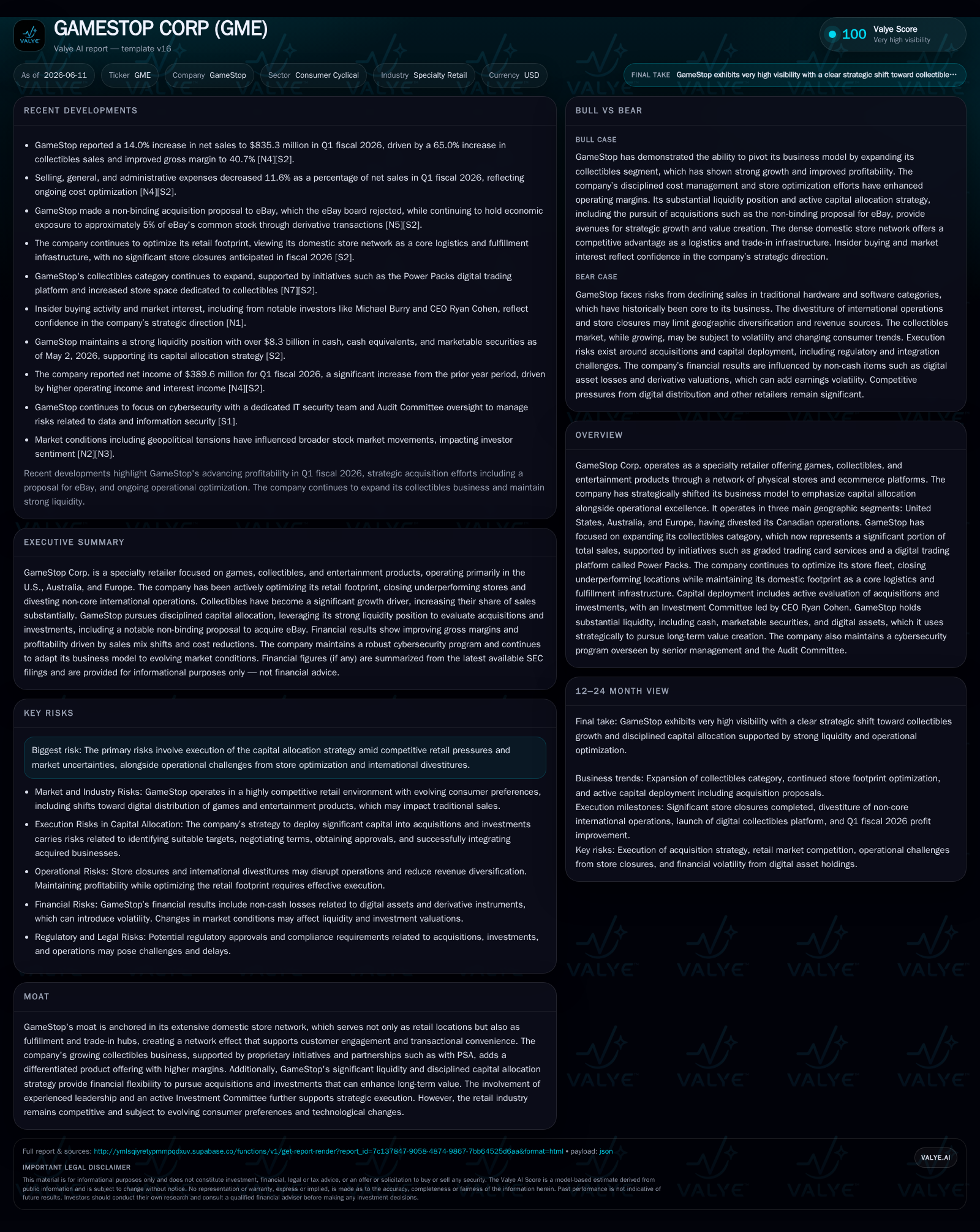
GameStop's latest quarter reveals a fortified cash position of $7.4 billion accompanied by an explicit pivot toward capital allocation, most notably marked by a non-binding proposal to acquire eBay. The company’s business model transformation accelerates through growing collectibles sales—now a substantial 29% of net revenue—augmented by proprietary digital platforms like Power Packs. Meanwhile, store fleet rationalization balances closures with logistics needs, positioning GameStop to leverage its physical footprint in fulfillment. Competitive pressures endure but the firm’s liquidity and disciplined capital deployment underpin a strategic repositioning beyond traditional retail operations.
Latest Quarter Highlights: Liquidity Fortified for Strategic Moves
GameStop’s Q1 2026 filing underscores a substantial liquidity fortress with $7.4 billion in unrestricted cash augmented by nearly $971 million in marketable securities [S2]. This robust cash pile leaves the company with net cash positioning roughly $3.2 billion ahead after accounting for debt [F1], granting it significant capital flexibility. The firm explicitly positions this liquidity as a strategic asset for pursuing acquisitions and control transactions anticipated to yield long-term value creation [S2]. Notably, shortly after quarter-end, GameStop announced an unsolicited non-binding proposal to acquire eBay Inc., signaling an aggressive capital deployment stance targeting transformational investments beyond its core retail business [S2][S3]. While no binding commitments currently exist, the appointment of an Investment Committee featuring CEO Ryan Cohen confirms governance alignment on rapid execution capability for deals deemed accretive.
Business Model Evolution: Blending Retail with Collectibles and Digital Innovation
Historically rooted as a specialty retailer focused on video games and entertainment products through both physical stores and ecommerce channels, GameStop has adeptly expanded its revenue streams into collectibles—a category now accounting for approximately 29% of total sales [S1]. This represents a material uplift from 19% just one year earlier, highlighting a deliberate shift toward higher-margin niche products that include graded trading cards serviced through all U.S. stores and proprietary first-party repack offerings [S1]. Complementing this is Power Packs, an innovative digital trading platform launched in partnership with PSA’s Professional Sports Authenticator division [S1]. Through Power Packs, users buy digitally secured graded cards held in vaults allowing instant sales or trades—a hybrid offering that bridges traditional collecting with digital marketplace convenience.
GameStop’s store network plays a dual role as not only consumer-facing retail outlets generating customer foot traffic but also crucial nodes in its fulfillment infrastructure supporting ecommerce and trade-in service capabilities. After closing 727 underperforming U.S. locations in fiscal 2025 as part of comprehensive store optimization efforts [S1], further large-scale store closures are not anticipated in fiscal 2026 [S1], reflecting recognition of the footprint’s ongoing utility beyond front-end sales.
Competitive Environment: Specialty Retail Peers and Emerging Digital Platforms
Within the specialty retail industry context, GameStop’s expansive physical store presence coupled with omnichannel initiatives differentiate it relative to peers such as Best Buy that similarly balance brick-and-mortar scale with growing ecommerce penetration. The company leverages its store footprint not only for traditional direct-to-consumer sales but as localized fulfillment centers – a critical advantage against online-only competitors facing last-mile logistic challenges. In addition to competing with other specialty retailers offering gaming-entertainment assortments, GameStop confronts emerging competitive forces from pure-play collectibles hobby shops and digital trading marketplaces that cater directly to enthusiasts.
GameStop’s evolving digital ecosystem via Power Packs directly addresses these new competitive dynamics by integrating secure transaction technology with brand-backed certification services, enhancing customer engagement and potentially reducing attrition common in purely physical or legacy platforms.
Growth Engines: Collectibles Expansion, Store Optimization, and Acquisitions Pipeline
GameStop’s growth trajectory is primarily driven by three interconnected engines:
- The rising contribution of collectibles sales has not only enhanced average transaction values but also improved gross margin percentages owing to ancillary premium services like grading and repacks [S1][F1].
- Store fleet optimization curtailed broad closures in fiscal 2026 following a steep rationalization phase previously; this steady footprint supports logistical efficiency needed for omnichannel retailing without diluting profitability [S1].
- Capital allocation discipline fuels an active pipeline evaluating acquisition prospects beyond traditional gaming retail. The recent unsolicited proposal for eBay exemplifies leveraging strong liquidity toward transformative mergers or investments supported by dedicated governance processes [S2][S3].
Increased ecommerce sales penetration concurrently expands reach beyond physical geography constraints while maintaining strategic synergy with store-located inventory management and trade-in services.
Risks & Constraints: Execution Challenge in Capital Allocation Amid Retail Pressures
Despite promising strategic shifts, sizable risks remain inherent:
- Execution complexity looms over large-scale acquisitions such as eBay where regulatory scrutiny or integration hurdles could delay value realization.
- Inventory management risks are pronounced given the specialized nature of collectibles alongside volatile demand cycles that may precipitate markdowns or obsolescence.
- Competition intensifies from dominant ecommerce marketplaces challenging pricing power and customer loyalty.
- Store optimization involves operational risks balancing cost savings versus fulfillment capability erosion.
- Recent international divestitures reflect ongoing strategic pruning but also underscore exposure to geopolitical or currency headwinds [S1].
- Cybersecurity remains an ongoing concern given growing reliance on digital platforms; Company disclosures reveal active oversight from senior leadership supported by dedicated information security teams and Audit Committee monitoring [S1].
Looking Forward: Acquisition Milestones and Operational Priorities to Track
Key indicators will derive from updates on acquisition pursuits including progress following GameStop's eBay offer rejection episode [N14], signaling potential rerouting or renewed bids. Metrics around adoption rates and transactional volume for the Power Packs platform will serve as barometers of digital marketplace traction relative to collectibles penetration targets.
Operationally, monitoring same-store sales trends alongside any resumption or pause in store closures will indicate management’s confidence level in correcting the physical footprint versus fulfilling omnichannel delivery mandates. Inventory turnover improvements driven by refined assortment planning amid store rationalization efforts are critical to maintaining gross margin upward momentum.
Capital deployment outcomes beyond disclosed proposals will be pivotal for driving portfolio repositioning aligned with shareholder value creation ambitions highlighted across multiple quarterly disclosures [S2].
Financial Profile Snapshot: Strength Enabling Tactical Flexibility
This analysis synthesizes data exclusively from GameStop's latest SEC filings supplemented by reputable market news sources without speculative extrapolation or investment guidance. Readers should consider this report contextual analytic insight rather than predictive research view.
Disclaimer: This is research-only, informational analysis and not investment advice. It may include AI-generated interpretation and general industry context. Always verify important details using primary sources.

Comments