
FREIT Extends Debt Amid Challenging Occupancy Trends in New Jersey Portfolio
FREIT’s recent loan extension provides short-term liquidity support even as occupancy pressures in select commercial assets raise operational vigilance.
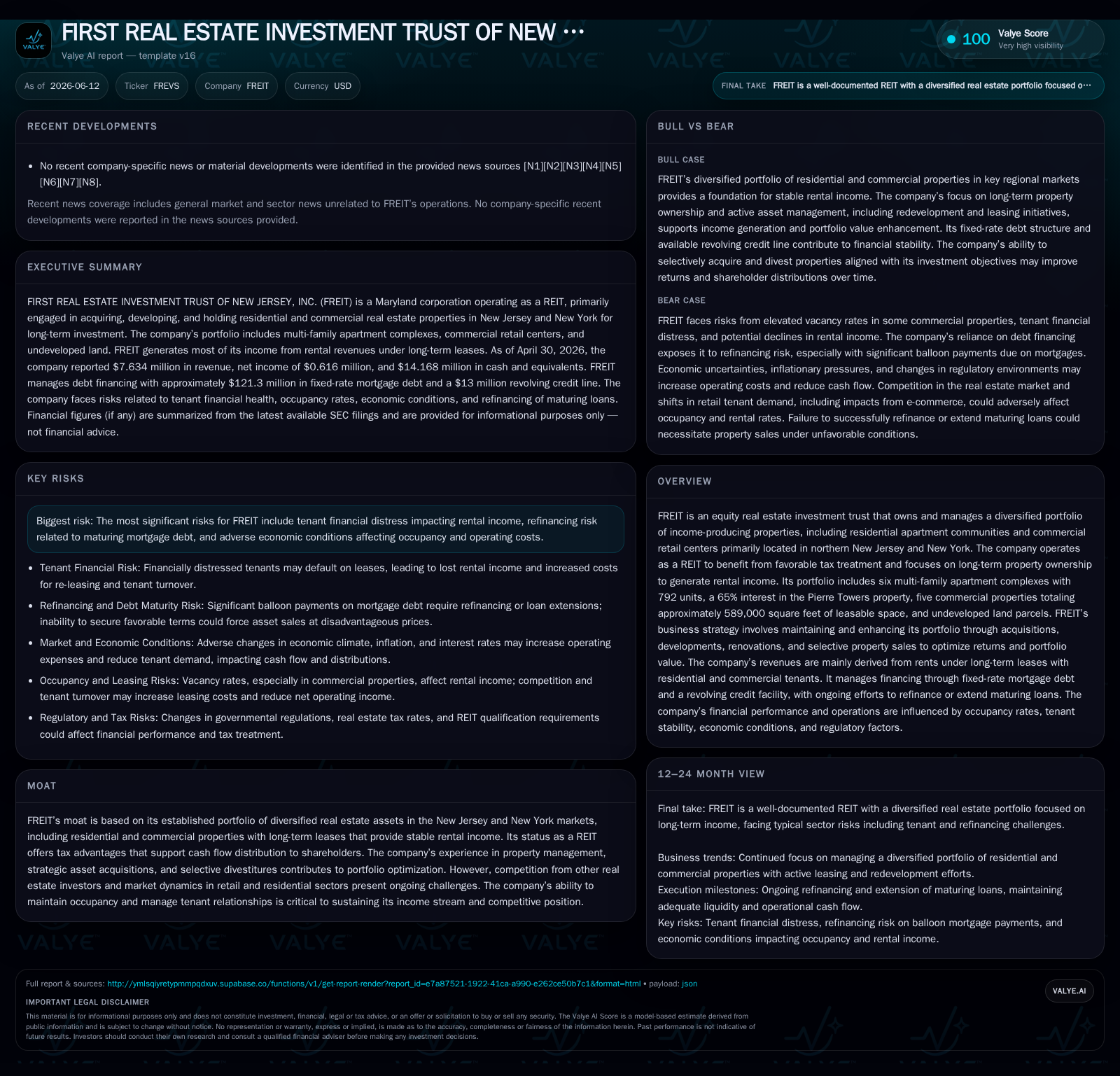
In its latest quarter, First Real Estate Investment Trust of New Jersey (FREIT) executed a strategic loan extension with Valley National Bank, reducing principal and extending maturity to May 2026. This maneuver alleviates immediate refinancing pressures amid a rising interest rate environment that now commands an 8.5% fixed rate on the outstanding $10 million balance. FREIT’s diversified portfolio of residential apartments and commercial retail properties continues to generate stable rental income, although elevated vacancy rates in certain shopping centers signal operational headwinds. The company is focusing on asset optimization through leasing efforts and redevelopment explorations to sustain net operating income and funds from operations amidst these challenges.
Loan Extension Strengthens Near-Term Liquidity during Elevated Interest Rates
In its latest quarterly filing dated June 12, 2026 [S2], FREIT disclosed the execution of a loan extension and modification agreement with Valley National Bank effective May 1, 2025. The agreement included a loan paydown of approximately $5.7 million (including deferred interest of approximately $0.2 million), reducing the loan balance to $10 million, and extended the loan maturity date by one year to May 1, 2026. The modification also fixes the interest rate at 8.5%, resulting in combined monthly principal and interest payments of roughly $108,000.
The company additionally recorded an escrow fund reduction from around $2 million to $1.3 million, releasing approximately $705,000 back into cash reserves. This incremental liquidity buffer offers FREIT some flexibility to manage near-term obligations during continued volatility in credit markets and rising interest costs—the latter being a common challenge for REITs navigating debt refinancings post-2022's interest rate hikes.
This extension reflects FREIT's proactive approach to managing debt maturities by negotiating terms that mitigate immediate refinancing pressure while controlling monthly cash flow demands within their operational capacity.
Portfolio Composition Anchors Stable Rental Income With Mixed Performance Across Assets
FREIT’s property portfolio comprises a diversified mix of residential apartment communities and commercial retail centers focused primarily within northern New Jersey and the New York metropolitan area [S1]. The six multi-family apartment complexes encompass 792 units providing recurring rental income with relatively long lease durations typical for residential tenants.
On the commercial front, the trust owns five properties aggregating approximately 589,000 square feet of leasable space. Notably, Franklin Crossing and Glen Rock shopping centers report higher occupancy rates consistent with stronger neighborhood positioning or tenant mixes favoring essential services. Conversely, Westwood Plaza and Preakness Shopping Center experience elevated vacancy rates contributing to rental income variability.
This bifurcated performance underscores the importance of asset-level management intensity: residential units benefit from demographic-driven demand stability supportive of steady occupancy rates whereas retail segments face sector-specific headwinds linked to shifting consumer preferences away from traditional shopping centers [S1].
Lease Terms and Occupancy Trends: A Tale of Residential Stability Versus Commercial Pressure
Management commentary details relatively stable rents achieved at turned units within their residential portfolio alongside existing lease renewals maintaining cash flow predictability albeit with observed modest softening compared to prior periods [S1]. Tenant retention tends to be higher in this segment given longer average lease terms typically spanning one year or more.
In contrast, commercial retail vacancies in Westwood Plaza and Preakness Shopping Center introduce revenue volatility risk due to shorter tenant lease tenures and potential for non-renewal or tenant default—a material concern especially during economic slowdowns or when faced with tariff-driven cost increases pressuring small-business operators [S1][S2]
The company actively engages third-party advisors aiming to attract financially robust tenants while exploring redevelopment initiatives designed to repurpose underutilized retail spaces for alternative uses—an increasingly critical strategy recognized across REITs confronting structural changes in retail behavior.
Capital Expenditures And Asset Management: Balancing Maintenance With Opportunity Costs
Capital expenditures are deployed strategically to maintain asset quality through renovations while experimentation with redevelopment seeks to unlock enhanced rental streams or value appreciation over time [S1]. Such spending decisions weigh immediate margin impacts against longer-term benefits like improved tenant retention or repositioning of poorly performing assets.
FREIT’s willingness to selectively dispose of non-core or underperforming properties is consistent with industry practices aimed at portfolio optimization—trading lower-yielding holdings for assets promising superior income growth or capital appreciation aligned with evolving urban development patterns.
Competitive Positioning Within The Regional REIT Landscape: Peer Context And Market Challenges
Within its regional real estate universe, FREIT occupies a niche comparable to diversified residential-commercial REIT peers such as AvalonBay Communities (primarily residential-focused) and Kimco Realty (specialist in retail centers). However, unlike larger peers boasting scale advantages or national footprints allowing broader geographic risk diversification, FREIT’s concentrated presence in northern New Jersey/New York subjects it more acutely to localized economic cycles.[S1]
Competitive pressures manifest distinctly across segments: residential supply-demand dynamics remain generally supportive but are susceptible to affordability constraints from macroeconomic factors; Meanwhile commercial tenants face rising operational costs compounded by ecommerce disruption’s sustained impact on foot traffic—factors challenging leasing velocity and rental rate expansions for shopping center landlords.
This mixed landscape demands nimble asset management coupled with precise capital allocation sensitivities toward tenant creditworthiness evaluation—a critical determinant shaping occupancy trends and net operating income sustainability.
Growth Opportunities Around Strategic Acquisitions And Redevelopment Potential
FREIT’s stated investment approach leverages acquisitions targeted at complementing existing holdings while increasing portfolio cash flows and overall valuation [S1]. Redevelopment initiatives particularly in retail assets aim to convert vacancy liabilities into productive real estate uses responsive to demographic shifts favoring multifamily housing or mixed-use concepts.
The gradual easing of financing conditions following diligent loan extensions contributes marginally toward enabling these endeavors; however the still-elevated borrowing costs mandate disciplined project selection—prioritizing ventures with robust yield spreads over cost of capital [S2].
Urbanization patterns along New Jersey/New York corridors offer macro tailwinds that can underpin medium-term growth trajectories provided management can execute leasing strategies effectively amidst changing consumer demands.
Emerging Risks: Tenant Financial Health, Refinancing Timing And Regional Economic Factors
Tenant financial distress remains FREIT’s foremost risk vector influencing rental income flow stability [S1]. Protracted vacancies increase carrying costs; lease renegotiations under financial strain could pressure contractual rental escalations downward; whereas tenant bankruptcies pose direct default hazards disrupting cash inflows.
Refinancing risks persist notably around large mortgages such as the recently matured $25 million Preakness Shopping Center loan which has undergone multiple extensions under unchanged terms reflecting lender caution amid market uncertainty [S1]. Though short-term solutions limit disruption risks temporarily, long-term financing arrangements must contend with rising rates compressing interest coverage ratios.
Broader macroeconomic variables including inflationary input cost pressures (maintenance labor/materials), local employment conditions affecting tenants’ disposable income levels, plus potential zoning/regulatory changes further complicate the operating landscape requiring vigilant stewardship.
What To Watch Next: Key Milestones For Leasing, Refinancing And Dividend Sustainability
Investors should monitor several upcoming operational milestones as indicators of FREIT’s medium-term outlook:
- Lease renewal rates particularly within vulnerable commercial properties which directly influence occupancy rates and NOI trajectory;
- Progress on refinancing or replacing significant maturing debt obligations post-May 2026 maturity of the modified Valley National Bank loan;
- Funds from operations trends underpinning dividend payout capacity—a key metric given REIT tax distribution requirements.
These markers will shed light on management’s ability to navigate funding cycles without excessive liquidity strain while sustaining tenant base quality amid challenging real estate market dynamics.
Financial Profile Snapshot (Supporting Analysis)
As of April 30, 2026, FREIT held approximately $14.2 million in cash equivalents [F1]. The loan balance on the key Valley National Bank loan was reduced to $10 million following the May 2025 modification and paydown [S2]. Total debt was last comprehensively disclosed at about $130 million subject to subsequent repayments [F1]. After accounting for available cash reserves, net debt stands near $116 million highlighting leverage considerations central to refinancing discussions [F1][S2].
The fixed-rate nature of recent loan modifications introduces some predictability into interest expense planning though the elevated coupon at 8.5% exerts notable finance cost pressure relative to pre-2022 benchmarks [S2]. This dynamic necessitates efficient operations producing consistent net operating income sufficient for debt servicing coverage ratios aligned with lender covenants.
While detailed funds from operations figures were not explicitly published for this quarter, ongoing revenue contributions principally derive from stable residential leases supplemented variably by commercial rents that currently require close operational oversight given localized vacancy issues [S1][F1]
Disclaimer: This is research-only, informational analysis and not investment advice. It may include AI-generated interpretation and general industry context. Always verify important details using primary sources.

Comments