
Driven Brands Advances Unit Growth and Profitability Amid Strategic Divestiture and Debt Reduction
Driven Brands' latest quarter reflects robust operational execution supported by franchising momentum and capital structure improvements.
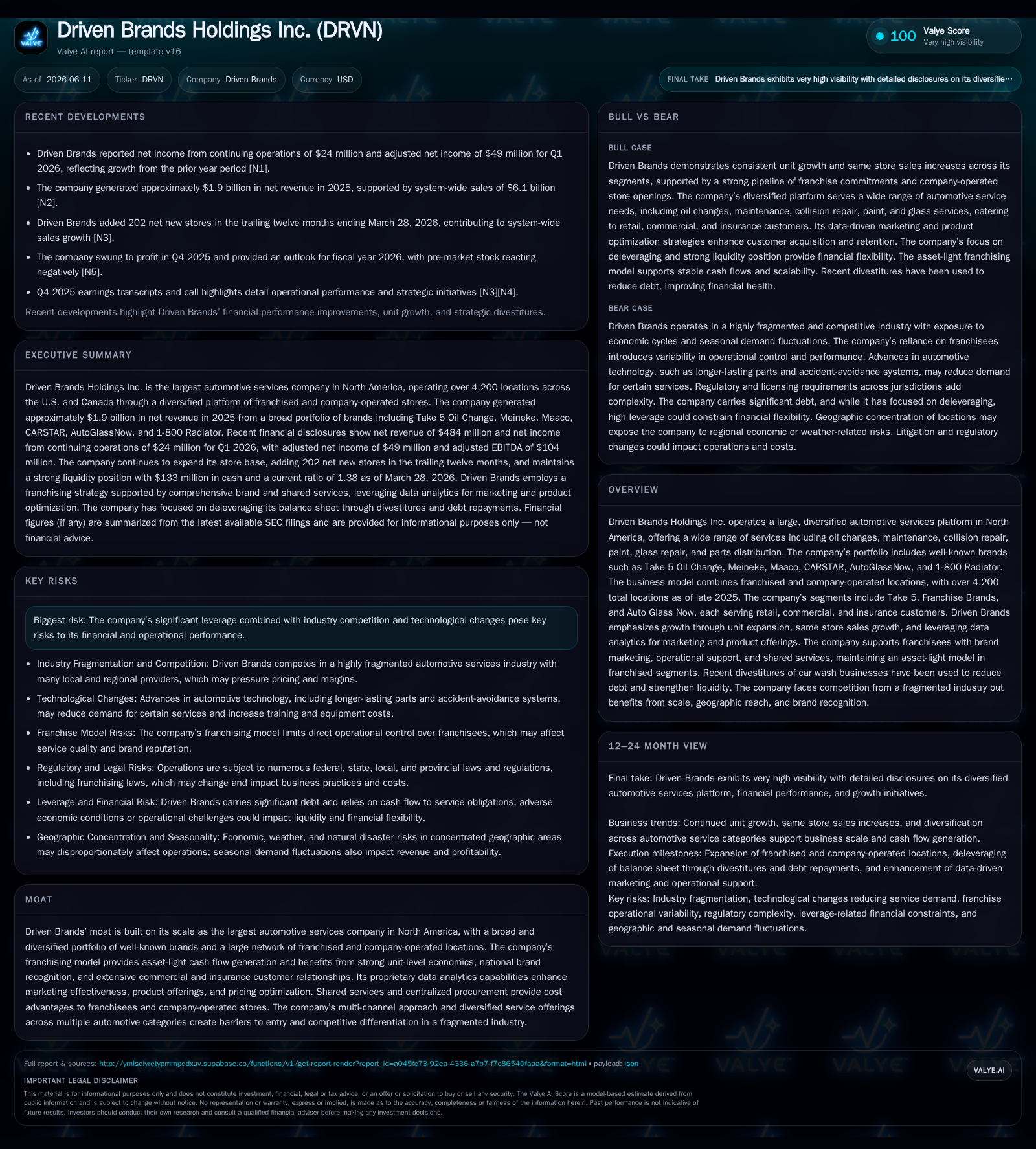
Driven Brands Holdings Inc. reported Q1 2026 net revenue growth driven by same-store sales gains and unit expansion across its Take 5 and Franchise Brands segments. The company completed a significant divestiture of its International Car Wash business, deploying proceeds toward debt repayments that materially improved leverage. Its diversified automotive services platform benefits from strong brand recognition, a balanced mix of franchised and company-operated locations, and scaling advantages through shared services and data analytics. However, elevated leverage and competitive pressures in a fragmented industry remain watchpoints.
Operational Update: Q1 2026 Financial Results Anchor Near-Term Picture
Driven Brands Holdings Inc. commenced fiscal 2026 with solid growth in its core automotive services business as delineated in its June 11, 2026 Form 10-Q filing [S2]. The company's net revenue for the three months ended March 28 surged to $484 million from $448 million year over year, propelled notably by both same-store sales uplift across all segments and net store count increases in Take 5 Oil Change and Franchise Brands portfolios. These operational gains translated into a net income from continuing operations of $24 million compared to $14 million one year prior. Key drivers included improved operating leverage benefiting from scale economies alongside a $13 million decline in interest expense driven by reduced borrowings. Adjusted Net Income also expanded by roughly $10 million to $49 million reflecting the underlying profitability trajectory absent non-core impacts.
Amidst these performance markers, Driven Brands strategically completed the divestiture of its International Car Wash business (ICW) in January 2026 for roughly $490 million euros (~$490 million USD equivalent). This transaction removed discontinued operations from the ongoing revenue base but fortified the balance sheet via repayment of senior notes totaling $472 million alongside reductions on revolving credit facilities [S4]. Consequently, while total net debt remained elevated at about $1.58 billion after accounting for $133 million cash reserves [F1], the refinancing effort reduced interest costs measurably.
Business Model: Diversified Franchise-Heavy Platform Capitalizing on Scale
Driven Brands operates the largest automotive services network in North America spanning over 4,200 combined franchised and company-operated locations distributed across the U.S. and Canada under multiple well-established brands including Take 5 Oil Change, Meineke Car Care Center, Maaco paint & collision repair, CARSTAR collision centers, AutoGlassNow glass repair/replacement specialists, among others [S1]. The business model leverages an asset-light franchising approach that drives recurring royalty fees supplemented by direct operating income contributions from company-operated outlets.
Revenue derives primarily from retail customers seeking routine maintenance (oil changes, filter replacements), commercial fleet contracts requiring scheduled servicing, insurance-related collision repairs including paint & bodywork, glass replacement with warranty services tailored for insurer partnerships, and parts distribution tied to these operations. The broad service suite aligns with multiple value chain touchpoints: front-line vehicle maintenance delivery plus upstream brand licensing support backed by centralized procurement advantages.
The stay-in-your-car oil change format offered by Take 5 exemplifies efficient unit-level economics enabled by compact footprint stores emphasizing speed and convenience — factors important for driving high customer frequency rates essential to recurring visit models. Similarly, franchisee support encompasses operational training, marketing leveraging proprietary data analytics for targeted customer acquisition/promotion effectiveness, supply chain economies via aggregated purchasing power that enhances margins at store level.
Industry Context: Fragmented Market with Scale-Driven Competitive Moat
In the fragmented automotive aftermarket services industry characterized by numerous small independent repair shops as well as competing franchised chains (e.g., Monro/Midas/Caliber Collision), Driven Brands distinguishes itself via scale-led advantages including an expansive network footprint conducive to cross-brand referral opportunities and diversified revenue streams that reduce cyclical volatility concentrated within any single segment.
Insurance claims management partnerships particularly reinforce volume visibility in auto glass replacement and collision repair segments while fleet service contracts deliver steadier commercial demand streams amid shifting consumer behavior patterns. Centralized shared services help mitigate cost inflation pressures especially relating to labor overheads and parts sourcing — critical considerations amid tightening margins industry-wide.
Operational KPIs such as same-store sales growth (7.2% recorded recently), new franchise openings (>1,000 new units on agreement pipeline), adjusted EBITDA margin expansion (~9% range noted in recent quarters), average ticket size expansion through ancillary maintenance upselling all signal healthy demand fundamentals bolstered by branding efficacy.
Growth Drivers: Franchise Expansion Coupled with Portfolio Synergies
Future growth prospects hinge on multiple levers:
- Sustained unit expansion driven by new store openings plus conversions of independents attracted by scalable platform economics.
- Same-store sales momentum supported by increasing consumer preference for branded convenience versus DIY alternatives.
- Penetration into underserved geographic markets capitalizing on national brand reach.
- Enhanced analytics capabilities optimizing pricing strategies and targeted marketing investment efficiencies.
- Deepening insurance carrier relationships powering claims volume alongside customized glass claims management.
- Cross-selling opportunities between collision repair, maintenance services and glass replacement enhancing average customer spend.
- Fleet program expansions securing stable B2B contract revenues resistant to retail cyclicality.
Each lever is anchored on maintaining franchisee compliance rigor (to protect brand equity), service quality consistency supported by training initiatives, and operational efficiency gains realized via technology upgrades such as cloud-based computing implemented recently albeit accompanied by higher amortization charges reflecting investment intensity [S2], [S10].
Risks and Constraints: Leverage Burden Amid Competitive Headwinds
While Driven Brands enjoys structural competitive strengths, material risks persist:
- Elevated leverage represents an important constraint; despite recent reductions via asset sales proceeds used for note retirements totaling nearly half a billion dollars, net debt remains north of $1.5 billion impacting interest expense exposure and covenant agility under adverse market conditions [F1], [S4].
- Competition is intense not only among franchisors but also from independent repair outlets often able to compete on price or localized service customization.
- Labor cost inflation combined with commodity price variability threaten margin compression given fixed-price service offerings common in retail maintenance categories.
- Technological transitions towards electric vehicles could reduce aftermarket servicing demand for traditional internal combustion engine repairs necessitating adaptation or product mix shifts.
- Franchisee financial health influences system stability; underperformance or compliance lapses can erode reputation jeopardizing network-wide economics.
- Regulatory scrutiny particularly around franchise legislation reforms may alter operational flexibility or increase compliance costs.
- Foreign currency volatility affects earnings due to Canadian operations exposure as reflected recently with notable currency transaction losses impacting adjusted earnings metrics [S2].
What to Watch Next: Execution Milestones and Demand Indicators
Key milestones informing ongoing assessment include:
- Tracking unit openings pace versus pipeline visibility disclosed (>1,000 new franchises agreed backing sustained footprint growth).
- Monitoring quarterly same-store sales trajectories which serve as primary demand barometers especially post-divestiture of discontinued businesses.
- Evaluating margin trends reflecting cost passthrough ability amid inflationary pressures.
- Observing balance sheet deleveraging progress alongside refinancing terms noting covenant compliance signals.
- Gauging insurance partnership developments potentially influencing collision repair volumes.
- Technology platform evolution impact on marketing effectiveness through advanced data analytics deployment plans beyond current cloud investments.
Brief Financial Profile: Solid Top-Line Growth with Improving Profitability But High Leverage
tement-related costs [S2], [S10].
Taken together these figures portray a company actively managing core profitability while de-risking financial structure post acquisition-driven expansion phases but still subject to macroeconomic sensitivities typical of high-leverage scenarios prevalent among large franchise-based service providers.
Disclaimer: This is research-only, informational analysis and not investment advice. It may include AI-generated interpretation and general industry context. Always verify important details using primary sources.

Comments