
Collective Acquisition Corp. II’s IPO Proceeds Secure Initial Capital Amid SPAC Market Pressures
CAII’s first quarterly report post-IPO confirms $221 million trust account capital preservation and highlights the typical operational framework ahead of its business combination.
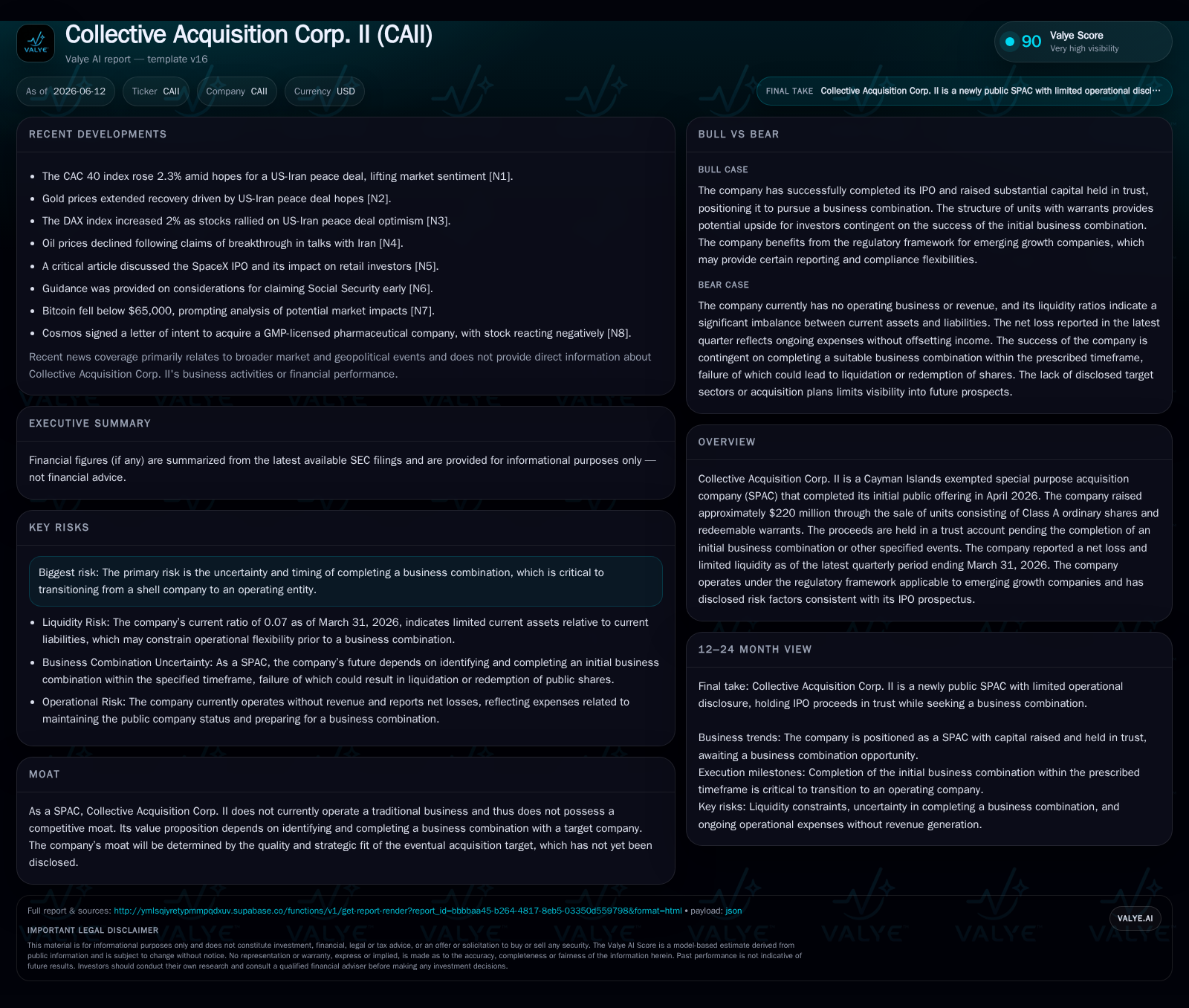
Collective Acquisition Corp. II (CAII), a Cayman Islands-exempted SPAC, completed its IPO in April 2026, raising approximately $220 million plus private placement proceeds, all held in a trust account pending a business combination. The latest 10-Q filing reaffirms the company’s net loss profile consistent with early-stage SPAC operations and maintains risk disclosures aligned with its IPO prospectus. As CAII progresses through its initial lifecycle stage, key investor focus centers on its timeline to identify a target, shareholder redemption dynamics, and regulatory compliance ahead of the de-SPAC transaction.
Initial Capital Raise and Trust Account Status: Foundations of Value Preservation
Collective Acquisition Corp. II successfully launched its initial public offering (IPO) in April 2026, issuing 22 million units priced at $10 each, collectively raising about $220 million gross proceeds [S8]. Each unit entailed one Class A ordinary share accompanied by half of a redeemable warrant exercisable at $11.50 per share—a common structure designed to balance initial equity exposure with optional leverage for investors. Concurrently, the sponsor acquired approximately 5.8 million private placement warrants at $0.80 each, adding roughly $4.7 million in proceeds [S9]. The combined funds totaling $221.1 million—net of deferred underwriting commissions aggregated at $6.6 million—were deposited into a U.S.-based interest-bearing trust account managed by Efficiency INC., acting as trustee [S6], [S9].
This trust arrangement is vital operationally and structurally: it protects investor capital from premature deployment and ensures availability exclusively upon satisfying stringent conditions such as consummation of an initial business combination (de-SPAC transaction), shareholder redemptions triggered in failure scenarios, or mandatory liquidation [S6]. The arrangement follows the industry-standard protocol for newly formed SPACs seeking to safeguard value while negotiating acquisition targets.
Audited financial statements dated April 30, 2026 confirm this secure cash position underpinning CAII's liquidity profile [S9]. The segregation of these funds means operating expenses outside administrative costs have yet to commence substantial drawdowns from investor capital.
Understanding the SPAC Business Model: Units, Warrants, and Redemption Dynamics
As a Special Purpose Acquisition Company (SPAC), CAII operates as an empty shell at inception without any commercial operations or revenues prior to consummating its business combination. Its primary value-driving mechanism is through capital raised by selling units incorporating both equity shares and warrants—the latter granting holders rights to purchase shares at a premium ($11.50) later on [S10]. This introduces potential dilution but also offers economic leverage that can enhance returns post-merger depending on exercise behavior.
Public shareholders retain redemption rights giving them option flexibility to withdraw their capital prior to closing any acquisition deal [S2]. These provisions serve as investor protection but simultaneously introduce uncertainty into the quantum of capital ultimately deployed for an acquisition. Such dynamics make redemption rate a critical KPI reflective of market confidence toward management's ability to source appealing targets.
Additionally, Collective Acquisition Corp. II qualifies as an emerging growth company under Securities Act regulations, entailing specific scaled disclosure and reporting requirements that streamline compliance processes without compromising transparency necessary for public investment decisions [S8]. The company’s governance framework includes standard sponsor-related contracts covering underwriting agreements, indemnities, registration rights, and administrative services ensuring operational continuity during the pre-deal phase [S12], [S15].
Market Competition and Peer Benchmarks: Where CAII Stands in the Current SPAC Environment
Within the broader SPAC ecosystem—dominated by well-known entities like Pershing Square Tontine Holdings and Churchill Capital—CAII's IPO size around $220 million places it toward the middle spectrum relative to peers recently entering public markets. This amount is consistent with typical offerings aimed at sourcing small- to mid-sized growth companies where moderate initial capital offers agility alongside credible deal-making capacity.
Underwriting fees structured into deferred commissions totaling roughly $6.6 million align with contemporary norms reflecting adjustments from previous years’ elevated fee levels amid tightening market competition [S6]. Warrant structures remain conventional with half-warrants bundled per unit promoting manageable dilution risk while providing upside optionality.
Trading dynamics expected post-listing follow conventional patterns where public shares offer liquidity but also volatility based on redemption sentiment pre-business combination announcements. Post-announcement PIPE investors traditionally play pivotal roles bridging financing gaps though no such developments have emerged yet for CAII.
Pathway to Business Combination: Timelines, Sponsor Roles, and Critical Milestones
SPACs like CAII operate under a finite window—commonly set around 18 months—to identify and close a business combination that transitions the shell company into an operating entity listed publicly [S2]. Failing this deadline obliges liquidation procedures subject to shareholder votes potentially extending timelines if approved.
Sponsors manage deal sourcing alongside administrative functions under written agreements detailing compensation frameworks typically involving promote shares issued upon success [S15]. Shareholder approval represents a mandatory gate prior to finalizing major transactions with outcomes heavily influencing stock price performance beyond listing inception.
Milestone tracking encompasses target announcements often preceded by non-binding Letters of Intent or exclusive negotiation periods referenced in SEC filings elsewhere in similar deals though none disclosed yet for CAII. These upcoming steps form visible inflection points carrying material implications for remaining trust account capital utilization.
Principal Risks and Investor Watchpoints: Redemption Rights and Regulatory Factors
The foremost risk facing CAII stems from the uncertainty surrounding timely completion of its business combination within regulatory deadlines [S2]. High redemption rates could substantially erode available acquisition funding depriving sponsors from leverage.
Regulatory scrutiny over SPAC disclosures intensified recently especially pertaining to fairness opinions, redemption mechanics, and conflicts between public investors versus sponsors posing execution risks that may affect valuation negotiations or delay deal closure timelines.
Operationally constrained by lack of historical revenue stream or diversified cash flow sources until de-SPAC completion necessitates reliance on sponsor expertise whose track records critically influence market sentiment alongside governance safeguards defined by indemnity agreements protecting directors and officers against liability exposures [S14], [S15].
A reputational dimension exists should eventual target performance disappoint market expectations post-merger though this remains speculative as no candidate has been named.
What Investors Should Monitor Next: Announcement Signals, Shareholder Votes, and Market Conditions
Shareholders should monitor quarterly regulatory filings such as upcoming Form 10-Q submissions which may shed light on progress toward identifying targets or amendments proposing timeline extensions [S2], signaling strategic momentum or challenges.
Disclosure events including Letter of Intent filings or preliminary merger agreements could emerge as precursors triggering shareholder votes necessary for transaction approval entailing redemptions that directly impact net proceeds deployment.
General market appetite fluctuations will mediate trading spreads impacting liquidity dynamics influencing whether sponsors can attract complementary PIPE financing customary after announcements maximizing operational runway into merger close.
CAII's ability to secure attractive valuations hinges not only on sponsor sourcing effectiveness but also prevailing macro conditions shaping sector demand which remains opaque currently.
Financial Summary: Liquidity Position Post-IPO and Operating Expenses Evaluation
Financial data as of March 31, 2026 depict operating losses primarily attributable to routine administrative expenses totaling approximately $25,000—typical for nascent SPAC entities lacking commercial operations [F1]. Debt positions are negligible ($61,653) consistent with limited borrowing needs pre-combination while current assets stand modest given structure dominated by trust funds not reflected directly as liquid working capital since segregated externally from general corporate accounts [F1].
Current liabilities appear elevated relative to assets but largely represent accrued expenses inherent in structuring costs rather than long-term obligations yielding an anomalously low current ratio approximated at 0.07 reflecting entity's shell nature rather than distress signals [F1]
The protected trust account balance exceeding $220 million remains CAII's cornerstone asset underpinning liquidity ensuring capacity to fund future acquisition price considerations or execute shareholder redemptions per governing agreements securely sheltered from claims unrelated to transaction activities [S9]
This analysis is based exclusively on information disclosed in Collective Acquisition Corp. II's most recent SEC filings through June 12, 2026 ([S2], [S3], et al.) combined with industry contextualization pertinent to SPAC operating norms and structural features prevalent among comparable vehicles within current market conditions. It does not speculate on unidentified acquisition targets or outcomes beyond documented mandates.
Disclaimer: This is research-only, informational analysis and not investment advice. It may include AI-generated interpretation and general industry context. Always verify important details using primary sources.

Comments