
RH Emphasizes Membership Loyalty Amid Q1 Profitability Challenges
RH’s latest first-quarter filing reveals operational strains despite its luxury membership model and international expansion driving long-term growth prospects.
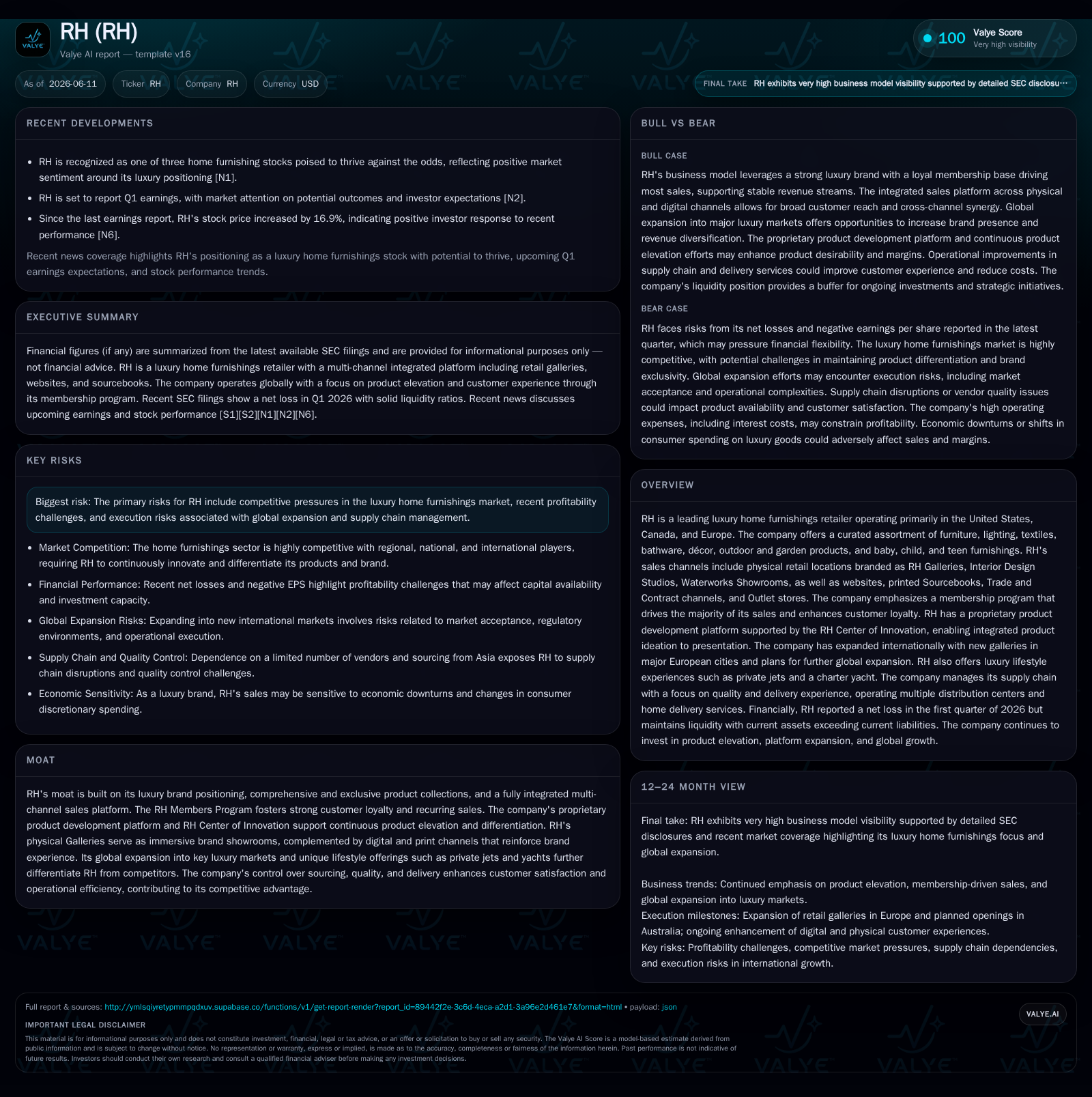
RH’s June 11, 2026, 10-Q filing highlights a first-quarter net loss contrasting prior year gains, indicating near-term profitability pressures amid ongoing investments. The company continues to lean on its membership program as the primary revenue engine, integrating multi-channel sales through physical Galleries, Sourcebooks catalogs, and digital platforms. International expansion with new European Galleries and lifestyle brand extensions underpin long-term growth plans. However, supply chain complexities and elevated real estate costs weigh on margins and cash flow, signaling execution risks ahead.
Q1 Operating Highlights: Profitability and Cash Flow Signals
RH’s most recent quarterly filing dated June 11, 2026, reports a net loss of approximately $13.7 million for the three months ended May 2, marking a notable reversal from an $8 million profit in the same period last year [S2]. This swing primarily reflects higher depreciation and amortization expenses alongside non-cash lease costs totaling over $66 million, which exert downward pressure on earnings despite stable operating cash flow generation. The company continues to invest heavily in capital expenditures related to new gallery openings and product innovation initiatives.
Liquidity remains healthy as RH had only $30 million in outstanding borrowings against $361 million in revolving credit availability (net of letters of credit), providing ample cushion for operational needs and expansion strategies [S2]. The maintenance of this liquidity during modest leverage signifies management’s commitment to sustaining growth investments while navigating near-term profitability challenges.
RH’s Luxury Membership Program: Driving Recurring Revenue and Loyalty
At the core of RH’s business model is its membership program that drives the majority of revenue by compelling customers to pay an annual fee for preferred pricing across its curated product lines spanning furniture, lighting, textiles, bathware, décor, outdoor living, and youth furnishings [S1]. This membership base enables RH to generate more predictable demand patterns and higher customer retention rates relative to sporadic transactional retail peers.
The program also supports elevated average transaction values as members gain access to exclusive collections introduced through proprietary product development overseen by RH’s Center of Innovation. By integrating product ideation with design execution tailored for luxury consumer tastes, RH reinforces exclusivity — a critical factor underpinning its pricing power in a market where brand prestige heavily influences purchase decisions.
Multi-Channel Integration: Galleries, Sourcebooks, and Digital Synergies
RH operates an integrated multi-channel sales platform combining physical retail galleries branded as “Galleries,” complemented by Interior Design Studios and Waterworks Showrooms. These immersive spaces serve not only as points of sale but as lifestyle brand environments enhancing experiential engagement with customers.
Beyond physical venues, RH leverages a suite of print catalogs known as Sourcebooks — including RH Interiors, Modern, Outdoor, Baby & Child/Teen — which act both as marketing vehicles and sales drivers by pictorially presenting products within aspirational lifestyle settings congruent with the brand’s aesthetic ethos [S1]. This print strategy stands out among luxury home furnishing retailers increasingly shifting focus towards digital-only marketing.
E-commerce further complements these channels by providing convenience for digitally inclined consumers without diluting RH’s high-end positioning. Together, these elements create a cohesive ecosystem that encourages higher foot traffic into Galleries while sustaining online engagement through catalog inspiration.
Global Expansion: European Galleries and Execution Risks
RH has extended its geographic footprint beyond North America into Europe by opening flagship Galleries in major luxury-centered cities. These expansions are pivotal growth levers intended to capture wealthy clientele seeking premium home furnishings consistent with RH’s brand proposition [S1]. Sequential international rollouts reinforce brand cachet globally while diversifying revenue streams.
However, global expansion introduces execution complexities such as localization demands in merchandising mix, currency exposure volatility, and amplified supply chain coordination challenges due to increased delivery distances for bulky goods. These factors represent short-to-medium-term risks that could pressure operating margins if not meticulously managed.
Supply Chain and Delivery Challenges Unique to Luxury Furnishings Retail
Handling large-format luxury furniture entails significant logistical constraints including inventory storage costs, delivery precision requirements for affluent customers, and susceptibility to raw material cost fluctuations. RH acknowledges risks linked to supply chain disruptions which may delay order fulfillment or elevate freight expenses [S1].
The company also administers a voluntary supplier financing program easing cash flow for vendors but requiring sophisticated accounts payable management. Such programs underscore RH’s proactive approach yet point toward the financial complexity inherent in orchestrating an extensive product assortment spanning multiple categories.
Competitive Positioning Against Key Peers in Luxury Home Furnishings
Within the luxury home furnishings space populated by players like Williams-Sonoma (multi-brand offerings) and Ethan Allen (premium furniture with design services), RH distinguishes itself through vertically integrated control over product design via a proprietary development platform allied with strong brand storytelling across physical and print channels.
Its membership model provides stickiness uncommon among competitors relying more heavily on open retail or less exclusive loyalty programs. Furthermore, the deliberate use of lifestyle branding extensions—stretching into private aviation and marine segments—augments the company’s aspirational image beyond traditional home décor boundaries.
Growth Vectors: Product Innovation and Lifestyle Brand Extensions
Product elevation remains central as evidenced by recent launches such as "RH Estates," featuring bespoke furniture lines emphasizing craftsmanship quality tied closely to customer personalization trends [S1]. Continuous introduction of curated assortments across diverse lifestyle segments sustains customer engagement.
Lifestyle brand extensions reflect an ability to capitalize on high-net-worth client preferences for holistic luxury experiences by incorporating offerings like private jets or yachts under the broader RH umbrella — a move that could enhance lifetime customer value though entails incremental capital commitments.
Risks: Margin Pressures, Real Estate Footprint, and Membership Dependency
Margins face compression from rising occupancy costs inherent in large footprint Galleries located in affluent urban areas alongside inflationary pressures affecting raw materials and transportation costs [S1]. The capital-intensive nature of expansive physical stores coupled with international rollout investments intensifies these concerns.
Additionally, dependence on membership program economics introduces risk; fluctuations in renewal rates driven by consumer discretionary spending or competitive alternatives could impact recurring revenue streams crucial for demand stability.
What to Watch Next: Upcoming Milestones and Operational Indicators
Important near-term markers include tracking same-store sales growth alongside membership program penetration rates which signal strength or softness in customer loyalty. Monitoring foot traffic trends at newly opened European Galleries will provide insight into expansion execution efficacy.
Further evaluation of catalog engagement metrics can reveal marketing effectiveness of Sourcebooks amidst evolving consumer media consumption preferences. Finally, any updates on supply chain financing utilization or inventory turnover ratios will illuminate operational resilience amid cost challenges.
This analysis incorporates facts exclusively sourced from filings dated June 11, 2026 ([S2], [S3], [S1]) reflecting RH's latest operating environment without speculative assumptions. It aims to elucidate underlying business dynamics shaping performance within the luxury home furnishings retail sector.
Disclaimer: This is research-only, informational analysis and not investment advice. It may include AI-generated interpretation and general industry context. Always verify important details using primary sources.

Comments