
MIND Technology Manages Production Resumption and Market Expansion Amid Revenue Timing Volatility
After resuming manufacturing in Q3 following a temporary suspension for facility expansion, MIND focuses on leveraging proprietary marine survey technology into new energy and security sectors.
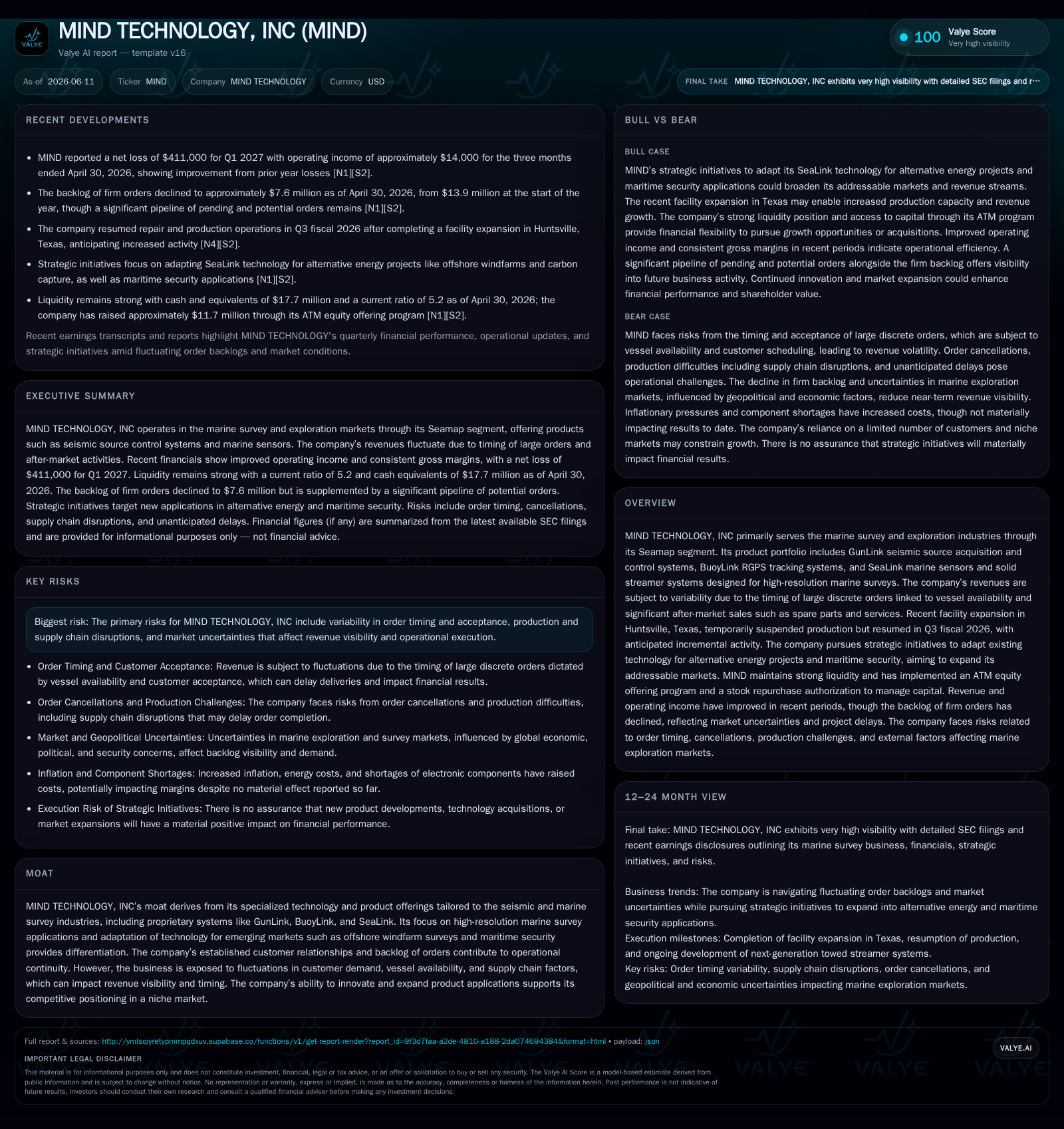
MIND Technology’s latest quarter reflects operational progress with production restarting after a facility expansion pause. The company’s niche marine survey equipment business remains subject to order timing variability tied to vessel availability and exploration cycles. Strategic moves include adapting its core GunLink, BuoyLink, and SeaLink systems for offshore renewable energy surveys and maritime security applications. Healthy liquidity underpins ongoing investment, but revenue predictability continues to fluctuate due to project-dependent demand and supply constraints.
Recent Operating Update: Production Restart Signals Facility Expansion Progress
In its latest filing dated June 11, 2026, MIND Technology reported that the Huntsville, Texas manufacturing facility—which had temporarily suspended production to accommodate expansion efforts—resumed full operations during Q3 fiscal 2026 [S2]. This restart is expected to incrementally enhance the company’s production capacity after prior quarters where output was constrained. The report underscores the cyclical nature of the business, noting that revenue variability remains influenced by the timing of substantial seismic equipment orders closely coupled with vessel availability for marine survey projects.
The adjacent earnings release on June 10 detailed stable gross profit margins aligned with prior year periods despite fluctuating revenue levels [S3]. Operating expenses rose slightly attributable primarily to stock-based compensation expense volatility rather than structural cost increases. Research and development spending remained consistent as MIND continues advancing its proprietary product suite.
Business Model: Project-Driven Marine Survey Equipment with Aftermarket Support
MIND operates primarily through its Seamap segment which designs, manufactures, and sells specialized hardware pivotal for marine geophysical data acquisition. The company’s key offerings comprise:
- GunLink: A seismic source acquisition and control system central to managing energy output during exploration surveys.
- BuoyLink: An RGPS tracking system providing precise positioning for seismic sources and streamers during marine operations.
- SeaLink: A line of marine sensors and solid streamer systems engineered for high-resolution three-dimensional seismic data collection.
Revenue generation is inherently tied to large discrete orders correlating with client vessel scheduling for system installation. These orders create natural lumpiness in top-line figures due to their project-specific timing [S1]. Complementing product sales is a robust aftermarket business covering spare parts, maintenance contracts, and repair services that sustain cash flows between large orders. This recurring aftermarket component contributes margin stability during broader cyclicality.
Margins benefit from MIND’s vertically integrated manufacturing approach combined with proprietary system design providing defensibility against commoditized competition. Nonetheless, product mix and order timing remain key margin influencers.
Industry Structure and Competitive Positioning
MIND occupies a specialized niche in the marine survey and exploration technology industry focusing on seismic source control and streamer instrumentation technologies crucial for offshore hydrocarbon exploration. Its competitive moat rests on proprietary technology platforms like GunLink and BuoyLink combined with established relationships within the marine survey vessel operator ecosystem.
While this sector traditionally serves oil & gas exploration budgets—which are subject to macro-driven cyclicality—MIND distinguishes itself by actively adapting its core technologies toward growing adjacent markets such as offshore renewable energy (wind farm surveys) and maritime security solutions [S1]. These expansions are intended to diversify revenue streams beyond the cyclical oilfield services market backdrop.
Peer benchmarking finds MIND comparably scaled among specialized marine geophysical equipment makers but uniquely positioned through its combined product breadth in source control plus RGPS positioning tracking.
Growth Drivers: Diversification into Renewable Energy Surveys & Maritime Security
Emerging growth avenues identified by MIND revolve around leveraging existing platform technology into expanding offshore windfarm survey contracts necessitating high-resolution seabed characterization [S1]. Additionally, maritime domain awareness applications requiring sophisticated sensor suites represent rising demand pockets enabling cross-sector technology reuse.
Growth KPIs include order backlog size moderated by unpredictable vessel usage schedules, adoption rates in new segments like offshore renewables, customer contract renewals within established oil & gas clients, plus incremental aftermarket activity linked with installed base ramp-up.
Investment in R&D focused on next-generation towed streamer systems aims at capturing improved waveform fidelity necessary for evolving subsurface imaging requirements—supporting competitiveness across both legacy hydrocarbon and new energy markets [S27].
Risks and Operational Constraints: Order Timing Volatility & Supply Chain Sensitivity
MIND faces typical risks inherent in capital equipment manufacturers serving cyclical offshore industries:
- Fluctuating customer demand contingent on exploration budget cycles introduces unpredictability in quarterly revenue recognition [S25].
- The timing of acceptance for large discrete orders is subject to external factors including vessel docking schedules implying revenue lumpiness.
- Supply chain disruptions impacting component availability or manufacturing throughput have potential adverse effects on delivery timelines [S1].
- Capacity constraints during facility expansions can temporarily reduce output as recently experienced before resuming production in Q3 fiscal 2026.
- Concentration risk exists given reliance on a relatively limited number of key customers within marine survey operators.
- Technological obsolescence pressures require ongoing investment into R&D to maintain product relevance across shifting offshore energy landscapes.
These contingencies require disciplined financial flexibility which MIND manages through proactive working capital oversight plus an active At-The-Market (ATM) equity program facilitating rapid capital raises if needed [S6], alongside potential buyback programs signaling confidence without jeopardizing liquidity.
What To Watch Next: Backlog Conversion & Progress into New Markets
Key upcoming milestones involve monitoring the pace at which expanded production capacity translates into backlog fulfillment given inherent order timing volatility. Clarity on uptake in alternative market segments such as offshore wind surveys will be critical to assessing whether diversification efforts offset traditional oilfield cyclicality.
Additional execution points include sales bookings velocity, movement in aftermarket revenues supporting revenue stability between projects, progression in technology launches especially regarding next-generation streamer systems, and operating expense trends particularly around stock-based compensation influencing profitability metrics.
Future liquidity reports are also relevant given ongoing use or non-use of ATM programs alongside any strategic capital deployments targeting acquisitions or facility upgrades [S23]
Financial Profile: Stabilizing Profitability Supported by Strong Liquidity
Although annual revenue figures remain subject to project cycle swings—with recent twelve-month revenues near $13.3 million—MIND has reached net income profitability as of fiscal 2026's year-end ($750,000 net income) supported by operating income exceeding $2.8 million [F1]
Adjusted EBITDA turned positive at $811,000 for the recent quarter ending April 30, 2026 versus prior-year quarterly loss comparisons indicating improving underlying operating leverage [S2]. Cash and equivalents totaled approximately $17.7 million at quarter-end supporting ample liquidity; current assets significantly exceed current liabilities yielding a healthy current ratio above 5x [F1].
Total debt stands at about $15.2 million nominally but net debt is negative considering available cash balances reflecting conservative leverage management [F1]. This financial footing provides MIND considerable runway amid cyclicality while sustaining investments in innovation.
This analysis is based exclusively on disclosed filings through June 2026 without speculative forecasting or investment research views.
Disclaimer: This is research-only, informational analysis and not investment advice. It may include AI-generated interpretation and general industry context. Always verify important details using primary sources.

Comments