
Navan’s AI Platform Positions It to Capture Business Travel and Expense Market Share
Navan's Q1 2027 results highlight AI-driven automation and integrated SaaS offerings fueling growth despite macroeconomic headwinds.
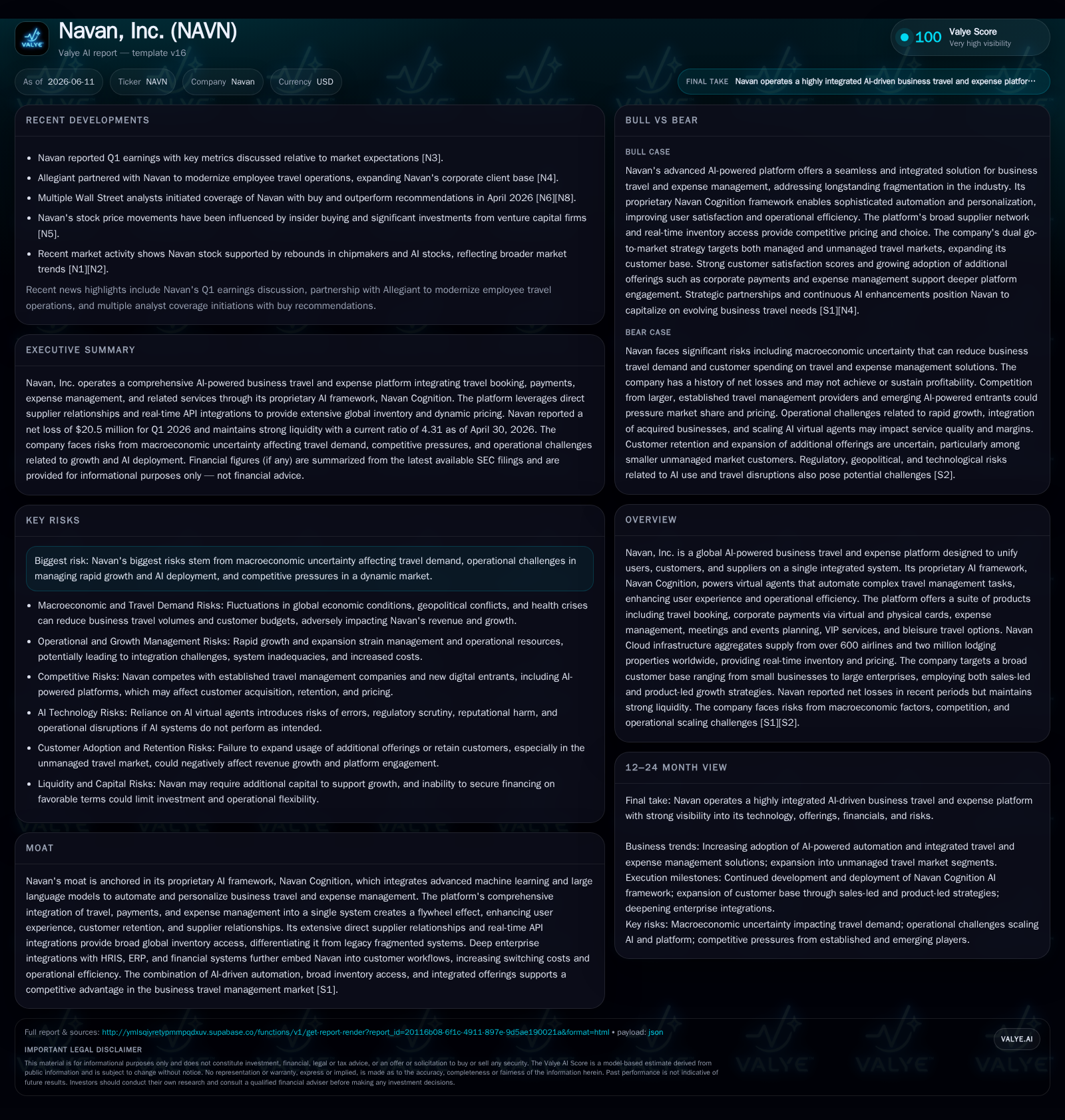
In its latest quarter ended April 30, 2026, Navan demonstrated continued progress in platform adoption and engagement amid a still volatile business travel environment. The company leverages its proprietary AI framework, Navan Cognition, to unify travel booking, corporate payments, and expense management into a seamless SaaS platform that supports both sales-led enterprise growth and product-led penetration of unmanaged segments. Despite ongoing net losses driven by operational investments, Navan’s flywheel effect, strong customer satisfaction scores, and broad real-time supplier integrations underpin its competitive moat versus legacy providers. Key risks include macroeconomic uncertainty affecting travel demand, execution complexity scaling AI capabilities, and intensifying competition from established and emerging SaaS peers.
Q1 Results Unveil Progress Amid Macroeconomic Uncertainty
Navan’s quarterly filing for the period ending April 30, 2026 ([S2]) reveals continued revenue growth driven by increasing adoption of its AI-powered travel management offerings. Despite this momentum in usage-based revenue streams, the company sustained substantial operating losses as it invested heavily across sales, marketing, and R&D to scale its platform globally. This reflects the broader industry dynamics where corporate travel demand remains sensitive to macroeconomic variables such as inflationary pressures and geopolitical instability causing variable T&E spending patterns. Management acknowledges challenges in forecasting due to disruptions in traveler behavior post-pandemic but remains focused on driving growth through product innovation and broadening market reach ([S3]).
Unifying Business Travel with Proprietary AI: Navan’s Platform Advantage
At the core of Navan’s competitive edge lies its proprietary AI framework—Navan Cognition—which powers a suite of specialized virtual agents handling intricate travel workflows from pre-booking personalization through post-trip reconciliation ([S1][S6]). These agents automate complex tasks traditionally requiring human intervention, enhancing efficiency for travelers while enabling better policy compliance for organizations.
The company’s integrated SaaS platform converges multiple functionalities: travel booking leveraging a vast "Navan Cloud" infrastructure aggregating over 600 airlines and two million lodging properties worldwide via real-time API connections; corporate payment solutions including physical and virtual cards; expense management automation; as well as meetings/events planning and bleisure travel options ([S1]). This comprehensive offering fosters a flywheel effect binding users who seek simplicity and rewards, customers who gain spending visibility and operating efficiencies, and suppliers desiring access to an engaged traveler base.
Deep enterprise integrations with SSO, HRIS, ERP, and financial systems streamline onboarding processes and embed Navan within broader corporate workflows—significantly raising switching costs while facilitating cross-selling across product lines ([S6][S24]). The high customer satisfaction score (CSAT) of 96% alongside an NPS of 45 underscores strong user endorsement of the platform’s intuitiveness and time-saving features ([S1]).
Competitive Context: Strengths Versus Legacy and Emerging SaaS Players
Navan operates within a crowded landscape featuring entrenched legacy vendors like SAP Concur—traditional stalwarts characterized by fragmented systems limiting user experience—and newer SaaS challengers such as TripActions that similarly emphasize cloud-native platforms integrating travel with expense management ().
What differentiates Navan is its sophisticated AI-driven automation combined with its holistic approach seamlessly uniting booking, coupled payments solutions, expense reporting, VIP services, events planning, and bleisure offerings in one system ([S1]). Its direct supplier integrations provide breadth akin to travel supplier technology providers like Amadeus but extended into next-gen AI capabilities. This integration depth fosters a durable competitive moat via enhanced operational efficiencies, improved customer retention rates due to superior service levels reflected in CSAT scores, and a compelling value proposition for enterprises seeking unified T&E platforms.
Scaling Growth: Exploiting Integration Depth and Usage-Based Models
Navan’s dual go-to-market strategy blends sales-led motions targeting mid-sized to large enterprises—capitalizing on existing frustrations with legacy platforms—and product-led growth aimed at the sizable unmanaged segment (~65% of global business travel spend) through self-service onboarding tools that reduce friction for smaller businesses ([S6][S10][S12]). This hybrid revenue model balances stable subscription seat licenses with variable usage-based fees aligned with bookings or transactions.
The recurring revenue build benefits from deep organizational adoption as Navan extends beyond core travel into corporate payments and expense management suites. Cross-selling efforts are bolstered by in-app prompts nudging customers toward expanding their footprint inside accounts. Usage metrics such as booking volume alongside renewal rates serve as key KPIs supporting ARR growth potential ([S6]).
By embedding within enterprise infrastructure via API integrations—SSO for security compliance; HRIS for traveler profiles & policies; ERP for finance workflows—Navan reduces implementation complexity while driving higher LTV through stickier customer relationships ([S24]). The growing penetration across various departments—from finance to procurement to executive leadership—furthers platform entrenchment.
Risks and Headwinds: Macroeconomic Volatility, AI Deployment Challenges, Competition
Despite promising technology leadership and market strategy execution,[S26][S27][S28] outline critical risk vectors. Chief among them is macroeconomic uncertainty impacting corporate T&E budgets amidst inflationary trends, interest rate shifts, geopolitical tensions influencing both travel volumes and IT spend priorities. Moreover, AI-powered virtual agents necessitate ongoing refinement—the risk of technology underperformance or integration glitches could hamper user satisfaction or slow deployment velocity.
Competition intensifies not only from legacy players doubling down on modernization but also from emerging SaaS startups innovating in niche subsegments or payment processing realms. Regulatory complexities around corporate card programs or privacy compliance further demand resource allocation that could strain operational bandwidth. Finally, the company's history of operating losses underscores the execution risks inherent in scaling rapidly while balancing cost structures.
"Next Steps" for Investors: Key Milestones to Monitor Ahead
Looking forward ([N1], [S2]), investors should track indicators such as:
- Uptake rates for expanded Navan offerings beyond traditional travel bookings including meetings/events management;
- Progression on automation feature rollouts encapsulated within enhancements to Navan Cognition’s natural language processing capabilities;
- Net Revenue Retention improvements reflective of stronger wallet share gains across installed bases;
- Usage patterns revealing resilience or sensitivity amid prevailing economic conditions affecting bookings volume. These milestones will reveal how effectively Navan mobilizes its flywheel to convert technical differentiation into commercial gains under shifting market dynamics.
Financial Summary: Stable Liquidity Enables Investment Continuation
As of April 30, 2026, [F1] shows Navan held $518 million in cash & equivalents against $124 million total debt, resulting in a net cash position near $394 million and a current ratio of approximately 4.31. This liquidity position supports ongoing investments despite substantial operating losses reflecting prioritized spending on R&D innovation, especially related to AI enhancements, plus global sales expansion ([F1],[S2]). This financial posture aligns with an investment phase typical of SaaS platforms pursuing market share leadership over near-term profitability.
Disclaimer: This is research-only, informational analysis and not investment advice. It may include AI-generated interpretation and general industry context. Always verify important details using primary sources.

Comments