
Stitch Fix Leverages Data Science and Private Labels to Reinvent Apparel Retail
The latest quarter underscores Stitch Fix's progress in melding AI and human stylists while advancing private label growth amidst ongoing profitability hurdles.
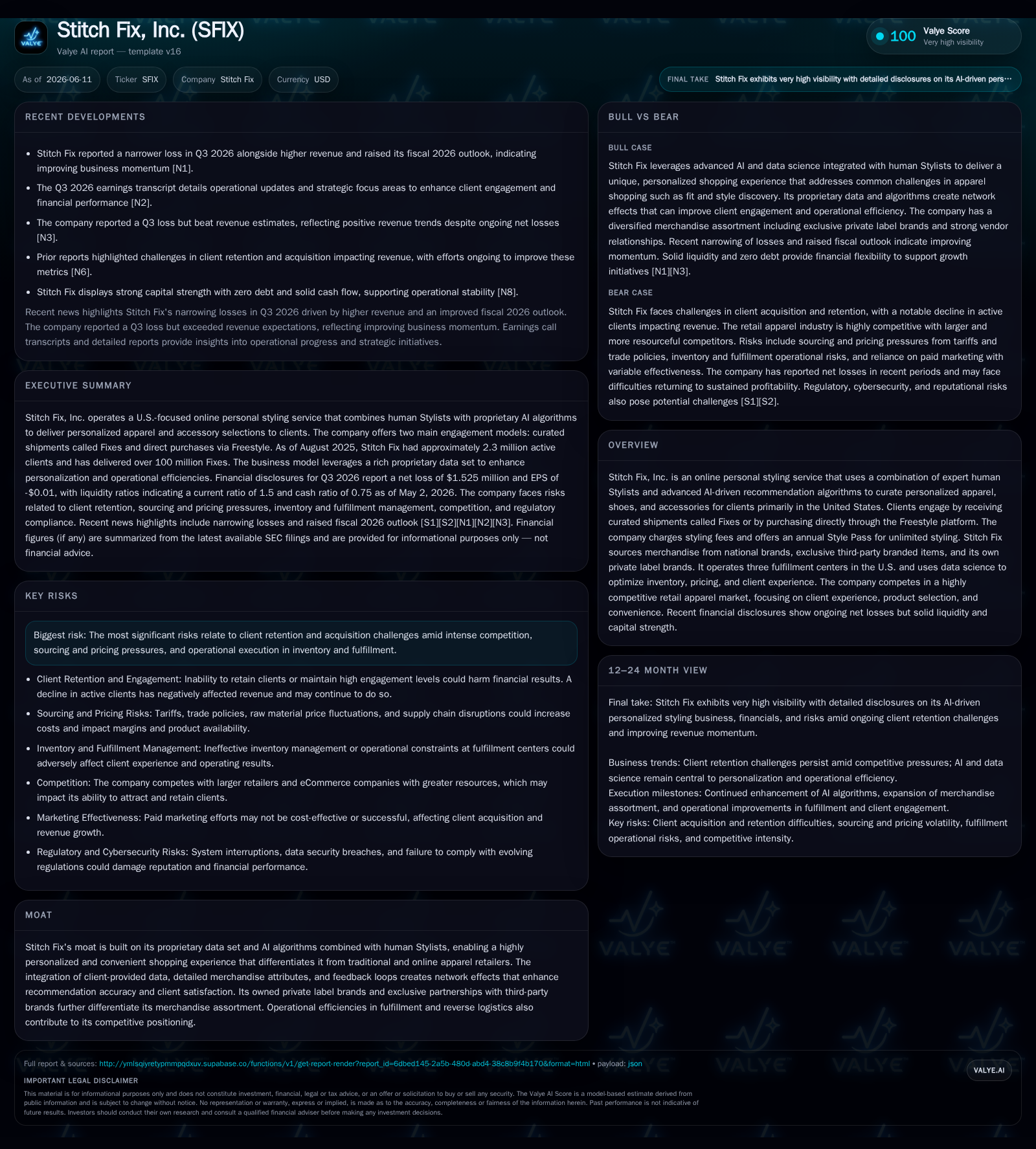
In its Q3 fiscal 2026 filing, Stitch Fix reported accelerating revenue growth accompanied by a narrowing operating loss, driven primarily by enhanced integration of AI recommendation algorithms with human Stylists and expansion of its private label assortment. The company’s hybrid model combines curated shipment "Fixes" with freestyle e-commerce purchases, supported by subscription styling passes and styling fees that contribute to recurring revenue stability. Operational execution at its U.S.-based fulfillment centers remains critical for margin improvement but also presents capacity risks amid an intensely competitive online apparel market. Risks persist around client retention, sourcing costs, and marketing efficiency, though data science innovation and product expansion offer growth catalysts going forward.
Q3 Fiscal 2026: Operating Momentum Amid Loss Compression
Stitch Fix’s Q3 fiscal 2026 results released June 11, 2026 [S2][S3][N1][N3] mark a meaningful step forward in revenue acceleration paired with a continued but narrowing operating loss. Revenue growth was supported by stronger client engagement driven by tighter integration of AI research view algorithms with the company’s human Stylists—key to enhancing personalization in curated shipments known as "Fixes" as well as tailored freestyle purchasing experiences. Despite higher revenue, margin pressure from merchandise sourcing challenges held back wholesale profitability gains though operating loss margins showed improvement compared to prior quarters.
How AI-Enhanced Stylists Drive Personalized Apparel Sales
Stitch Fix’s business model uniquely blends expert physical Stylists with proprietary AI research view algorithms [S1]. This hybrid approach leverages data science extensively: the company gathers detailed client inputs directly rather than inferring preferences externally. Its algorithms analyze merchandise attributes down to fit details such as inseam length or pocket shape, feeding stylists’ selections to optimize each Fix.
By empowering Stylists with data-driven insights, Stitch Fix can improve both the quality of personalized apparel selections and operational efficiencies. Matching clients accurately with Stylists skilled in particular style categories further increases client satisfaction, reduces guesswork, and enhances retention potential. This symbiosis establishes a moat rooted in a continuously expanding proprietary dataset coupled with machine learning feedback loops.
Subscription Passes, Styling Fees, and Merchandise Mix: Revenue Breakdown Insights
Revenue streams at Stitch Fix comprise a mix of product sales from curated Fix shipments and direct freestyle orders plus value-added styling fees and subscription passes [S1][S2]. Styling fees constitute recurring income when clients accept a shipment (or "Fix"), while the annual Style Pass provides unlimited styling for a fixed fee encouraging repeat engagement.
This dual revenue mechanism offers partial insulation against the volatility of apparel retail margins through subscription predictability. Additionally, the private label brand penetration within merchandise helps improve gross margins relative to national brands alone. Expansion efforts here broaden assortment appeal while giving Stitch Fix greater control over cost structures compared to third-party branded items.
Competitive Dynamics in Online Personal Styling: Peer Contextualization
Stitch Fix sits at the confluence of online personal styling services such as peers Rent the Runway or Trunk Club and broader traditional retailers like Nordstrom or Macy's. Its model competes on personalization accuracy combined with convenience—attributes challenging to match by pure-play e-commerce or conventional bricks-and-mortar stores.
Subscription box companies like Birchbox provide comparable frameworks emphasizing lifestyle curation through recurring delivery but often lack Stitch Fix’s specialized stylist-human plus AI data synergy. In this intensely competitive environment, customer acquisition costs are volatile, highlighting the importance of differentiated technology assets and client trust built via superior styling outcomes.
Inventory and Fulfillment: Operational Levers Impacting Margins
Managing three U.S.-based fulfillment centers is a pivotal operational focus for Stitch Fix; these centers enable rapid shipment of curated items but also require efficient staffing and reverse logistics management for returns [S2]. Inventory management remains vital given markdown risks inherent in apparel retail.
Inventory turnover rates are critical KPIs tied directly to margin sustainability—excess stock or slow sell-through can amplify margin erosion [S2]. While fulfillment investments promise scale advantages over smaller peers and brick-and-mortar counterparts reliant on physical stores, they introduce risk if operational constraints lead to delays or higher costs that erode client experience.
Growth Catalysts: Data Science Innovation and Product Expansion
Continued innovation in data science underpins Stitch Fix’s growth trajectory [S1][S2]. Enhancements in AI-driven research view accuracy increase order relevance fostering higher average revenue per client. Concurrently, expanding private label assortments diversifies product offerings beyond national brands allowing tailored exclusivity.
Mobile platform investment enabling freestyle purchasing complements curated shipments providing multi-channel engagement opportunities that capture broader consumer preferences for convenience without sacrificing personalized discovery.
Risks to Client Retention, Sourcing Pressures, and Execution Challenges
Risks highlighted supplement industry-wide concerns including difficulty maintaining high client retention rates amid competition [S1][S2]. Paid marketing effectiveness is uncertain with variable success in new client acquisition driving sensitivity in customer acquisition costs.
Apparel sourcing involves exposure to tariffs and supply chain disruptions impacting raw material prices creating cost pressures that feed into either compressed margins or elevated customer pricing risking demand erosion [S2]. Fulfillment center staffing challenges could degrade service levels affecting reputation.
Additional risk stems from legal proceedings related to securities claims settled with $32 million provision recently announced [S16], alongside cybersecurity threats targeting proprietary AI systems where breaches could impair operational integrity.[S23]
'What to Watch': Guidance Signals, Client Metrics, and Margin Trajectories Ahead
Future monitoring should focus on key subscriber metrics such as active client base size trajectories given past declines reported [S20], uptake rates of annual subscription passes reflecting revenue predictability gains, and incremental styling fee revenue signaling increased engagement intensity.[N2][N3]
Inventory turnover improvements will be a harbinger of better margin prospects while fulfillment center operational efficiencies will remain crucial execution points [N1]. Management commentary on marketing spend efficiency and new product launches will provide directional clues on competitiveness amidst sector headwinds.
(Brief) Financial Snapshot: Current Liquidity and Profitability Overview
Stitch Fix’s balance sheet at quarter-end shows cash reserves near $87 million with current assets outpacing current liabilities by a ratio approximately 1.5 times [F1], reflecting adequate short-term liquidity buffers. However, net losses persist with operating income remaining negative at $38.9 million as of latest available metrics ending August 2025 [F1], consistent with disclosed ongoing investments in scale-up initiatives.[S2]
Navigating path-to-profitability depends heavily on sustained revenue growth coupled with operational leverage realized via fulfillment scaling, inventory optimization, styling fee stabilizations, and subdued customer acquisition costs.
Disclaimers: This analysis is based exclusively on public SEC filings dated through June 11, 2026 complemented by reputable news transcripts without any forward-looking projections not explicitly stated by the company. It supplies no investment research views but aims solely to provide informed industry context deeply grounded in available evidence for professional readers.
Disclaimer: This is research-only, informational analysis and not investment advice. It may include AI-generated interpretation and general industry context. Always verify important details using primary sources.

Comments