
Photronics' Q2 Miss Reflects Delays in Semiconductor Design Activity
Photronics’ latest quarterly filing reveals near-term demand softness linked to postponed semiconductor design releases, underscoring the importance of its advanced lithography capabilities and global footprint.
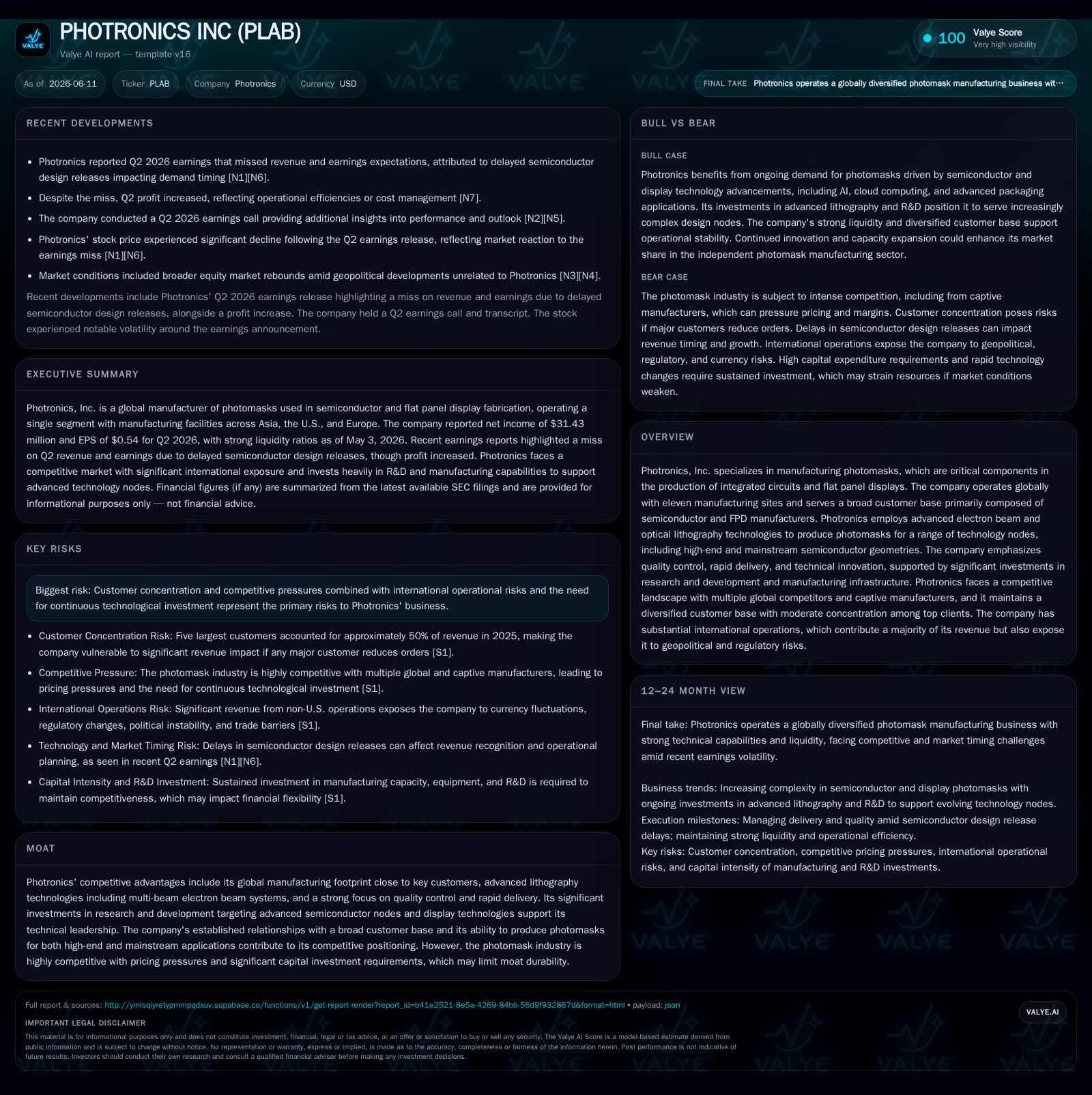
In its Q2 fiscal 2026 report filed June 11, 2026, Photronics Inc. reported a revenue miss attributed primarily to delays in semiconductor customer design launches, which impacted photomask orders and production volumes. The company’s business model centers on manufacturing high-precision photomasks for integrated circuits and flat panel displays using electron beam and optical lithography, serving a diverse but moderately concentrated client base across multiple global sites. Competitive pressures remain intense due to captive fab operations and pricing dynamics, but Photronics sustains its position through technological investments, a broad technology node coverage including cutting-edge sub-28nm masks, and regional proximity to customers that help reduce cycle times. Looking forward, structural growth drivers include advancing semiconductor technology nodes and expanding display technologies, though customer concentration and price competition pose persistent risks. Financially, Photronics maintains a robust balance sheet with significant cash reserves supporting continued R&D and capital expenditures despite short-term near-term demand headwinds.
Q2 Operating Performance Highlights Demand Variability
Photronics’ Q2 fiscal 2026 filing dated June 11 shows a notable revenue miss attributed directly to delayed semiconductor design releases by key customers [S2][N1]. These delays have slowed the cadence of new photomask orders as the launch timing of integrated circuit designs influences the demand for mask sets used in wafer patterning. The shortened visibility into customer order flow underlines the cyclical sensitivity inherent in the photomask business tied closely to semiconductor industry product cycles [N3]. With typical order-to-delivery cycle times ranging from days to a few weeks for certain mask types — especially those deployed early in wafer processing layers — such shifts disrupt production throughput and near-term volume realization.
Photronics’ Manufacturing Model: Technology Nodes and Customer Dynamics
Operating eleven manufacturing facilities spanning Taiwan, China, South Korea, the United States, and Europe enables Photronics to be strategically proximate to major semiconductor hubs worldwide [S1]. This geographic footprint helps reduce logistics delays critical in an industry where timely delivery affects wafer fab yields.
At the core of Photronics’ revenue are high-precision photomasks produced through sophisticated electron beam lithography complemented by optical lithography systems. This dual approach supports diverse product requirements clustered around two principal technology segments: high-end masks for advanced sub-28nm nodes applicable to next-generation IC designs and AMOLED/LTPS display substrates; and mainstream masks targeting ≥32nm nodes for more mature fabrication processes [S23]. Mask sets typically consist of multiple layers corresponding to different circuit pattern strata on wafers or display substrates.
The company’s client base comprises integrated device manufacturers (IDMs), pure-play foundries, fabless semiconductor companies, and flat panel display makers. Revenue demonstrates moderate concentration with the top five customers accounting for roughly half of total sales—a factor necessitating ongoing diversification focus while leveraging deep customer relationships for stable reorder streams [S5][S6]
Competitive Set: Independent Supplier Advantages and Captive Challenges
Photronics competes with several notable global photomask suppliers including Dai Nippon Printing Co., Ltd. and Hoya Corporation as well as a range of Asian vendors such as LG Innotek. Equally important is the competition from captive photomask operations embedded within large semiconductor fabs that produce masks internally for their own wafer fabrication needs or third-party supply in some cases [S6].
Against this backdrop, Photronics’ competitive advantages are rooted in delivering consistent product quality checked through rigorous defect inspection regimes; maintaining high photomask yield rates via clean-room controlled manufacturing; providing rapid order turnaround facilitated by localized factories close to customers; and sustaining pricing competitiveness while investing heavily in technological upgrades [S5][S6]. Its service model emphasizes agility alongside technical proficiency as order urgency can vary extensively across customers.
Technological Investment Sustaining Lithography Leadership
Capital intensity characterizes photomask manufacturing due to the need for cutting-edge lithographic machinery. Photronics invests considerable R&D resources—around $15–17 million annually—to enhance multi-beam electron beam lithography systems which enable parallel pattern writing essential for addressing shrinking design nodes and improving throughput efficiency [S22]. This investment underpins the firm’s ability to supply both mainstream volume demands and advanced-generation mask requirements encompassing EUV-compatible templates.
Research arms in Boise (IC masks) and South Korea (FPD masks) tailor innovations aligned with regional customer roadmaps. Intellectual property protection through patents and trade secrets further fortifies the technological moat critical given rapid node evolution driven by AI-grade applications influencing mask complexity [S22].
Growth Catalysts: Node Shrinkage, Foundry Expansion, and Display Tech Advances
Structural industry tailwinds remain firmly supportive over the medium term. The perpetual miniaturization trend toward sub-7nm nodes increases mask complexity—resulting in lengthier job cycle times but also higher-value mask sets with multiple layers required per chip design iteration.
Moreover, surging fabs’ capacities globally — notably among foundry players servicing fabless companies — elevate total photomask volumes ordered each year. Flat panel displays' transition towards advanced generations like Generation 10.5+ AMOLED/LTPS necessitates specialized mask offerings not only reflecting circuit intricacies but also accommodating larger substrate sizes increasing manufacturing sophistication.
Parallelly, replacement demand stems from yield improvement initiatives where defective or obsolete masks require rapid turnover—a dynamic anchoring recurring revenue streams in an otherwise cyclical market.
Risks to Monitor: Customer Concentration and Pricing Pressures Intensify
Notwithstanding these growth drivers, Photronics still faces elevated risks centered on its reliance on a limited number of large customers representing half its revenues—a potential source of volatility if any single client delays orders or switches suppliers abruptly [S5]. Intense price competition further compresses margins especially among mainstream mask segments considered more commoditized vis-à-vis ultra-high-end node-specific products dominated by fewer suppliers with specialized machinery [S6].
On the international front, operating across multiple jurisdictions exposes Photronics to geopolitical tensions affecting supply chains or imposing tariffs that could raise costs or disrupt production timelines. Moreover, rapidly evolving lithography technologies compel continuous heavy capital expenditure risking obsolescence if innovation lags competitors or customer expectations shift suddenly.
'Next Steps': What The Market Should Watch Forward
Key upcoming milestones include management commentary updates on semiconductor design release schedules impacting backlog clarity beyond typical short-order cycles as disclosed in Q2 earnings calls [N3][S2]. Indicators such as order book recovery rates or upward revisions in forecasted utilization will signal normalization.
Additionally, metrics related to margin improvement through pricing discipline or operational efficiencies amid competitive pressures will be pivotal. Tracking R&D output translating into commercialized multi-beam capabilities underpinning penetration into latest node masks will serve as strategic barometers.
Financial Health Snapshot: Balance Sheet Strength Underpins Strategic Flexibility
Photronics enters this uncertain demand phase fortified by a robust financial position revealed in its latest balance sheet: cash & equivalents exceeding $511 million eclipsing nominal debt obligations around $3.8 million yields a strong net cash posture—approximately negative $507 million net debt—and a current ratio over 5x indicating excellent liquidity buffers [F1]
Such strength supports ongoing capital investments required for equipment upgrades alongside continued research spending despite near-term revenue softness resulting from external demand timings rather than intrinsic operational issues.
This analysis synthesizes publicly available financial filings as of June 11, 2026 ([S1],[S2],[S3]) combined with corroborating earnings call insights ([N1],[N3]) providing a grounded perspective on Photronics Inc.’s latest standing within the competitive photomask manufacturing sector without investment research views.
Disclaimer: This is research-only, informational analysis and not investment advice. It may include AI-generated interpretation and general industry context. Always verify important details using primary sources.

Comments