
BUCKLE INC’s Q1 2026 Highlights Solid Same-Store Sales Growth and Strong Liquidity
Recent quarterly results reveal stable retail execution with inventory discipline supporting margin preservation.
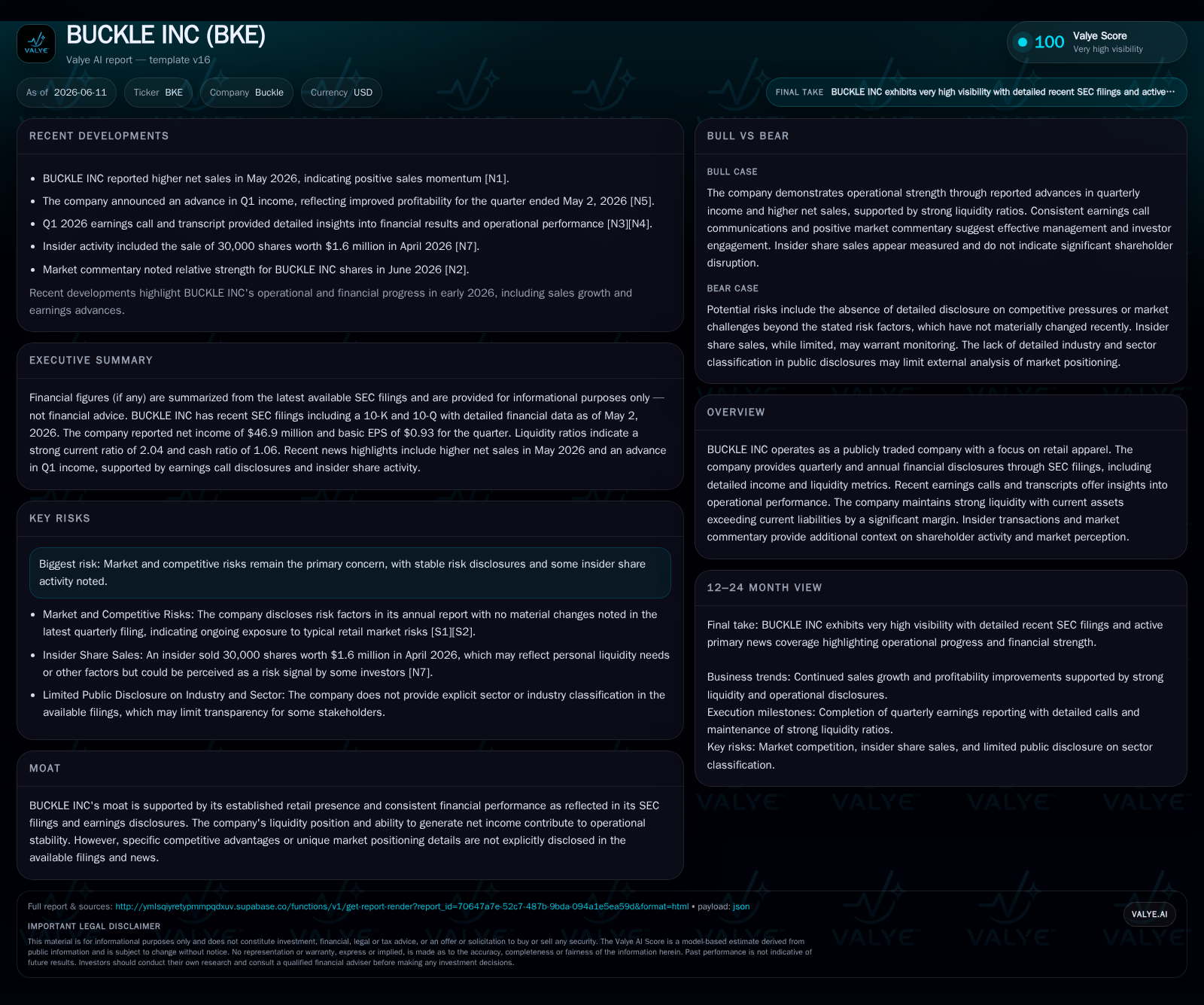
The Buckle, Inc. reported first-quarter fiscal 2026 results showing favorable same-store sales trends, reflecting steady foot traffic and consistent merchandising appeal. The company benefits from a robust liquidity position supported by a current ratio exceeding 2x as of May 2026, underpinning operational flexibility. While the apparel retail sector remains challenged by shifting consumer preferences and supply chain considerations, Buckle’s focus on inventory turnover, markdown control, and selective store footprint management positions it competitively within specialty apparel retailing.
Recent Operating Update
In its latest quarterly filing dated June 11, 2026, The Buckle, Inc. disclosed operating results for the fiscal quarter ended May 2, 2026 [S2]. The company highlighted favorable management discussions emphasizing improved same-store sales (comparable sales) performance during Q1 fiscal 2026. This sales uplift was primarily attributed to maintained foot traffic levels combined with a slight increase in average transaction size, suggesting effective merchandising and customer engagement.
Liquidity is robust with current assets standing at approximately $471 million against current liabilities near $231 million as of May 2026, resulting in a current ratio of about 2.04 [F1]. This ample liquidity position gives Buckle operational stability in an apparel retail environment where working capital management—especially inventory levels—is crucial.
A recent event filing from June 2 confirmed ongoing dividend payments which underscore consistent cash flow generation capabilities [S3]. No material changes were reported to risk factors affecting the business compared to the annual report from April 2026 [S24].
Business Model Overview
Buckle generates revenue principally through sales of casual apparel and accessories targeting specialty apparel consumers via brick-and-mortar stores predominantly located in regional shopping malls and lifestyle centers. The product mix focuses on branded denim wear alongside complementary items like footwear and accessories. Increasingly, Buckle incorporates omnichannel retailing elements including direct-to-consumer e-commerce platforms that provide broader geographic reach beyond physical locations.
Revenue mechanics hinge on both volume (units sold) and price/mix factors such as product assortment freshness and promotional activity. Comparable store sales growth is a key performance indicator reflecting traction in core markets. Inventory turnover rates affect cost-of-goods-sold dynamics materially since excess stock leads to higher markdowns adversely impacting gross margin.
Though detailed segmentation is not disclosed explicitly in filings, merchandise quality appears positioned to balance fashion relevance with durable appeal—important in managing SKU rationalization and markdown cadence.
Industry Structure and Competitive Position
Buckle resides within the specialty apparel retailer subset of the broader apparel retail sector. Competitors include American Eagle Outfitters, Abercrombie & Fitch, and Urban Outfitters—companies similarly balancing physical store footprints with digital channel investments.
The market is characterized by intense competition based on brand perception, assortment depth, pricing strategies, store experience quality, and increasingly on omnichannel integration effectiveness. Buckle’s competitive strengths lie in its established mall-based footprint focused on loyal customer segments known for affinity toward denim-oriented casual wear.
Operational efficiency benchmarks against peers include gross margin percentages maintained via controlled markdown rates and high inventory turnover ratios—both essential in minimizing obsolete inventory risks amid rapidly changing fashion preferences.
Growth Drivers
Growth initiatives highlight several vectors:
- Seasonal Assortment Expansion: Curated product launches aligned with fashion cycles aim to sustain customer interest and justify average transaction size gains.
- Omnichannel Sales Enhancements: E-commerce penetration continues to ramp incrementally providing convenience shopping options which complement physical store presence.
- Store Footprint Optimization: Selective openings in high-foot-traffic locales coupled with potential closures of underperforming sites aim at maximizing overall sales productivity per square foot.
- Customer Engagement Strategies: Though specific loyalty program metrics are undisclosed, targeted marketing efforts support retention amid sector-wide competitive pressures.
These drivers collectively fuel sustainable revenue gains while supporting operating margin stability through disciplined inventory management reducing markdown dependency.
Risks and Constraints
Key risks persist around:
- The cyclical nature of consumer discretionary spending affecting apparel demand volumes.
- Rapid shifts in fashion trends increasing susceptibility to inventory obsolescence if assortment agility falters.
- Supply chain disruptions or cost inflation potentially pressuring vendor terms leading to margin compression.
- Intensifying competition pushing discounting behaviors which could erode pricing power if not carefully managed.
- Store operating costs including rent escalations or labor challenges impacting profitability at specific locations.
Management's statement that there have been no material changes to previously disclosed risk factors reiterates stable but ongoing exposure to these challenges [S24].
What to Watch Next
Financial Profile Snapshot
The Buckle’s latest available balance sheet metrics reflect strong liquidity cushions supporting its capital-intensive retail operations with $470.97 million in current assets against $230.69 million in current liabilities (current ratio ~2.04) as of May 2026 [F1]. This level of working capital is constructive for maintaining healthy inventory levels without excessive reliance on short-term debt or liquidity strains.
In sum, Buckle exhibits operational discipline in managing merchandise flow while sustaining profitability through careful balance of store footprint strategy and evolving omnichannel capabilities within competitive specialty apparel retailing conditions.
This analysis is based exclusively on publicly available SEC filings up to June 11, 2026, supplemented by relevant earnings call transcripts and structured companyfacts data; no proprietary or speculative information has been used.
Disclaimer: This is research-only, informational analysis and not investment advice. It may include AI-generated interpretation and general industry context. Always verify important details using primary sources.

Comments