
Oxford Industries’ Q1 2026 Results Reflect Channel Resilience Amid Margin Pressures
Oxford Industries navigates a challenging apparel market in Q1 2026 with steady direct-to-consumer growth offsetting margin headwinds from promotional activity and supply chain costs.
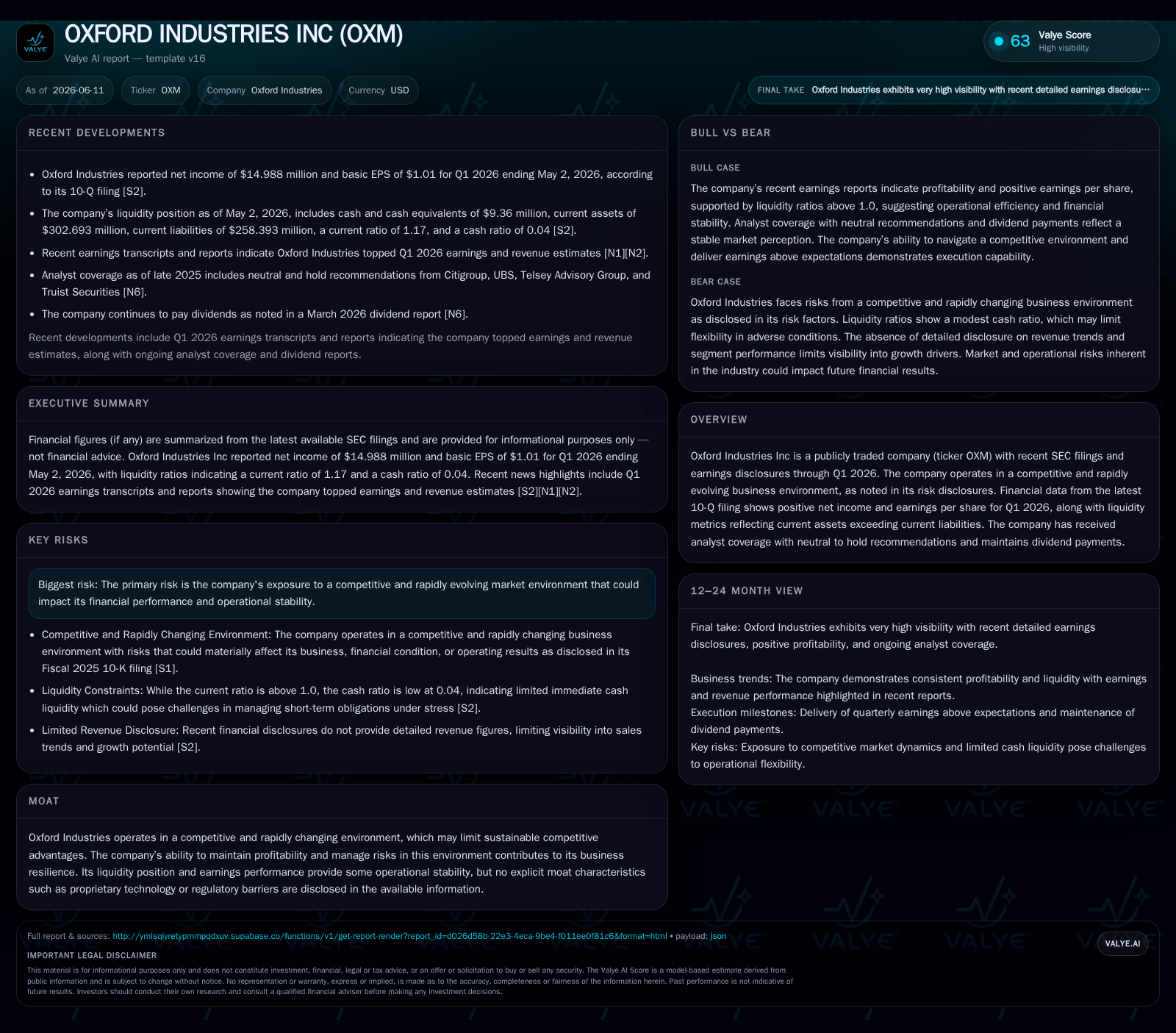
Oxford Industries reported its fiscal Q1 2026 results highlighting operational resilience with positive net income and solid liquidity despite continued margin pressure from elevated promotional spending and supply chain inflation. The company’s multi-brand lifestyle portfolio benefits from a balanced revenue mix across wholesale and direct-to-consumer channels, including e-commerce and full-price retail stores, enhancing brand engagement. Growth initiatives focus on expanding direct-to-consumer sales via digital enhancements and omnichannel strategies while addressing inventory management amid fashion cycles. Macroeconomic challenges such as tariffs, inflation, and geopolitical tensions continue to impact the sector’s competitive landscape.
Q1 2026 Operating Update
Oxford Industries reported fiscal Q1 2026 results in its June 11, 2026 10-Q filing demonstrating operational resilience with positive net income despite a challenging retail environment marked by discretionary spending softness [S2], [F1]. The company maintained a current ratio of approximately 1.17 at quarter-end with $9.36 million in cash equivalents against current liabilities of $258 million, reflecting prudent liquidity management [F1]. Comparable sales metrics combined e-commerce with full-price retail store sales according to Oxford’s methodology which excludes outlet stores and locations undergoing significant remodels or relocations, providing a clear view of underlying demand [S1]. However, operating income was pressured by heightened promotional activity aimed at driving traffic during intensifying price competition alongside inflationary supply chain cost increases that are prevalent across the apparel sector [S2], [S1].
Business Model: Brand Portfolio & Revenue Channels
Oxford operates a portfolio of lifestyle apparel brands including Tommy Bahama, Lilly Pulitzer, Johnny Was, and emerging labels focused on premium consumer segments with strong brand equity [S1]. Its business model integrates wholesale distribution to retail partners alongside direct-to-consumer (DTC) sales via owned physical stores and growing e-commerce platforms. The company’s comparable sales approach reflects this integrated channel strategy by combining online and full-price store sales that share inventory planning, return policies, and cross-channel marketing initiatives designed to deepen consumer loyalty [S1]. DTC expansion improves revenue quality through enhanced pricing control and customer experience but requires careful management of channel conflict with wholesale partners. Product differentiation is driven by lifestyle branding rather than proprietary technology or scale moats [S1].
Competitive Positioning
In the broader context of multi-brand apparel companies like PVH Corp, Ralph Lauren Corporation, Tapestry Inc., and VF Corporation, Oxford occupies a niche emphasizing curated lifestyle brands with modest scale but strong emotional connections to consumers. Unlike some larger peers operating global luxury portfolios or broader geographic footprints, Oxford focuses on optimizing channel mix—particularly increasing DTC penetration—while maintaining wholesale partnerships carefully. This approach helps mitigate some cyclical exposure but leaves the company vulnerable to discretionary spending fluctuations common in apparel retail. Industry-wide margin pressure from discounting remains a persistent challenge.
Growth Drivers: Channel Expansion & Digital Strategy
Oxford’s growth strategy centers on expanding the direct-to-consumer segment fueled by investments in e-commerce capabilities and personalized digital marketing leveraging data analytics tools [N1], [S1]. Omnichannel initiatives aim to meet evolving consumer preferences for convenience, transparency, and speed across all touchpoints. Additional growth avenues include selective new product launches broadening seasonal appeal alongside supply chain optimization efforts targeting cost reduction and faster inventory turnover amid fashion sensitivities [S1]. These strategies support diversification away from wholesale dependency toward higher-margin DTC revenue streams.
Risks & Watchpoints
Oxford faces risks typical of the apparel industry including volatility in discretionary spending linked to macroeconomic factors such as inflationary pressures, trade tariffs on imports, labor cost increases, currency fluctuations, and geopolitical instability affecting logistics costs [S1], [S2]. The sector’s competitive environment drives frequent promotions that erode gross margins while inventory management missteps risk markdowns on obsolescent stock amid fast-changing fashion cycles. Channel conflicts may arise between wholesale customers seeking volume discounts versus direct consumers valuing exclusivity. Digital transformation execution also presents cybersecurity and operational risks. Oxford’s recent focused efforts on operating expense realignment seek to address these headwinds while maintaining investment in growth areas [S2].
Looking Ahead: Key Milestones
Critical near-term indicators include forthcoming quarterly comparable sales updates offering insight into consumer demand across physical stores and e-commerce channels [N2], ongoing improvements in inventory turnover signaling merchandise planning effectiveness reducing markdown risk, cadence of new product introductions enhancing consumer engagement seasonally [N2], as well as returns from digital platform investments boosting personalized marketing reach. External macroeconomic variables such as interest rate changes or tariff adjustments will remain important factors influencing discretionary spending dynamics shaping Oxford's near-term trajectory [S3].
Financial Snapshot Summary
The Q1 financial update reveals positive net income despite operating income pressure primarily due to increased promotional spend offsetting revenue gains reported for the period ending May 2, 2026 [S2]. Liquidity remains solid with cash equivalents at $9.36 million supporting a current ratio near 1.17 at quarter-end against current liabilities totaling approximately $258 million [F1]. Total debt is estimated around $29 million based on earlier available data resulting in moderate net leverage levels manageable within industry norms given expected operational cash flows [F1]. This financial position provides Oxford flexibility to support ongoing investments in brand development and channel expansion while navigating cyclical headwinds.
This analysis is based solely on information available as of June 11, 2026. It refrains from forecasting future events or providing investment advice. It reflects Oxford Industries' strategic execution within an evolving apparel retail landscape characterized by shifting consumer behavior patterns, cost pressures, channel transformations, and macroeconomic uncertainty.
Disclaimer: This is research-only, informational analysis and not investment advice. It may include AI-generated interpretation and general industry context. Always verify important details using primary sources.

Comments