
Vera Bradley Battles Market Pressures with Digital Initiatives and Direct Growth
Q1 2026 results show top-line resilience under new leadership amid ongoing net loss and strategic channel focus.
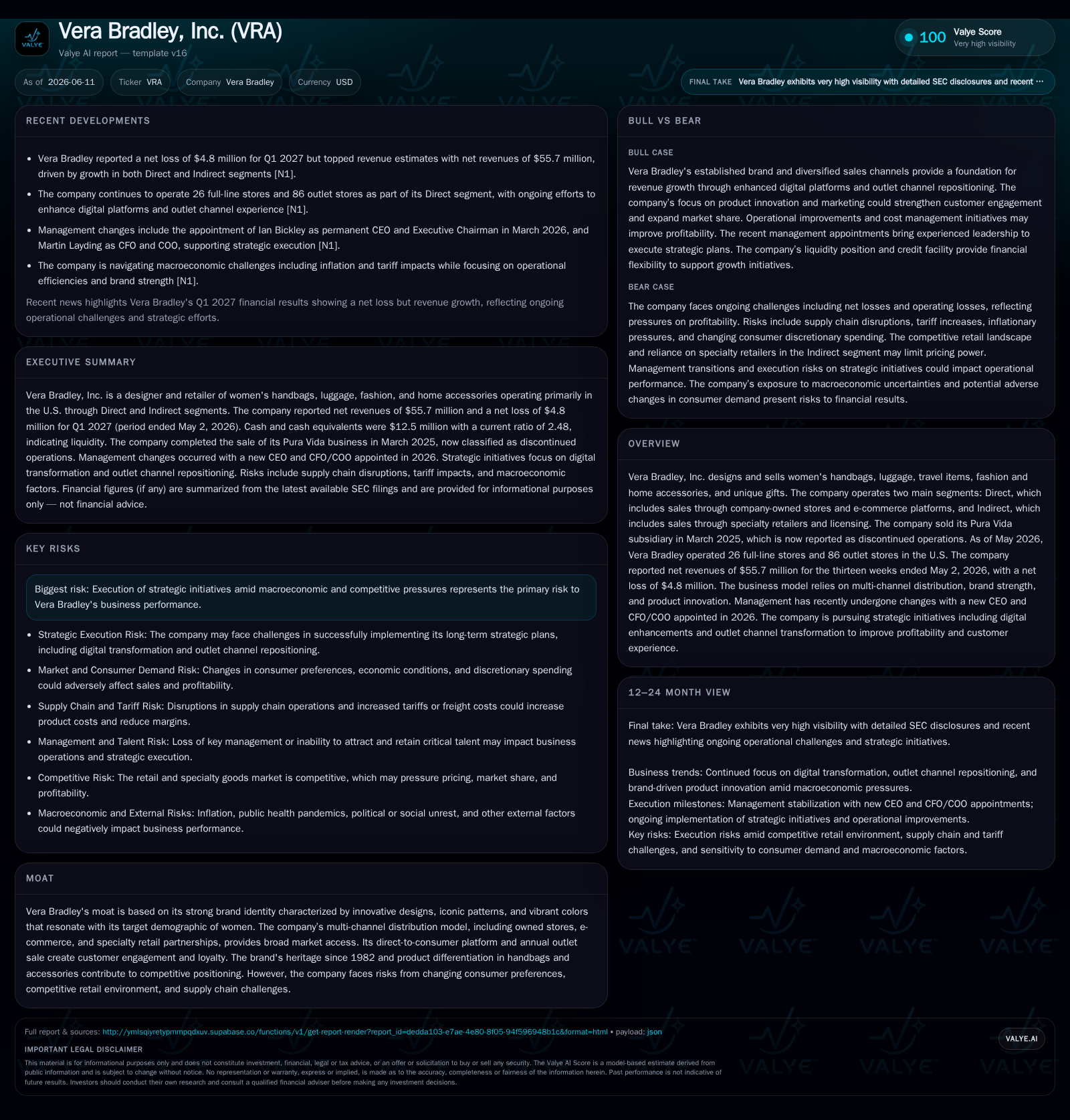
Vera Bradley's first quarter of fiscal 2026 reveals a strategic reset led by new CEO Ian Bickley and CFO/COO Martin Layding, focusing on digital transformation and strengthening its direct-to-consumer business. Despite beating revenue estimates with $55.7 million in net sales, the company reported a net loss of $4.8 million due to lingering costs and operational challenges. The multi-channel retail model remains central, with direct channels including company stores and ecommerce balancing wholesale distribution. Key risks include evolving consumer preferences and supply chain pressures, while growth hinges on product innovation and digital expansion. Liquidity appears solid with approximately $12.5 million cash on hand against roughly $10 million debt, supporting ongoing turnaround efforts.
First Quarter Operating Update: Early Signs from New Leadership
The period marks pivotal management transitions with Ian Bickley confirmed permanent CEO after serving interim since mid-2025, and Martin Layding promoted CFO & COO concurrently in March 2026 [S2][S3]. Their leadership heralds focused execution on digital commerce growth alongside operational efficiency improvements.
Multi-Channel Business Model: Harnessing Brand Equity Across Direct and Indirect
Vera Bradley continues leveraging a dual-segment structure comprising Direct (company-operated retail stores including outlet concepts plus ecommerce) and Indirect (specialty retail wholesale distribution plus licensing agreements) [S1][S2]. As of May 2026, direct operations encompass a network of 26 full-line stores complemented by 86 outlet locations in the U.S., enabling controlled brand environment touchpoints particularly for clearance merchandise—a vital lever for inventory turnover management [S1].
The direct-to-consumer (DTC) platform remains strategically important, especially as management invests in enhanced online site functionality aimed at delivering seamless cross-channel shopping experiences supported by data analytics to improve conversion rates and operational profitability metrics [S2]. Product innovation featuring Vera Bradley’s signature vibrant prints is leveraged to maintain emotional brand equity resonance within its core female demographic.
The indirect channel provides breadth via specialty retailers allowing broader market access but comes with typical margin compression risks inherent to wholesale partnerships. Licensing adds non-retail revenue streams that diversify income but depend on partner execution.
Competitive Landscape: Positioning Against Specialty Retail Peers
Positioned among specialty lifestyle brands such as J.Jill and Lands’ End—both described recently posting mixed earnings outcomes—Vera Bradley’s distinctiveness arises from pattern-driven handbags/accessories rooted in brand heritage dating back to 1982 [N2][N3]. Its store productivity metrics are influenced by widespread outlet presence which trades off full-price selling for inventory clearance efficiency.
Ecommerce penetration ramps present growth pathways paralleling peer trends where DTC expansion drives higher gross margins relative to wholesale distribution. Compared to semi-luxury peers (e.g., Kate Spade, Coach), Vera Bradley focuses less on luxury price points but seeks differentiation through innovative design cycles and loyalty program activation to mitigate promotional intensity.
Growth Levers: Product Innovation, Digital Expansion, and Customer Loyalty
Management emphasizes fresh product assortments designed to boost sell-through rates while optimizing markdown levels to balance inventory turnover without eroding margins excessively [S1][S2]. The company has explicitly retooled outlet strategy (“Outlet 2.0”) shifting away from deep discounting towards a curated value proposition that enhances brand perception with improved conversion efficiency at these locations.
Investment in upgraded ecommerce infrastructure underpins digital growth ambitions aiming for an integrated omnichannel customer journey that enhances average transaction values and reduces customer acquisition costs through data-driven personalization [S2]. Expansions in loyalty programs further support repeat purchase behaviors critical for boosting lifetime value in this niche sector.
Risks and Challenges: Supply Chain Pressure, Inventory Management, Consumer Trends
Operating challenges remain pronounced around inventory markdown management amid macroeconomic uncertainty impacting discretionary consumer spending patterns. Tariff increases combined with freight cost inflation exert upward pressure on product costs threatening gross margin stability [S1][S2]. Additionally, potential disruptions in supply chain reliability could constrain product assortment freshness—a vital component to maintaining competitive relevance.
Execution risk persists as management navigates the integration of new strategic initiatives amidst cost structure realignments indicated by remaining severance liabilities and restructuring charges impacting quarterly performance dynamics.
What Investors Should Monitor Next: Channel Metrics & Strategic Execution Milestones
Key near-term indicators include same-store sales trends reflecting retail footprint effectiveness; gross margin trajectory signaling markdown control success; e-commerce penetration rates demonstrating scalability of direct channels; and refreshed merchandise launches gauging sustained customer engagement levels [S2][S3]. How the company balances promotional cadence against maintaining brand desirability will equally inform margin recovery paths.
The efficacy of leadership’s digital transformation roadmap alongside outlet channel repositioning will be critical milestones influencing longer-term sustainable growth prospects.
Financial Health Snapshot: Liquidity and Leverage Support for Turnaround Efforts
As of May 2, 2026 quarter-end, Vera Bradley held approximately $12.5 million in cash and equivalents against about $10 million in outstanding debt, yielding a net positive liquidity cushion supporting operational flexibility amidst ongoing investments into strategic initiatives [F1][S2]. The current ratio stood at 2.48, indicating solid short-term balance sheet health able to withstand working capital fluctuations common within specialty retail [F1].
The revolving credit facility amended in March 2025 includes financial covenants that Vera Bradley has maintained compliance with thus far, underpinning manageable leverage levels during turnaround execution [S2]
This analysis is based on publicly filed SEC disclosures up to June 11, 2026, supplemented by relevant sector context for specialty retail fashion brands. It does not constitute investment advice or research views.
Disclaimer: This is research-only, informational analysis and not investment advice. It may include AI-generated interpretation and general industry context. Always verify important details using primary sources.

Comments