
Gloo Holdings Advances AI-Driven SaaS Platform Supporting Faith Ecosystem
The June 2026 quarterly filing highlights Gloo’s efforts to scale its AI-enabled SaaS platform amid financial headwinds and diversification of subscription revenues within the faith ecosystem.
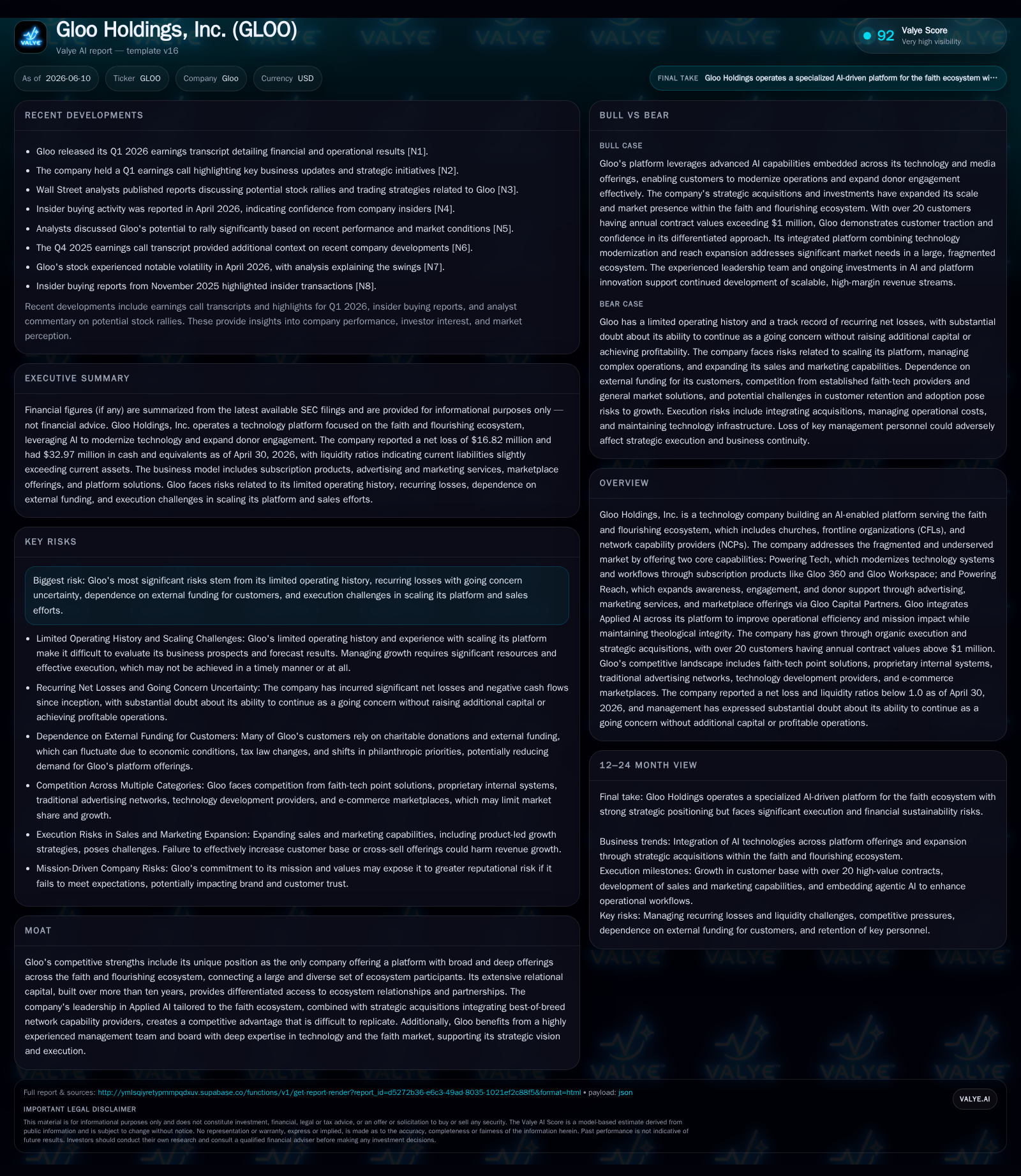
Gloo Holdings’ latest 10-Q filing for the quarter ended April 30, 2026, reveals ongoing operational scaling challenges alongside meaningful progress in diversifying subscription revenue streams and integrating applied AI across its platform. The company’s dual-service model combines technology modernization subscriptions with marketing and fundraising initiatives targeted at churches and nonprofit organizations. Despite strong top-line growth from acquisitions and organic expansion, Gloo faces substantial liquidity constraints and going concern risks that underscore execution complexities in this fragmented and conservative market niche. Strategic acquisitions and AI deployments remain key growth levers as the company navigates risks related to customer concentration, cash burn, and platform scalability.
Recent Operating Update: Quarterly Results and Key Developments
Gloo Holdings’ Q2 fiscal 2026 filing dated June 9 details operational progress amid notable financial pressures. The company reported net losses continuing at elevated levels while advancing subscription revenue diversification away from reliance on legacy media campaigns toward its broader SaaS platform products targeting churches, frontline organizations (CFLs), and network capability providers (NCPs) within the faith ecosystem [S2]. The quarter ended April 30, 2026 showed cash and equivalents of approximately $33 million against total debt just under $35 million resulting in near net debt neutrality on the balance sheet but a current ratio slightly below 1 at 0.94—a liquidity position that underscores working capital constraints [F1], [S22].
Operationally, Gloo emphasized steady scale-up of its core offerings under its dual-branded strategy (“Powering Tech” and “Powering Reach”) supported by applied AI integration designed to automate mission-critical workflows while respecting theological imperatives unique to faith-based organizations [S1], which also emerged in recent earnings call commentary highlighting incremental adoption metrics [N1], [N2]. However, recurring cash burn remains substantial with $17.1 million consumed in operating activities in Q2 alone, sustaining the company's position under 'going concern' uncertainty flagged explicitly by management [S2].
Business Model: Powering Tech and Powering Reach Service Dynamics
Gloo’s business model centers on two complementary platform components addressing distinct yet interlinked needs across a fragmented multi-layer faith ecosystem:
Powering Tech delivers subscription-based SaaS products such as Gloo 360 and Gloo Workspace that modernize client technology infrastructure with AI-enhanced workflow automation aimed at frontline churches and ministries to improve operational efficiency.
Powering Reach encompasses advertising technology, marketing services, and marketplace offerings through Gloo Capital Partners subsidiaries focused on donor engagement, awareness expansion, and fundraising effectiveness for network capability providers.
This bifurcated model enables diversification of revenue streams balanced between more predictable subscription-derived annual recurring revenue (ARR) and higher-margin marketing/fundraising service contracts often supplemented by marketplace transaction fees [S17],. By deploying proprietary applied AI tailored to unique sector requirements—such as preserving doctrinal integrity—Gloo differentiates itself from generic SaaS products. Moreover, it pursues progressively deeper engagements where it assumes internal operational functions formerly performed by clients themselves through an outsourcing model powered by agentic AI workflows that support scalable impact and generate durable revenue [S1],.
Competitive Positioning: Niche SaaS Meets Faith Ecosystem Complexity
Within the nonprofit software sector, peers range from established players like Blackbaud—recognized for fundraising CRM solutions—to church-specific platforms such as Church Community Builder. Gloo seeks to carve out a distinctive position by spanning beyond software into encompassing integrated technology modernization combined with donor engagement services underpinned by sophisticated AI applications. This breadth contrasts with specialized incumbents typically focused on discrete segments or feature sets.
The faith ecosystem's fragmentation—with hundreds of thousands of congregations and mission-driven groups—creates both opportunity and challenges around customer acquisition cost (CAC), sales cycles, retention durability, and scalability of personalized platform delivery. Network capability providers serve as critical intermediaries distributing Gloo's offerings downstream to frontline organizations enhancing reach but also complicating direct customer relationships,.
This positioning exploits relational capital accrued over a decade enabling exclusive access to diverse ecosystem stakeholders while enforcing high switching costs via embedded workflows aligned with faith values—a moat difficult for generic SaaS vendors or marketing firms lacking domain-specific credentials to replicate fully.
Growth Drivers: AI Integration and Strategic Acquisition Impacts
At the core of Gloo’s growth strategy lies continuous enhancement of its applied AI capabilities that transition customers towards agentic operating models automating labor-intensive processes such as outreach management or donor engagement campaigns. This not only improves client mission effectiveness but also drives internal efficiencies translating into potential margin expansion [S1],.
Additionally, the firm has accelerated growth through strategic acquisitions broadening Product suite breadth (e.g., Treasury of consulting services via Westfall acquisition) and boosting advertising/media network scale under Gloo Capital Partners umbrella expanding ecosystem participation opportunities [S10],. These moves facilitate cross-selling bundled solutions increasing share of wallet within large clients—the more than 20 customers reportedly exceeding $1 million in annual contract value broadly validating enterprise traction despite overall market conservatism.
Organic growth is propelled by self-service onboarding funnels facilitated by Gloo Workspace allowing grassroots adoption among frontline organizations complemented by enterprise sales targeting network capability providers who resell or integrate broader platform features reinforcing ARR sustainability over time [S17], [N1].
Risks and Watchpoints: Scalability, Liquidity, and Customer Concentration
Despite promising growth dynamics, Gloo faces material risks typical for emerging SaaS vendors in complex niche markets:
- Limited operating history: Scaling the platform at enterprise grade while integrating acquisitions imposes execution risk compounded by the complex fragmentation of target customers.
- Customer concentration: Dependence on a relatively small set of large contracts (>20 above $1M per year) concentrates revenue risk should any renewals or expansions falter.
- Liquidity pressures: Cash burn remains pronounced at ~$17 million quarterly versus cash reserves around $33 million offsetting roughly equivalent debt levels; continued negative cash flow casts substantial doubt about sustaining operations absent profitable ramp or new capital raise [F1], [S22].
- Funding dependency: Many customers rely on external funding impeding spend predictability; macroeconomic shifts could stress their budgets reducing subscription renewals or marketing spend.
- Valuation volatility: The stock market valuation presumably keenly sensitive to execution risk amplifies pressure to meet milestones shrinking tolerance for deviation.
Management’s disclosures reiterate going concern considerations indicating financial health will remain a watchpoint closely tied to effective sales pipeline conversion rates, ARR expansion velocity, churn control measures, and cost containment efforts over coming quarters [S2],.
What to Watch: Upcoming Milestones and Demand Signals for GLOO
Key indicators reflecting trajectory improvement include:
- Progress in rolling out advanced agentic AI features designed to assume operational workflows internally outsourced by customers signaling maturation from product-led growth towards service-driven higher-margin revenues.
- Expansion of marketplace offerings linking diverse ecosystem participants facilitating cross-brand upsell opportunities expected to enlarge transactional revenues attached to core subscriptions.
- Pipeline momentum evidenced through new customer onboarding volumes balanced against retention metrics among flagship accounts controlling majority ARR.
- Integration efficacy post-acquisitions influencing cost synergies attainment alongside headcount scaling particularly in engineering/product teams responsible for delivering AI innovation.
- Any public disclosure or commentary regarding additional financing initiatives impacting balance-sheet flexibility may be pivotal for sustaining investment required during scaling phases.
Investor calls from June underline management’s emphasis on these elements underscoring the link between technological sophistication advancement via AI deployment with commercial adoption as central narrative arcs driving midterm value creation potential [N1], [N2], [S3].
Financial Snapshot: Liquidity, Cash Burn, and Balance Sheet Health
As of April 30, 2026, Gloo held approximately $33 million in cash versus roughly $35 million in total debt yielding almost neutral net debt positioning yet maintaining a current ratio marginally below one at 0.94—reflective of near-term liquidity tightness requiring careful working capital management [F1], [S22]. Operating losses persist with net loss recorded at $17.1 million for Q2 indicative of ongoing negative free cash flow driven by heavy investment in R&D (notably engineering hires focusing on Gloo AI), sales & marketing expansion aimed at accelerating market penetration plus general overheads associated with public-company compliance costs connected with recent IPO activities executed late last year [S14], [F1].
Disclaimer: This analysis is based solely on information explicitly sourced from regulatory filings (), official news transcripts (), and authorized financial data ([F1]). It does not constitute investment advice or valuation guidance but seeks to provide detailed industry-informed business insight.
Disclaimer: This is research-only, informational analysis and not investment advice. It may include AI-generated interpretation and general industry context. Always verify important details using primary sources.

Comments