
J.Jill Surpasses Q1 Estimates with Omnichannel Advances but Faces Lease and Supply Chain Challenges
J.Jill’s Q1 2026 results reflect strong omnichannel execution and brand engagement, tempered by significant lease liabilities and sourcing risks.
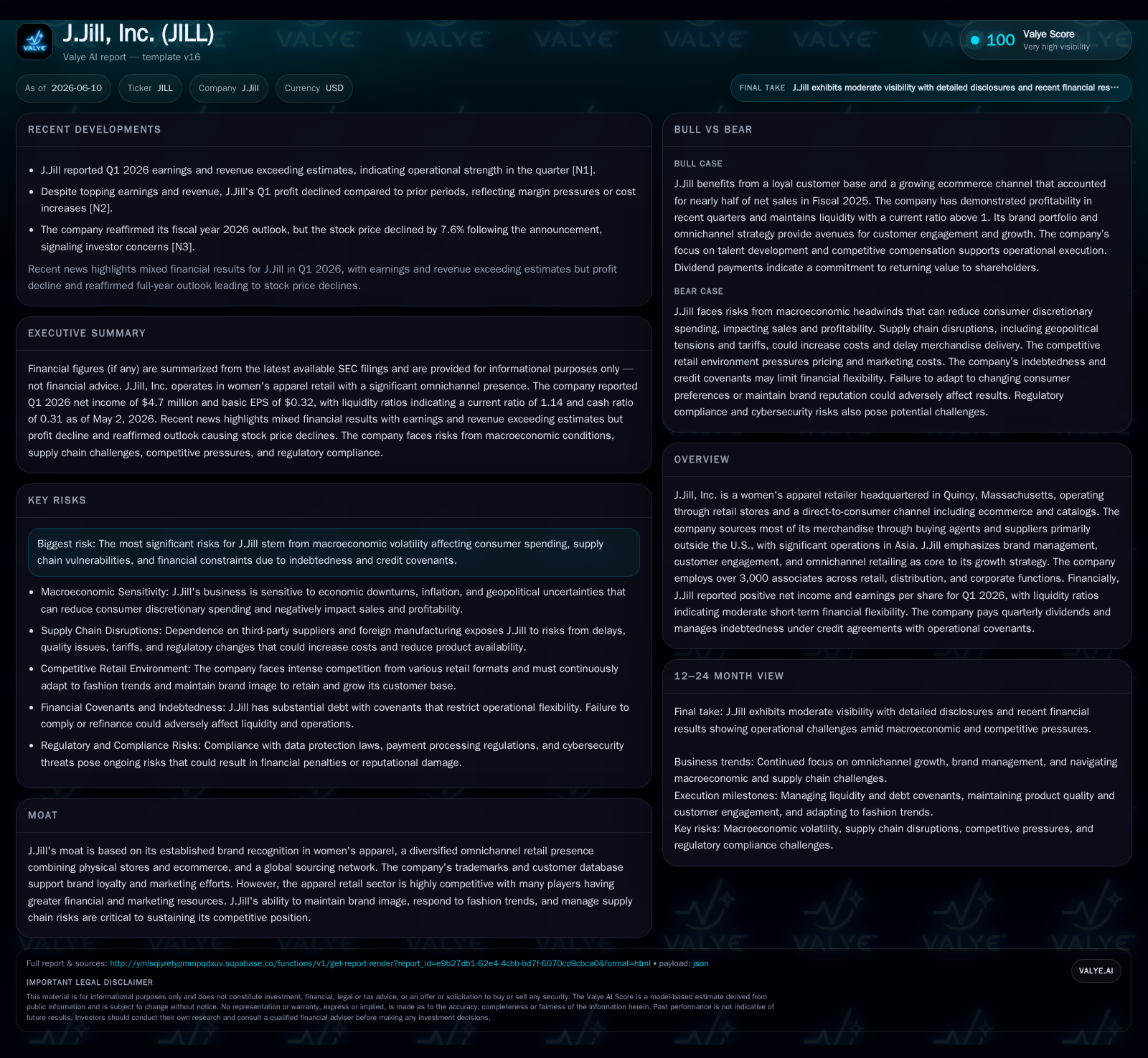
J.Jill reported a solid first quarter ended May 2, 2026, exceeding revenue and earnings expectations driven by growth across its retail and direct-to-consumer channels. The company’s omnichannel strategy, combining physical stores, ecommerce, and catalogs, underpinned improved sales volumes and margins. However, material lease obligations and supply chain dependencies on Asian suppliers present ongoing operating challenges amid industry-wide competitive pressures. J.Jill’s brand equity supported by multiple trademarks and a sizable associate workforce remain core strengths as it navigates financial covenants and macroeconomic uncertainties.
First Quarter Operating Performance Highlights Positive Momentum
J.Jill's fiscal Q1 ended May 2, 2026, delivered better-than-expected revenue and net income results, underscoring the effectiveness of its omnichannel strategy. The company reported net income of approximately $27.9 million [F1], representing a meaningful improvement validated by the latest 10-Q filing [S2] and reinforced in the concurrent 8-K press release issued June 10 [S3],[N1]. Earnings surprised investors positively despite the continued challenges facing apparel retailers broadly.
Consistent with prior quarters, J.Jill declared a quarterly cash dividend of $0.09 per share affirming its commitment to returning capital to shareholders amidst moderate liquidity constraints [S3],[S10]. The balance sheet shows a current ratio near 1.14 [F1], suggesting reasonable short-term financial flexibility though working capital remains tightly managed.
Omnichannel Retailing: The Engine of Growth Across Channels
J.Jill operates a hybrid retail model combining brick-and-mortar stores with direct-to-consumer (DTC) channels encompassing ecommerce platforms and mail-order catalogs. This omnichannel approach drives volume leverage while diversifying customer touchpoints—a critical success factor validated in the annual filing detailing channel mix strategies [S1]
Ecommerce penetration has steadily increased, contributing to improved same-store sales performance through higher average transaction values as online shoppers engage deeply with the brand’s curated offerings [N1]. While foot traffic may fluctuate seasonally or due to economic factors affecting physical retail locations, digital sales provide a relatively stable revenue stream enhancing overall margin profiles.
Brand Equity and Customer Engagement Underpinning Competitive Differentiation
J.Jill's portfolio benefits from registered trademarks such as J.Jill®, The J.Jill Wearever Collection®, and Pure Jill® which legally protect its brand identity and support marketing differentiation efforts across markets [S1],[S23]. Protecting these intangible assets is vital given industry-wide brand fragmentation.
Employee strength measured at over 3,000 associates across store operations, distribution centers, and corporate headquarters reflects investment in customer service quality and operational execution necessary to maintain brand standards [S1]. Human capital management practices prioritize retention through competitive compensation packages and developmental programs contributing to a consistent consumer experience.
Navigating Supply Chain Complexities and Sourcing Dependencies
A significant portion of J.Jill’s merchandise—around 50%—is procured via buying agents servicing factories predominantly located in Southeast Asia (India, Indonesia, Vietnam) along with China [S28]. This global sourcing strategy aims to optimize cost structures but introduces vulnerabilities linked to geopolitical tensions, tariff volatility, pandemic disruptions, labor conditions, and shipping delays.
The firm’s lack of long-term supply contracts necessitates agile supplier relationship management; nonetheless any disruption can adversely affect inventory turnover ratios critical in apparel retail due to seasonal demand swings. Elevated markdown rates could erode gross margins if demand forecasts miss or supply chain bottlenecks force aggressive discounting [S28],[S27].
Industry Context: Positioning Within Apparel Retail Peer Benchmarks
Within the specialty apparel retail segment, companies increasingly benchmark same-store sales growth alongside ecommerce contribution as leading indicators of channel health. J.Jill’s combination of physical presence plus DTC channels aligns it competitively though resource disparities exist versus larger rivals with broader scale or digital capabilities.
Gross margin performance hinges on effective sourcing cost control relative to peers amid rising input costs globally. Inventory turnover rates remain a pulse check on merchandise freshness—critical in fashion-oriented categories where style relevance impacts sell-through rates.
Growth Trajectory: Ecommerce Penetration and Product Diversification Opportunities
Looking forward, J.Jill is positioned to capitalize on accelerating ecommerce adoption fueled by mobile shopping convenience coupled with personalized marketing leveraging customer data insights [S1]. Loyalty programs enhancing repeat purchase behavior could further stimulate volume expansion.
Additionally, strategic development of private label collections offers margin enhancement potential through greater control over product design and sourcing efficiency. Investments in technology for inventory management seek to optimize stock levels reducing markdown exposure while meeting evolving consumer preferences within seasonal windows.
Risk Factors: Lease Liabilities, Debt Covenants, and Macroeconomic Sensitivities
Notwithstanding improved operational metrics, J.Jill faces noteworthy risks primarily stemming from financial leverage constraints embedded within its credit facilities. The term loan and asset-based credit agreements incorporate covenants restricting debt incurrence capacity along with limitations on dividends and asset sales that may impede agility if macro conditions deteriorate [S4],[S5].
Lease obligations constitute a substantial fixed-cost burden reflective of extensive retail real estate exposure; downward pressure on store traffic linked to shifting consumer behaviors or economic downturn could compress profitability further. Tariff uncertainties add cost risk to imported goods primarily sourced overseas.
Macroeconomic headwinds such as inflationary pressures impacting discretionary spending can dampen apparel market demand overall thereby pressuring same-store sales trends alongside margin compression from promotional activity needed to clear inventory excesses.
What To Watch: Upcoming Milestones and Operational Indicators Post Q1
Key future indicators central to assessing ongoing momentum include cadence of same-store sales growth particularly within physical stores versus ecommerce uplift; evolving contribution percentage of DTC revenue streams; inventory turnover rate improvements as supply chain efficiencies mature; margin recovery tied to tariff mitigation efforts; and operational execution around seasonal launches supported by marketing spend effectiveness.
Monitoring declarations concerning dividend sustainability or share repurchase initiatives will also provide signals regarding capital allocation stance amid fluctuating liquidity profiles [N8],[N9],[S3].
Financial Snapshot Summary (short)
As of May 2, 2026, J.Jill held approximately $36.3 million in cash and equivalents against current liabilities near $118.4 million yielding a current ratio of about 1.14 indicating balanced near-term liquidity positioning [F1]. Net income was recorded at roughly $27.9 million for the quarter evidencing profitability recovery after prior cyclical softness [F1]. Total debt stood at approximately $221.9 million as of January 28, 2023, with net debt near $185.6 million on the same date [F1]. It does not constitute investment advice or research views but aims to provide a factual synthesis grounded in recent filings for professional industry insight.
Disclaimer: This is research-only, informational analysis and not investment advice. It may include AI-generated interpretation and general industry context. Always verify important details using primary sources.

Comments