
How McGraw Hill Leverages Proprietary Content and Data Analytics to Sustain Market Leadership
McGraw Hill’s latest quarterly results underscore its strategic focus on AI-enhanced digital platforms and multi-year institutional contracts as pillars of competitive advantage and revenue durability.
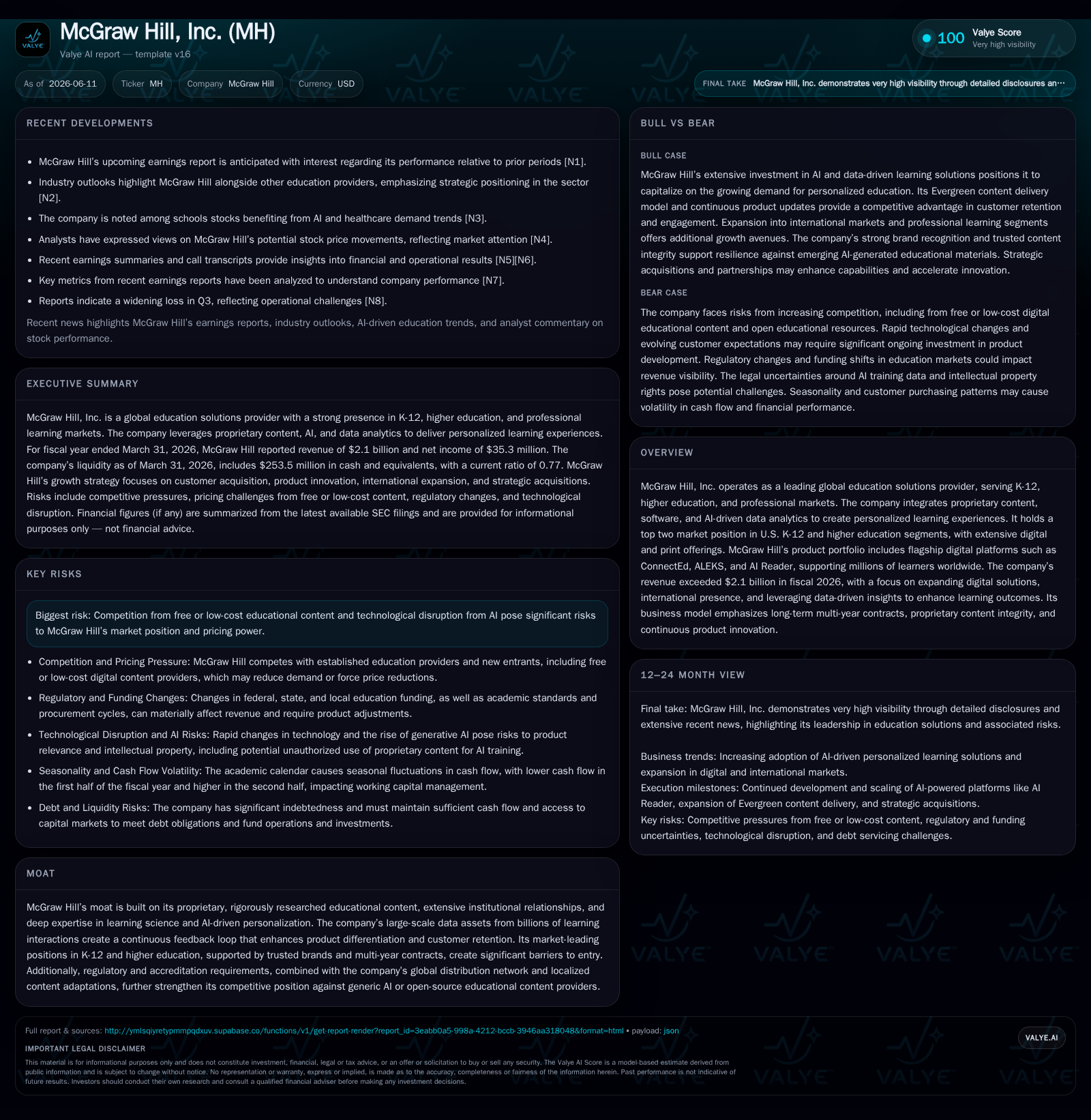
In its 2026 fiscal fourth quarter filing, McGraw Hill reinforced its position as a leading education solutions provider by advancing investments in AI-driven platforms like ALEKS and ConnectEd while executing meaningful debt reduction following its recent IPO. The company’s business model, deeply rooted in proprietary content paired with large-scale data analytics, supports recurring revenue through long-term contracts with educational institutions. Competitive moats including rigorous curriculum integrity, learning science expertise, and substantial data feedback loops underpin resilience against industry disruption from open resources and generic AI content. Growth is driven by ongoing digital adoption, international expansion, AI integration, and contract renewals amid evolving educational standards.
Latest Quarterly Operating Trends: Strengthening Through Digital Adoption Amid Leadership Change
The most recent quarterly filing dated February 11, 2026 ([S2]) offers a clear operational snapshot for McGraw Hill entering fiscal 2026 Q4. The company has successfully repaid $385.7 million of term loan debt using IPO proceeds from July 2025 alongside an additional $200 million paid down during the third quarter. This deleveraging lowers interest expenses due to reduced principal balances and lower variable rates as refinanced in prior amendments. Despite substantial total debt standing at approximately $2.63 billion end-March 2026 ([F1]), management emphasizes sustained generation of operating cash flow sufficient to support working capital needs, capital expenditures (including product development), and financing commitments.
Leadership changes also mark this period with CEO Simon Allen retiring effective February 9, 2026, succeeded by Philip Moyer who brings continuity to the company’s strategic direction emphasizing AI-enabled digital transformation. Early signals around sustained license renewal rates and engagement metrics linked to industry-leading platforms ALEKS and ConnectEd confirm the company's traction in leveraging technology to deepen adoption across K-12 and higher education segments.
Core Business Model: Proprietary Content Fueling Subscription Revenue through Institutional Contracts
McGraw Hill monetizes its offerings primarily through curriculum licensing models that combine traditional print materials with increasingly dominant digital learning platforms deployed under multi-year institutional contracts ([S1],[S2]). The portfolio includes flagship products such as ConnectEd for K-12 engagement, ALEKS for math assessment and adaptive learning, and the recently introduced AI Reader platform aimed at personalized literacy development.
Subscription revenue streams benefit from 'Evergreen' delivery—continuous on-demand content updates eliminating friction associated with textbook refresh cycles—resulting in strong retention rates among public school districts (serving roughly 91% of U.S. public K-12 districts) as well as higher education institutions ([S1]). Integration of learning science principles coupled with data feedback loops gathered from millions of active licenses globally underpin iterative enhancements improving platform stickiness.
Competitive Positioning: Moats Established via Learning Science Expertise and Data-Driven Personalization
The company's competitive advantage is anchored in rigorously researched proprietary content developed by a substantial team of approximately 300 software engineers specialized in learning science ([S1]). Curriculum offerings adhere strictly to thousands of state-level educational standards and professional accreditations worldwide.
Unlike generic or open-source educational resources vulnerable to quality dilution especially amid proliferation of generative AI tools, McGraw Hill’s content integrity creates a unique barrier to entry. Their vast dataset capturing billions of learner interactions feeds AI-driven analytic models that personalize learning pathways effectively—creating a virtuous cycle of improved outcomes driving customer retention ([S1]).
Peer references such as Pearson plc or Chegg share similar hybrid print/digital approaches but McGraw Hill's scale across the full learning lifecycle—from core curricula to professional certification markets—and global distribution breadth distinguish its competitive moats ().
Growth Drivers: Scaling Digital Platforms, AI Integration, International Expansion, and Contract Renewals
Growth is propelled by significant investments exceeding $2 billion over the past decade aimed at deepening McGraw Hill's digital learning ecosystem ([S2]). Key drivers include accelerated institutional adoption of personalized digital content fueled by generative AI capabilities that meet educators' demand for tailored instruction supporting diverse learner needs.
International expansion remains a strategic priority with products delivered across more than 100 countries in over 80 languages adapting curricula for localized academic requirements ([S23]). This enhances addressable market size beyond mature U.S. channels.
Contract renewal cadence provides recurring revenue visibility; notably the Evergreen delivery model contributes about 68% of Higher Education revenues maintaining freshness in digital offerings to counteract competitor advances ([S1]). KPIs reflecting rising license counts, high renewal rates, consistent engagement metrics on digital platforms alongside frequent content updates signal healthy underlying demand.
Risks and Constraints: Industry Disruption from Free Content, Regulatory Changes, and Debt Leverage Risks
Despite leadership positioning, McGraw Hill faces risks stemming from increased availability of free or low-cost open educational resources which can erode market share or constrain pricing power ([S1]). The rapid evolution in AI technologies threatens potential disintermediation if generative models bypass proprietary content advantages without effective control mechanisms.
Regulatory uncertainties around funding levels for U.S. education institutions pose cyclical demand risks especially given historical seasonality in order timing affecting quarter-over-quarter cash flows ([S18]). Intellectual property infringement including piracy also remains a material challenge necessitating ongoing legal vigilance ([S22]).
Financial leverage remains elevated; although deleveraging progressed materially post-IPO repay-downs, net debt at approximately $2.38 billion versus cash of $253 million constrains flexibility ([F1],[S2]). Debt covenants impose restrictions that may limit agility in pursuing acquisitions or new investments critical for innovation ([S4],[S5],[S10]). Rising interest rate environments further compound interest expense sensitivity.
Key Milestones Ahead: Contract Renewals, Product Innovation Timeline, and Adoption Signals in New Markets
Looking forward, McGraw Hill’s operational agenda includes monitoring outcomes tied to major multi-year contract renewals that could materially influence subscription revenue stability ([S3],[S1]). Upcoming launches focused on enhancements to the AI Reader platform represent key innovation milestones expected to accelerate personalized literacy solutions adoption.
Additionally, tracking early engagement metrics within international expansion initiatives will be crucial for validating scalability beyond domestic markets. Progress against these execution points will serve as near-term indicators for sustaining growth momentum amid competitive pressures.
Financial Overview: Debt Reduction Progress Supports Investment in Innovation
The financial profile evidences positive operating cash flow supporting core expenditure needs alongside strategic capital spending on R&D totaling tens of millions annually geared towards product development efficiency ([S24],[S2]). Recent debt repayments using IPO proceeds significantly lowered gross indebtedness from prior levels exceeding $3 billion down to $2.63 billion as of March 31, 2026 ([F1],[S2]).
Liquidity appears manageable despite a current ratio below one at 0.77 due to the nature of seasonal cash fluctuations endemic in education publishing cycles ([F1],[S2]). Interest costs benefit from repricing actions reducing margins by up to 0.75% while maintaining compliance with covenants under revolving credit facilities keeps refinancing risk contained ([S4],[S10],[S20]).
This improved capital structure enables measured investment continuity into scalable digital products essential for preserving competitive differentiation amid technological shifts.
This analysis is grounded exclusively on information disclosed through official SEC filings and credible news sources. It aims to provide a nuanced understanding of McGraw Hill’s operating environment without prescribing any investment action.
Disclaimer: This is research-only, informational analysis and not investment advice. It may include AI-generated interpretation and general industry context. Always verify important details using primary sources.

Comments