
Bark’s Omnichannel Expansion and Focused Portfolio Shift Drive Customer Engagement
Bark refines its product mix and leverages AI personalization while expanding retail footprint, managing supply chain pressures and evolving customer retention strategies.
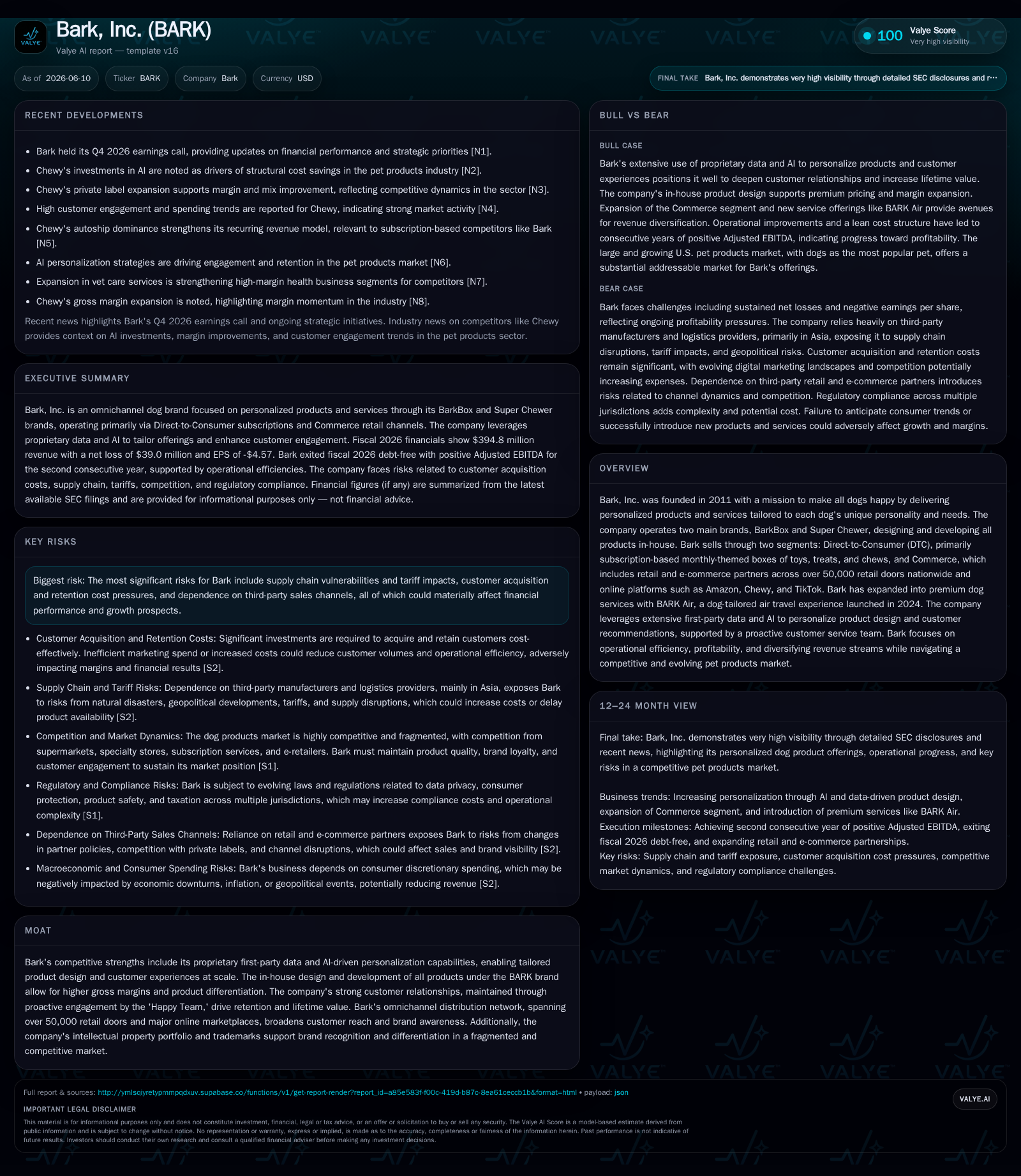
In its latest fiscal year ended March 2026, Bark, Inc. advanced strategic initiatives to sharpen focus on core toy products by discontinuing lower-margin kibble and dental consumables, aiming to enhance profitability. Simultaneously, the company expanded its omnichannel presence across over 50,000 retail doors plus online platforms and deepened personalization via proprietary first-party data and AI. These moves underscore Bark’s effort to balance growth of its subscription-based direct-to-consumer business with scaling commerce channels amid tariff-related supply challenges. Bark also inaugurated premium pet services such as BARK Air, signaling diversification targets for future revenue streams.
Latest Operating Highlights: Portfolio Rationalization and AI Personalization Impact
Bark's most recent quarterly filing highlights a deliberate narrowing of its product portfolio aimed at enhancing operational efficiency and profitability. In early 2026, the company discontinued all kibble products alongside certain dental and treat lines within its consumables segment [S2]. This move reflects a strategic pivot to concentrate on Bark's traditional core competence—the dog toy business—which offers higher-margin potential through proprietary product design developed entirely in-house [S9]. The exit from these lower-margin consumables has incurred a discrete exit cost of $2.8 million recognized in cost of goods sold but is expected to contribute positively to gross margin trends going forward.
Concurrent with this portfolio rationalization, Bark emphasized advances in its data analytics infrastructure, embedding AI-driven insights into both personalized product development and customer targeting algorithms [S2]. By leveraging an extensive first-party data set containing detailed dog profiles—such as breed, play style, allergies—and coupling it with machine learning models, Bark enhances the relevance of cross-selling efforts within its subscription boxes through "Add-to-Box" functionality. This precision in research view supports expansion of average revenue per user (ARPU) by increasing attach rates without proportional increases in acquisition spend.
However, supply chain challenges persist as a headwind. Tariff uncertainties coupled with logistics constraints pressured fulfillment costs during the latest fiscal quarter [S2]. While revenue modestly expanded from commerce channels driven by steady retail partner demand, cost management remains critical to preserve margins under these external stresses.
Business Model Deep Dive: Subscription Commerce Meets Omnichannel Retail Expansion
Bark operates predominantly through two segments: Direct-to-Consumer (DTC), centered on subscription offerings like BarkBox and Super Chewer monthly-themed boxes, and Commerce sales that include wholesale partnerships with large retailers alongside online marketplaces such as Amazon, Chewy, and TikTok [S1][S9]
The DTC model thrives on subscription renewal rates buttressed by the company's "Happy Team," which proactively engages approximately 175,000 customers monthly to tailor experiences according to each dog's preferences gleaned from ongoing interactions [S9]. This personalized engagement directly feeds into product innovation cycles where proprietary designs are created in-house rather than outsourcing or reselling third-party items. Such vertical integration permits premium pricing strategies that support elevated gross margins relative to peers reliant on commoditized products.
Commerce revenue comprised nearly 18% of total sales in FY26 with distribution spanning over 50,000 physical retail outlets including Target, Walmart, PetSmart, TJ Maxx, and Costco nationally [S16][S21]. Despite cautious spending from some partners amid tariff concerns, expanding retail assortments continue aiding brand visibility outside subscription circles. Bark aims for parity in contribution margin between DTC subscriptions and commerce channels by balancing scale economies against price competition inherent at retail.
Cross-selling within boxes via Add-to-Box introduces incremental revenue streams by recommending complementary products based on AI insights—boosting ARPU without substantial corresponding CAC growth [S9]. This integration embodies Bark’s relationship-commerce framework focusing on depth (customer understanding), density (touchpoint frequency), and durability (customer permission for new offerings) powered by proprietary data assets [S1].
Industry Context: Competitive Pressure from Retail Private Labels and Subscription Peers
Within the pet products market—a space estimated at $158 billion annually in U.S. discretionary spending—Bark contends with intense competition from both private label brands proliferating within mass-market retail chains and established omnichannel players like Chewy.
Private labels exert pronounced pricing pressure especially in consumable categories where large retailers leverage scale advantages limiting branded manufacturers’ premium pricing capability. Bark’s retreat from lower-margin consumables partially responds to this dynamic [S1]. In contrast, pure digital-native peers such as Chewy demonstrate how integrating subscription models with extensive e-commerce reach can balance engagement and margin optimization effectively [N2][N5]. Bark’s omnichannel strategy attempts a similar blend by elevating retail presence while deepening personalized offerings direct to consumers.
Premium service entrants like Wag! illustrate an emerging subsegment focused on experiential pet offerings beyond products; Bark’s BARK Air service launched in April 2024 aligns with this trend aiming to capture affluent customers seeking differentiated pet travel experiences [S16]. Early engagement reported suggests potential for long-term growth although the service currently forms a small portion of total revenue.
Growth Catalysts: Leveraging First-Party Data for Cross-Selling and Service Innovation
Key growth drivers center on scalable personalization capabilities underpinning both product innovation and customer monetization strategies. Bark’s proprietary first-party database allows matching dogs' profiles against available inventory using machine learning algorithms for optimized add-on product research views within subscription boxes [S1][S3]. Incremental cross-sell attach rates derived from this approach elevate ARPU—a vital metric distinguishing healthier subscription economics.
Expansion into premium services through BARK Air provides additional avenues for revenue diversification beyond physical products [S16]. Partnerships with specialized charter companies outsource operational functions while enabling Bark to curate superior dog travel experiences reflecting its dog-first ethos. Ongoing route additions and partnership growth feed an organic scaling narrative.
On the distribution front, continued growth in retail doors broadens brand exposure creating incremental commerce revenue streams that complement historically dominant DTC sales [S16][S21]. Strengthening multichannel synergies remains vital given evolving consumer habits blending online convenience with physical store discovery.
Risks and Constraints: Supply Chain Vulnerabilities and Customer Acquisition Headwinds
Despite strategic progress, Bark faces significant risks notably supply chain volatility amplified by tariffs creating cost inflation pressures impacting pricing levers and fulfillment efficiency [S2][S1]. Uncertain tariff landscapes constrain margin expansion even as consumer willingness for premium pet products grows.
Customer acquisition costs remain elevated due to vigorous competitive marketing investment requirements particularly as Bark seeks to sustain subscriber growth amid shifting discretionary spending patterns related to broader macroeconomic factors [S1]. Dependence on third-party retail partners introduces channel concentration risk challenging bargaining power when private labels intensify their presence.
Operational risks tied to technology platform unification efforts could affect customer migration experience impacting retention metrics critical for subscription economics [S2]. Maintaining the "Happy Team's" engagement effectiveness is pivotal to keeping churn low.
Economic downturns pose systemic threats given discretionary nature of pet spending; however, rising humanization trends provide some structural demand support mitigating cyclical downside fares.
What to Watch: Upcoming Milestones in Service Expansion and Platform Unification
Key upcoming execution points include monitoring progress on unifying various e-commerce platforms under a single scalable infrastructure designed to enhance user experience across DTC and commerce channels [S3]. Successful migration could improve operational efficiency thereby supporting margin recovery.
Expansion plans for BARK Air routes or partnerships would signal growing traction validating premium service investments amid nascent competitive fields. Also pivotal will be renewal rate trends within subscriptions—a primary gauge of customer satisfaction—and any shifts in retail distribution footprint indicating either expansion or contraction pressure.
Product innovation pipeline announcements emphasizing AI-personalized items or new add-to-box offerings would further validate investment themes tied to relationship commerce principles articulated by management.
Financial Snapshot: Margin Trends and Liquidity Position Amid Operational Shifts
For fiscal year ended March 31, 2026, Bark reported revenues of approximately $395 million but incurred an operating loss near $40 million reflecting restructuring charges related mainly to discontinued product lines alongside ongoing investments in AI capability and service expansion [F1][S26]. Net loss was roughly $39 million.
Liquidity remains adequate with cash balances around $19 million as at fiscal Q3 end yielding a current ratio estimated at 1.86—suggesting comfortable near-term coverage of short-term liabilities [F1]. The company carries net debt around $60 million primarily associated with convertible notes repaid partially in late 2025 but maintains compliance with credit covenants embedded within revolving facilities [F1].
All financial figures cited are sourced explicitly from firm disclosures or official filings without extrapolation or estimates beyond reported facts. No investment advice is offered herein; this is an informational overview focusing on operational dynamics relevant within the pet products market landscape.
Disclaimer: This is research-only, informational analysis and not investment advice. It may include AI-generated interpretation and general industry context. Always verify important details using primary sources.

Comments